

A frustrated father sat in my Pune clinic last Tuesday. He brought his seven-year-old daughter. She sat quietly in the corner chair, staring at the floor, swinging her legs.
The father looked entirely defeated. He rubbed his face and said, “Every single day is a battlefield. It doesn’t matter what I ask her to do. If I say ‘put on your shoes,’ she screams no. If I say ‘come eat dinner,’ she runs in the opposite direction. If I tell her it is time for a bath, she throws herself on the floor and kicks the door. I try being nice. I try offering rewards. I try taking away her screen time. Nothing works. She looks me dead in the eye and refuses to comply with the most basic requests. My own parents tell me she is spoiled and needs strict discipline, but yelling just makes her more aggressive. I am completely out of ideas.”
I looked at the little girl. She did not look like a spoiled tyrant. She looked like a child whose nervous system was operating entirely in the red zone.
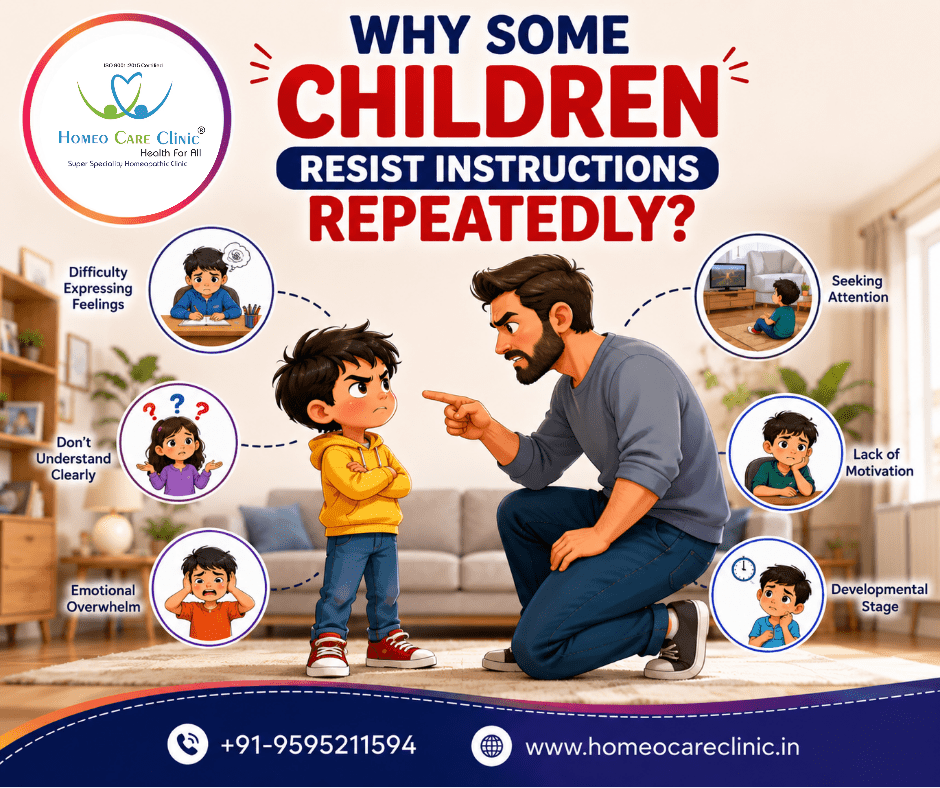
We need to have a direct, entirely unsentimental conversation about Why some children resist instructions repeatedly.
Society operates on a very simple, deeply flawed behavioral model for children. We assume that if a parent gives a command, the child should obey. If the child does not obey, we assume the child is being deliberately naughty, testing boundaries, or attempting to manipulate the adult. We treat the resistance as a discipline problem.
This is a massive biological misunderstanding.
When a child exhibits chronic, intense defiance to simple requests, you are not looking at a behavioral choice. You are looking at a neurological threat response. The child’s brain is interpreting a simple instruction as a physical attack on their autonomy and safety.
Parents panic. They buy behavior charts. They implement sticker systems. They double down on punishments. They completely fail to recognize that the child is not refusing to listen; the child’s brain has physically blocked the incoming command.
We are going to dissect the physical mechanics of pediatric defiance. We will outline the specific biological causes, expose the severe limitations of standard punitive discipline, and explain how deep, constitutional homeopathy combined with specific lifestyle and dietary restructuring repairs the child’s nervous system.
The Biological Reality: The Threat to Autonomy
To fix the defiance, you must understand the microscopic mechanics of the child’s brain when you give an instruction.
A healthy, rested child possesses enough flexibility in their prefrontal cortex to process a command, suppress their immediate desire to keep playing, and execute the task.
An overloaded, highly sensitive child lacks this flexibility. Their nervous system is hovering in a state of chronic hyper-arousal. They are highly attuned to control. When an adult walks into the room and says, “Put your shoes on right now,” the adult is taking away the child’s control over their physical body and their time.
For a dysregulated child, this sudden loss of autonomy does not feel like a minor annoyance. The amygdala—the primitive fear center of the brain—registers the demand as a mortal threat.
The brain instantly hits the panic button. It forces the adrenal glands to pump cortisol and adrenaline into the bloodstream. The child enters a state of fight-or-flight.
In this state, the brain literally shunts blood flow away from the auditory processing and logical reasoning centers. The child physically cannot process your command. The command just sounds like a threat. They fight back—screaming, hitting, running away, or completely shutting down—to regain a sense of safety and control.
This is exactly Why some children resist instructions repeatedly. You think you are asking them to put on shoes. Their brain thinks you are attacking their survival.
The Core Causes of Chronic Resistance
Children do not wake up and decide to ruin their parents’ day. The causes driving this massive neurological friction are highly specific.
- Pathological Demand Avoidance (PDA) Traits: Some children have a specific neurological profile where their central nervous system equates any demand with trauma. Even things they want to do—like eating a favorite food or going to the park—become impossible if an adult tells them to do it. The demand itself triggers the panic.
- Sensory Overload: The child’s sensory cup is completely full. The tags on their shirt itch. The lights in the classroom were too bright. The noise in the cafeteria was deafening. By the time they get home, their nervous system has zero capacity left. If you ask them to pick up a single toy, the cup overflows, and they explode.
- Processing Speed Delays: You say, “Go upstairs, brush your teeth, and get your pajamas.” You issue three commands in two seconds. The child’s brain takes eight seconds to process a single command. By the time they process “go upstairs,” you are already yelling at them for not moving. They feel overwhelmed, stupid, and defensive, so they simply refuse to do anything.
- Anxiety Masked as Anger: Many children who resist instructions are terrified of failing. If you tell them to do their math homework, and they secretly struggle with math, they will not say, “I am confused.” They will throw the pencil across the room and yell, “I am not doing this!” Anger is a safer emotion than vulnerability.
- Transactional Parenting: The parent only interacts with the child to issue commands. “Eat your food.” “Hurry up.” “Go to sleep.” The relationship bank account is entirely overdrawn. The child feels like an employee taking orders rather than a loved human being. They rebel against the management style.
Signs It Is Not Just “Bad Behavior”
You cannot support a failing nervous system if you treat it like a discipline issue. You must read the physical warning signs.
- The Equal-Opportunity Meltdown: A naughty child argues to get out of doing chores. An overloaded child will have a meltdown even when you tell them to do something fun, simply because you initiated the demand. You tell them, “Get in the car so we can get ice cream,” and they scream no.
- The Fight, Flight, or Freeze Response: When you give an instruction, they do not just ignore you. Their body physically reacts. They tense up. Their pupils dilate. They run and hide under a bed (Flight). They become physically aggressive and hit you (Fight). Or they stare blankly at the wall and go completely mute (Freeze).
- Extreme Inflexibility: They require massive amounts of routine to feel safe. If the morning routine changes by two minutes, or you give them the blue cup instead of the red cup, they fall apart entirely. They use rigid routines to construct a false sense of control in a world that feels terrifying.
- Post-Meltdown Exhaustion: After the screaming stops, the child looks pale, shaky, and physically drained. Some children will immediately fall asleep. A temper tantrum to get a toy stops the second you hand over the toy. A neurological overload takes hours to recover from.
Conventional Treatment
When the daily wars threaten to tear the family apart, parents seek professional help. The conventional psychological and behavioral response is often heavily mechanized and ignores the child’s internal terror.
- Behaviorism (Sticker Charts and Punishments): The therapist tells you to reward compliance with stickers and punish defiance with time-outs. This is disastrous for a dysregulated child. A child in fight-or-flight physically cannot comply. Punishing them for a neurological failure spikes their cortisol further, destroying the parent-child trust and driving the defiance deeper.
- The ODD Diagnosis: Rushed pediatricians will frequently label the child with Oppositional Defiant Disorder (ODD). This is a useless label. It simply describes the symptom—the child is defiant. It offers absolutely no insight into why the child’s nervous system is crashing, and it casts the child as the villain.
- Psychiatric Sedation: If the resistance involves physical aggression, a doctor may prescribe heavy psychiatric drugs like Risperidone or Clonidine to artificially sedate the child. This puts a chemical blanket over the developing brain, blunting their personality without ever fixing the underlying anxiety.
Homeopathy Treatment
Exhausted parents bring their children to Homeo Care Clinic because the conventional system has blamed them for bad parenting and labeled their child a problem. They want to help their child feel safe without forcing them into punitive behavioral programs or medicating them.
Homeopathy provides a structural, cellular reset for a highly sensitive, defensive nervous system. We do not use medicine to sedate the child or chemically force them into compliance. We use highly diluted, constitutional nanomedicines to treat the specific physiological and psychological blockades causing the threat response.
We observe the child. We look at their physical build. We watch how they react to questions in the clinic. Do they hide? Do they act arrogant? We ask about their digestion, their sleep architecture, and their fears. By matching the child’s specific physical and psychological pathology to the exact energetic frequency of the remedy, we prompt the central nervous system to turn off the fight-or-flight alarm bells. When the child feels safe, the defiance melts away.
Homeopathy Medicine
Here are 5 medicines from my clinical cabinet utilized to resolve severe resistance and defiance in children.
1. Tuberculinum
- Indicated for: The highly destructive, restless child who resists all authority and constantly seeks stimulation.
- Best suited for: The child who simply will not accept the word “no.” They are malicious when angry. They will look you in the eye and deliberately break a valuable object if you give them an instruction they dislike. They are constantly bored, constantly moving, and highly dissatisfied. They suffer from frequent respiratory issues and catch colds easily.
- Key actions: Acts deeply on the immune and nervous systems. It grounds the frantic, destructive energy, reduces the malicious defiance, and calms the constant, burning dissatisfaction, allowing the child to accept normal household boundaries.
2. Chamomilla
- Indicated for: Extreme, explosive irritability, unsoothable rage, and violent tantrums in an overloaded child.
- Best suited for: The child whose nervous system is entirely overstimulated and raw. They are hyper-sensitive to pain and noise. When you give an instruction, they scream. They demand an object, and the second you hand it to them, they throw it away. Their behavior is utterly unreasonable and intensely aggressive. They cannot be comforted.
- Key actions: A massive reset for a hypersensitive, raw nervous system. It dials down the intolerable physical and emotional sensitivity. It stops the violent, unsoothable rage and allows the child to calm down natively without needing physical restraint.
3. Lycopodium Clavatum
- Indicated for: Defiance masked by dictatorial arrogance at home, accompanied by deep internal insecurity.
- Best suited for: The child with profound imposter syndrome. At home, they are a tyrant. They order their parents around, refuse all instructions, and bully younger siblings. But the exact second they step into a new environment or a classroom, they become completely silent, insecure, and cowardly. They are terrified of failing. They often suffer from digestive gas and bloating, and their mood crashes heavily in the late afternoon.
- Key actions: Heals the gut-brain connection. It resolves the digestive discomfort. It builds true, quiet internal confidence, removing the need to act like an arrogant bully at home to mask their deep fears.
4. Cina
- Indicated for: The angry, highly irritable child who reacts to instructions with physical aggression and refuses to be touched.
- Best suited for: The overloaded child who becomes highly defensive and physically reactive. They refuse to be touched, carried, or even looked at. If you try to give them an instruction, they strike out, hit, or bite. They suffer from severe intestinal issues, grind their teeth aggressively at night, and constantly pick at their nose. Their sleep is highly restless.
- Key actions: Heals the gut-brain axis, particularly when stress triggers physical intestinal distress or parasitic vulnerability. It extinguishes the severe physical aggression, stops the night-time teeth grinding, and removes the violent aversion to touch.
5. Nux Vomica
- Indicated for: The highly competitive, irritable child who reacts to rushing and demands with explosive anger.
- Best suited for: The child living a fast-paced, high-pressure lifestyle. They are intensely competitive and hate losing or being told what to do. If you rush them or interrupt their task, they snap with violent, aggressive impatience. They suffer from severe constipation, often sitting on the toilet with the urge to go but producing nothing. They wake up in the middle of the night angry and restless.
- Key actions: Deeply detoxifies an overworked, highly strung nervous system. It cuts through the aggressive impatience, allows the child to physically relax, and regulates the bowel motility, clearing the physical tension from the gut.
Lifestyle and Diet: Rebuilding the Baseline
Homeopathic medicine provides the biological spark to reset the nervous system. But parents must architect the recovery environment. You cannot give a child a homeopathic remedy and then continue to bark orders at them like a drill sergeant. If you want to solve Why some children resist instructions repeatedly, you must change the way you interact with their brain.
1. Connection Before Direction
You cannot issue a command to a disconnected brain. Before you tell a child to do something, you must physically enter their world. Walk over to them. Put your hand gently on their shoulder. Wait for them to make eye contact. Acknowledge what they are doing (“Wow, you built a massive tower”). Only after you establish a physical and emotional connection do you issue the instruction.
2. Declarative Language (Low-Demand Parenting)
Stop using the imperative mood. Imperative language (“Put your shoes on,” “Eat your dinner”) triggers the amygdala’s threat response. Switch to declarative language. State facts about the environment and let the child’s brain solve the problem. Instead of: “Put your shoes on right now!” Say: “I see your shoes are still by the door, and we have to leave in two minutes.” This removes the direct demand. It gives the child the autonomy to process the information and make the decision themselves, bypassing the fight-or-flight response.
3. The 8-Second Processing Rule
When you issue an instruction, you must silently count to eight before speaking again. Parents speak rapidly. A dysregulated child’s brain processes language very slowly. If you repeat the command after three seconds, you restart their processing clock, and they become overwhelmed and angry. Give their neurological system the physical time it needs to scan the data, retrieve the plan, and execute the physical movement.
Diet Architecture for Nervous System Repair
You cannot feed a child processed sugar, artificial dyes, and refined carbohydrates and expect their brain to comply with instructions.
- Stop the Blood Sugar Panic Attacks: Sugar causes wild spikes and crashes in blood glucose. Every blood sugar crash triggers a massive cortisol release. A child with low blood sugar is a biologically terrified child. They will fight everything you say. Force them to eat heavy animal protein or dense fats in the morning (eggs, ghee, nuts) to stabilize their nervous system for the day.
- The Gut-Brain Serotonin Link: 90% of the body’s serotonin (the chemical responsible for cognitive flexibility and mood stability) is produced in the gut. If you feed the child junk food, you destroy the microbiome. Without serotonin, the brain becomes physically inflexible and highly resistant to change. Feed them real, whole foods to rebuild the gut lining.
- Magnesium and Zinc: Chronic stress burns through magnesium rapidly. Magnesium is the body’s natural nerve relaxer. Ensure the child is consuming pumpkin seeds, almonds, or taking a high-quality magnesium glycinate supplement to stop the physical muscle tension and calm the nervous system.
5 Commonly Asked FAQs
1. If I stop giving direct commands, won’t my child just walk all over me? No. Lowering demands is not the same as permissive parenting. You maintain rigid boundaries (e.g., “We are leaving the house”), but you change the delivery mechanism to bypass the child’s neurological threat response. You act as a calm, unbothered leader rather than an angry dictator.
2. Should I punish my child when they scream “no” to my face? Punishing a child who is in fight-or-flight is biologically useless. Their logical brain is offline; they cannot learn the lesson you are trying to teach. You must stay entirely neutral, wait for the storm to pass, and address the behavior hours later when their prefrontal cortex is back online.
3. Why is my child an absolute angel at school but a monster at home? This is a classic sign of sensory and cognitive overload. The child uses every ounce of their neurological energy to hold it together, follow the rules, and mask their anxiety at school. When they get home—their safe environment—they completely collapse. The defiance is the exhaustion speaking.
4. My child refuses to eat dinner when I tell them to. What should I do? Remove the demand. Place the food on the table and say nothing. Sit down and eat your own food. If you turn eating into a power struggle, the child’s anxiety will spike, shutting down their digestion and killing their appetite. If you remove the pressure, their natural hunger cues will eventually override their defiance.
5. How long does it take for homeopathy to lower the resistance? For acute, intense symptoms like violent tantrums, night terrors, and severe physical aggression, you often see a profound calming of the nervous system within the first few weeks of a well-chosen constitutional remedy. Deep structural healing to completely rewire their threat response and restore a cooperative dynamic usually takes several months of consistent treatment alongside the implementation of low-demand parenting techniques.
Conclusion
Living in a house where every single interaction turns into a screaming match is a profoundly exhausting and deeply isolating experience. It is terrifying to look at the child you love and see a tense, angry, defiant stranger who fights you over putting on a pair of socks. You face judgment from teachers, unsolicited advice from relatives, and a heavy, crushing sense of parental failure.
When society tells you to just discipline them harder, or a rushed doctor suggests labeling your child with an oppositional disorder, the frustration becomes unbearable. You feel completely unsupported.
Your child is not broken. They are not simply naughty. Their symptoms are entirely real, they are valid, and they are deeply rooted in the biochemistry of their exhausted cells.
When you truly understand the complex biological mechanics of why a pediatric nervous system perceives a command as a physical threat, the terrifying chaos makes complete sense. The sudden meltdowns, the blank staring, the extreme inflexibility, and the violent defiance are not a reflection of a bad child. They are the physical, external hallmarks of an amygdala locked in overdrive, managing a massive, demanding flow of logistical rushing and sensory pressure that far exceeds its biological capacity.
You do not have to panic. You do not have to subject your child to sterile, high-pressure behavioral therapies that spike their cortisol. You do not have to fight them every single morning.
Change your language. Remove the direct demands. Provide their brain with high-quality protein and deep sleep. Bring your child to Homeo Care Clinic for a constitutional reset with Dr. Vaseem Choudhary. Give their developing nervous system the biological foundation it requires to process instructions without fear.
Your child possesses a brilliant, capable mind. Clear the chemical static, turn off the anxiety alarm bells, and give their brain the absolute right to feel safe. Build your connection, trust the holistic process, and watch what happens when your child finally realizes they do not have to fight you to survive.
“Your health deserves more than temporary relief. Choose homeopathy for lasting results”
Start your journey towards better focus today.
About the Author Bio:
Dr. Vaseem Choudhary M.D is a seasoned classical homeopath with over 16+ years of experience, dedicated to treating patients with compassion, precision and holistic care. Mainly in Pune & Mumbai, serving both national and international patients from UK, USA, Germany, France, Canada, Bhutan, Dubai and China. With a wide range of acute and chronic conditions—from skin disorders, hormonal issues, and digestive problems to autoimmune diseases and mental health concerns.
Dr. Vaseem is widely respected for his unique approach that combines classical homeopathy, personalized diet planning, lifestyle guidance, and a spiritual perspective on healing. He is known for his detailed and empathetic case-taking process, which focuses on treating the root cause rather than just symptoms.
In recognition of his dedication and clinical excellence, Dr. Vaseem Choudhary MD has been honored with the Best Homeopathic Doctor in Pune award by leading platforms such as:
- Awarded for International Excellence in Autism & ADHD Treatment 2026 in UK Parliament, London
- Dr. Vaseem Choudhary honoured at the UK Parliament, receiving International recognition PG from the London College of Homeopathy 2026
- Dr. Vaseem Choudhary, MD, was further acknowledged in Dubai in 2026 for his expertise in Autism and ADHD, reinforcing his growing international recognition in this field
- Best Homeopathy Doctor in Pune – National Healthcare Service Excellence Awards 2024
- Most Trusted Centre for Autism and ADHD in India 2025 – Healthcare Excellence & Leadership Awards
- Best Homeopathy Doctor in Pune – Dr. Vaseem Choudhary Shines at Ayush 2nd International Conference, Dubai
- Recognized for spearheading homeopathic treatment protocols, improving patient satisfaction, and healthcare advancements.
He is also a contributing author to the International Journal of Homeopathy and Natural Medicines (IJHNM), where he shares his research and clinical experiences with the global medical community.
With a passion to take homeopathy to new heights, Dr. Vaseem continues to guide patients towards natural, safe, and sustainable healing.
Homeo Care Clinic offers a holistic approach to treating the disease. The remedies mentioned above can treat the underlying causes of the condition and offer relief from the discomfort. However, it is important to consult a qualified homeopathic practitioner for the correct dosage and duration of treatment. Homeo Care Clinic provides comprehensive care for various ailments, and offers customized treatment plans based on individual requirements.
To schedule an appointment or learn more about our treatment, please visit our website or give us a call +91 9595211594 our best homeopathy doctor will be here to help.
Follow us on Facebook, Twitter and Instagram for valuable insights into the world of homeopathy and holistic health.
- Facebook– https://www.facebook.com/homeocareclinicpune
- Instagram– https://www.instagram.com/homeocareclinic_in
- Website– https://linktr.ee/homeocareclinic
- Success Stories of Patients –https://www.homeocareclinic.in/category/case-study/
- Patient Testimonials – https://www.homeocareclinic.in/testimonial/
Chat with a best homeopathic doctor privately:
If you have any queries regarding your disease or any symptoms, click to send a What‘s App message. Our best homeopathy doctor will be happy to answer you. About Us Click
Book an Appointment:
If you want to visit our clinic, click to book an appointment.
Online treatment:
If you are a busy professional, or you are living in a remote town or city, with no best homeopathic doctor near you, Click to start an online homeopathic treatment with the world’s exclusive, most experienced and best homeopathic clinic, managed by Dr. Vaseem Choudhary world-renowned homeopathic doctor expert
- About Us – https://www.homeocareclinic.in/about-us/
- Our Doctors –https://www.homeocareclinic.in/team/