

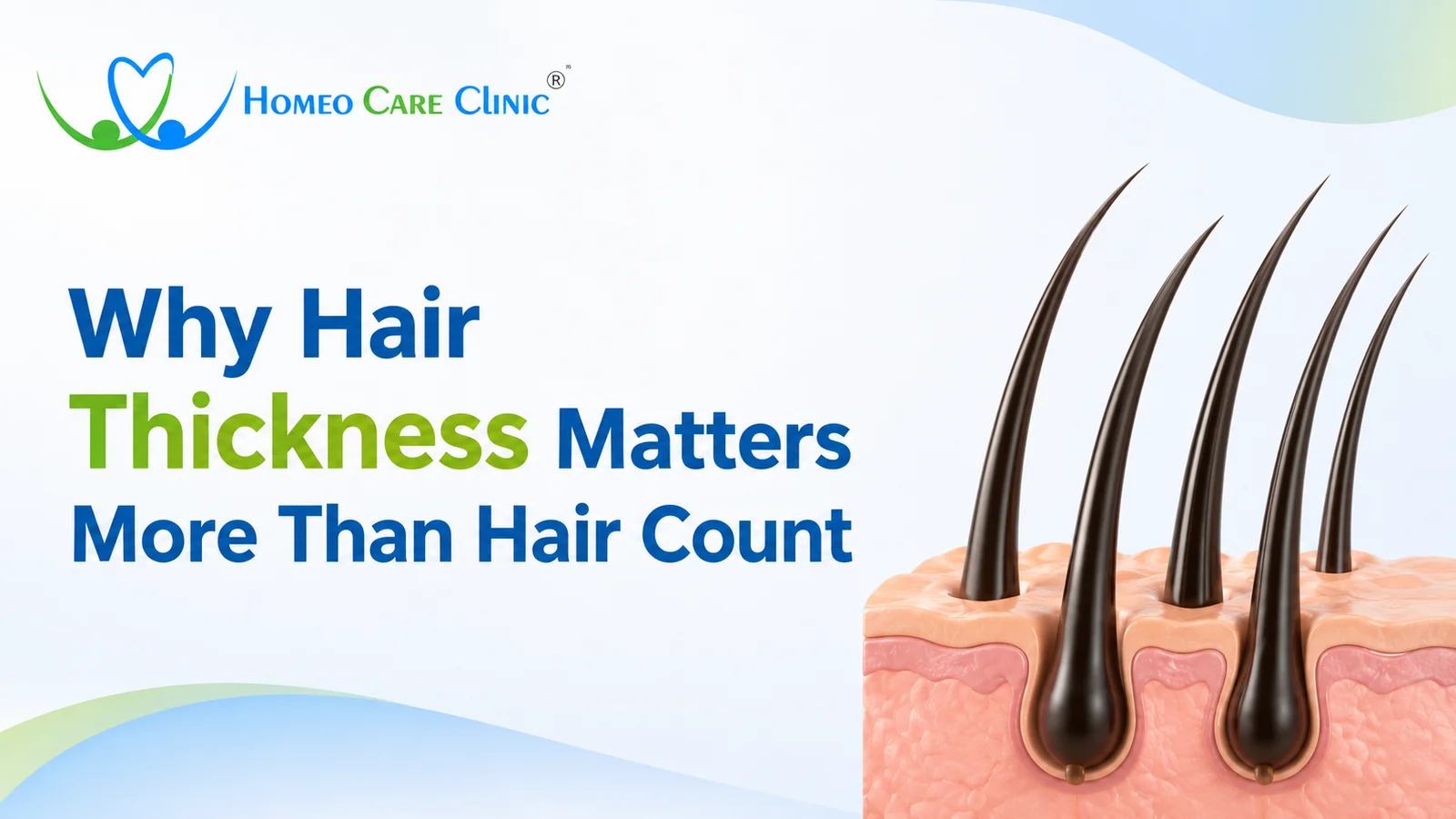
When people start noticing changes in their hair, the first thing they often look at is how much hair they are losing.
You may count the strands on your pillow, comb or shower drain and assume that fewer fallen hairs automatically mean healthier or thicker hair.
But hair health is more complex than simply counting strands.
Hair thickness, hair density and the diameter of individual hair strands all contribute to how full your hair looks and feels. In fact, clinical assessment of hair can consider both the number of hairs and their diameter when evaluating changes in overall hair mass.
At Homeo Care Hair, we believe that understanding what is actually happening with your hair is an important first step toward making informed decisions about your hair and scalp care.
What Is Hair Thickness?
Hair thickness refers to the diameter or calibre of an individual hair strand.
Think of your hair like a bundle of threads.
You could have many thin threads or fewer thicker threads, and the overall appearance of the bundle can be very different.
Hair evaluation commonly distinguishes hair density—the number of hairs in a particular scalp area—from hair thickness, which refers to the diameter of individual hairs.
This distinction is important because two people can have a similar number of hair strands but very different-looking hair.
One person may have relatively thick strands that create a fuller appearance, while another may have finer strands that make the scalp more visible.
Hair Thickness vs Hair Count: What’s the Difference?
These two terms are often confused.
Hair Count
Hair count refers to the number of individual hairs being measured in a particular area or under a particular assessment method.
Hair Density
Hair density generally refers to the number of hairs per unit area of scalp, such as hairs per square centimetre.
Hair Thickness
Hair thickness refers to the diameter of an individual hair shaft.
So, simply counting hairs does not tell the entire story.
A meaningful assessment can look at multiple factors, including density, hair diameter and overall hair mass.
Why Hair Thickness Matters
1. Thicker Strands Can Create a Fuller Appearance
The visual appearance of your hair isn’t determined only by the number of strands.
The diameter of individual hair fibres also contributes to the overall appearance of hair fullness. Research on hair assessment has identified both hair density and hair diameter as important factors influencing hair mass.
This is why someone may feel that their hair has become noticeably thinner even when they aren’t seeing dramatic changes in the number of hairs they shed.
2. Hair Count Alone Can Be Misleading h3
Counting the hairs you lose each day may seem like an easy way to measure progress, but it has limitations.
The American Academy of Dermatology notes that shedding around 50–100 hairs per day can be normal, although individual shedding can vary.
More importantly, hair shedding and hair loss are not necessarily the same thing.
Hair shedding refers to hairs leaving the scalp, while hair loss occurs when something interferes with the normal growth cycle.
Therefore, counting hairs in a brush or shower drain doesn’t provide a complete picture of your hair health.
3. Hair Can Become Finer Over Time
One of the reasons hair may appear less dense is that individual strands can become finer.
In certain types of hair loss, such as androgenetic alopecia, follicles can gradually produce smaller, finer hairs. This process is known as miniaturization.
As the diameter of individual hairs changes, the overall appearance of hair can change as well.
This is why evaluating only the number of hairs may overlook important changes in hair calibre.
4. Hair Thickness Can Influence Overall Hair Volume
When individual strands have more diameter, the hair can appear more substantial.
This doesn’t mean that thicker-looking hair necessarily means more follicles or more hair growth. Instead, strand diameter is one of several factors that influence the appearance and measurable mass of hair.
For someone monitoring changes over time, looking at consistent photographs, scalp visibility, part width and professional assessments can be more informative than relying on daily hair counts alone.
What Are the Signs Your Hair May Be Getting Thinner?
You may notice subtle changes before obvious hair loss becomes visible.
Common signs can include:
- A wider-looking hair part
- A thinner ponytail
- More visible scalp
- Reduced overall hair volume
- Hair strands feeling finer than before
- Gradual thinning around the crown
- Changes in the hairline
- Increased breakage
- A noticeable change in hair texture or fullness
The American Academy of Dermatology lists gradual thinning, a widening part, a thinner ponytail, bald spots and a receding hairline among common signs of hair loss.
How Should You Track Hair Growth Progress?
Instead of relying only on the number of hairs you see in your brush, consider using several consistent indicators.
1. Take Standardized Photos
Take photographs from the same:
- Angle
- Distance
- Lighting
- Hairstyle
- Parting position
This makes comparisons more meaningful.
2. Observe Your Hair Part
A widening part can be an early visual sign of thinning, particularly when the change is gradual.
3. Check Your Ponytail Volume
Changes in ponytail circumference or fullness may provide another practical visual reference.
4. Pay Attention to Strand Quality
Notice whether individual strands appear or feel finer, weaker or more prone to breakage.
5. Consider Professional Assessment
Hair and scalp concerns can have many possible causes. A qualified healthcare professional can help determine whether you’re experiencing normal shedding, excessive shedding, hair thinning or another form of hair loss.
Hair Thickness and Hair Health: What Can Affect Them?
Hair changes can have many different causes.
These may include:
- Genetics
- Age-related changes
- Hormonal changes
- Nutritional deficiencies
- Illness or significant stress
- Certain medications
- Scalp conditions
- Hair-care practices
- Repeated chemical treatments
- Tight hairstyles and mechanical damage
The cause matters because different types of hair loss and thinning can behave differently and may require different approaches.
This is why it is better to understand the underlying concern rather than simply trying to increase the number of hairs you see.
What Can You Do for Better Hair Health?
Healthy hair care begins with understanding your individual hair and scalp needs.
Some basic practices include:
Gentle Hair Care
Avoid excessive pulling, aggressive brushing and unnecessary mechanical stress.
Reduce Hair Damage
Repeated chemical treatments, excessive heat and certain styling practices can contribute to hair damage and breakage.
Maintain a Balanced Diet
Adequate nutrition supports normal hair growth. However, taking supplements without identifying a deficiency is not always appropriate; the AAD notes that excessive amounts of certain nutrients can actually worsen hair loss.
Monitor Changes Over Time
Hair changes are often gradual. Consistent photographs and professional assessments can help you identify changes more reliably than daily hair counting.
How Homeo Care Hair Approaches Hair Concerns
At Homeo Care Hair, our focus is on helping people understand their hair and scalp concerns instead of relying solely on superficial measurements such as daily hair counts.
Hair thickness, density, shedding patterns, scalp condition and the overall history of your hair can all provide useful information.
If you are experiencing persistent hair thinning, excessive shedding, a widening part or noticeable changes in hair volume, consider getting your concern properly evaluated.
The goal isn’t simply to count how many hairs you have. It’s to understand the quality, thickness and overall condition of your hair.
Frequently Asked Questions
Is hair thickness more important than hair count?
Hair thickness and hair count measure different things, so one shouldn’t simply replace the other. Hair density and individual hair diameter both contribute to overall hair mass and appearance.
What is the difference between hair thickness and hair density?
Hair thickness refers to the diameter of an individual hair strand, while hair density refers to how many hairs are present within a defined area of the scalp.
Does losing 50–100 hairs a day mean I have hair loss?
Not necessarily. The AAD states that losing approximately 50–100 hairs per day can be normal. Excessive shedding and hair loss are different phenomena.
Why does my hair look thinner even though I don’t see a lot of hair fall?
Hair appearance can change because of factors such as reduced hair diameter, density changes, breakage or styling. In some forms of hair loss, follicles progressively produce finer hairs.
How can I measure hair thickness?
Professional hair and scalp assessments can measure parameters such as hair density and hair diameter. Trichoscopy and other hair-evaluation methods may be used depending on the situation.
How do I know if my hair is getting thinner?
Look for gradual changes such as a widening part, thinner ponytail, increased scalp visibility or reduced overall fullness.