

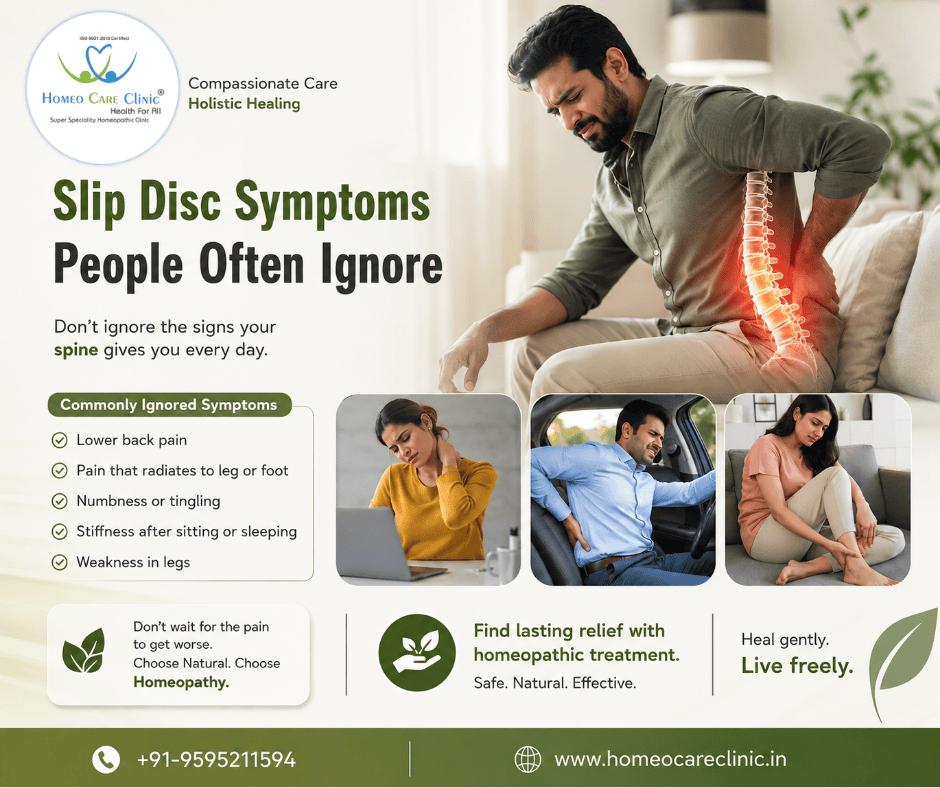
Today let’s talk about something we see almost every single day at our practice, something that causes so much silent suffering. Back pain is so incredibly common these days, isn’t it? As we all know, whenever a little ache starts, most of us just pop a quick painkiller, rub some ointment, and keep pushing through our busy day. But here is the thing. It is seen again and again in practice that people assume all backaches are just simple muscle strains from sitting too long or sleeping in a funny position. Many families are unaware that what they are actually brushing off are early slipped disc symptoms, which can slowly become a massive problem if left completely unchecked.
A slipped disc, which doctors also call a herniated or prolapsed disc, happens when the soft, jelly-like cushion sitting between the hard bones of your spine gets pushed out of place. This condition mostly are seen in adults who sit at desks all day, or folks doing heavy manual labor. The tough outer ring tears, and the soft inside leaks out, pressing directly onto highly sensitive spinal nerves. And that is when the real trouble starts. People try to ignore the odd twinges and shocks, hoping it will just magically fix itself. But the only set back is it takes time for a damaged spine to heal, and ignoring the warning signs only makes the nerve compression worse. The conventional world rushes towards aggressive painkillers or even scary surgeries. But there is a better way. Homeopathy has shown wonderful results without any side effects. At our clinic, we focus on identifying the very root of your spinal trouble, offering gentle medicines that help the body repair the disc naturally while deeply easing those ignored slipped disc in back symptoms.
Causes H2
When we look deeply into why a spinal disc suddenly gives way, it is rarely just one single bad movement. Usually, it is a combination of things building up over months or even years until the spine just says “enough.”
- Age-related wear and tear – As we get older, our spinal discs naturally lose some of their protective water content. They become a bit drier, stiffer, and much more prone to cracking. This age factor is one of the most common slip disc causes and symptoms we see in patients over forty.
- Lifting heavy objects incorrectly – This is a classic trigger. When people bend completely from the waist to pick up a heavy box or even a toddler, instead of bending their knees, massive pressure hits the lower spine. The disc just pops out under that extreme mechanical stress.
- Prolonged poor posture – Slouching in front of a laptop for eight hours a day puts very unnatural stress on your cervical and lumbar spine. Over time, this constant bad posture pushes the disc jelly backwards toward the nerve canal.
- Sudden awkward twisting motions – Sometimes you just turn too fast to grab something from the back seat of the car, or you swing a golf club a bit too aggressively. That sudden torque can easily rupture the outer layer of a vulnerable disc.
- Being significantly overweight – Extra body weight, especially a large belly, pulls the spine forward. The lower back has to carry all that extra burden every single time you take a step, making it a massive contributor to slipped disc symptoms lower back.
- Sedentary lifestyle and weak core muscles – If you do not exercise, the muscles in your stomach and back become very weak. They are supposed to act like a corset holding your spine safe. Without that muscle support, all the shock goes directly into the discs.
- Frequent driving and vehicle vibrations – People whose jobs involve driving trucks or long commutes sit in a vibrating seat for hours. Old medical records show that constant mechanical vibration slowly weakens the spinal structures over time.
- Genetic predisposition – Sometimes, it just runs in the family. If your parents had early spinal degeneration or herniated discs, your connective tissues might naturally be a little weaker, putting you at a higher risk.
- Traumatic injury or falls – A sudden impact, like slipping on a wet floor and landing hard on your tailbone, or getting rear-ended in a minor car crash, can force a perfectly healthy disc out of its normal position instantly.
- Smoking and poor circulation – Research proves that smoking reduces the oxygen supply to the disc itself. Because discs do not have their own strong blood supply, smoking starves them of nutrients, causing them to degenerate much faster than normal.
Types / Key Clinical Features
A slipped disc does not act the exact same way in every single patient. It mostly depends on which exact part of your spine has the bulge. Here are the key features based on location.
- Lumbar Slipped Disc (Lower Back) – This is by far the most common type we see. It happens in the bottom part of your spine. The person feels intense, shooting pain down their buttock and back of the leg. This is exactly where you will see the classic slipped disc symptoms lower back, often mimicking a condition called sciatica.
- Cervical Slipped Disc (Neck) – This happens in the upper spine, right below the skull. Mostly found in tech workers constantly looking down at their phones. The pain radiates down the shoulder, past the elbow, and right into the fingers, making it hard to even hold a coffee cup.
- Thoracic Slipped Disc (Mid Back) – This is quite rare because the rib cage keeps the mid-back very stable. But when it happens, the person feels a deep, burning pain wrapping around the front of their chest or stomach, which sometimes gets confused with heart or digestion issues.
Signs & Symptoms
This is the most crucial part. People ignore these signs for months, thinking they just slept wrong. By the time they realize it is serious, the nerve is heavily compressed. Here are the ignored symptoms you must watch out for.
- Tingling and “pins and needles” – You feel a strange buzzing or tingling sensation in your foot or hand that comes and goes. People think their limb just fell asleep, but if it happens often without pressure, it is one of the classic ignored slipped disc in back symptoms.
- Numbness in specific patches of skin – Touching your outer thigh or calf feels a bit dull, like you are touching it through a thick piece of cloth. A compressed nerve loses its ability to send proper sensory signals to the brain.
- Electric shock-like shooting pain – It is not a dull ache. It is a sharp, sudden zing of pain that shoots down your leg or arm when you sneeze, cough, or laugh. That sudden pressure in the belly pushes the bulging disc harder against the nerve.
- Muscle weakness in the arm or leg – You suddenly find that you keep stumbling over your own toes while walking, or you drop your keys because your hand grip has randomly become very weak.
- Pain that worsens specifically after sitting – If you feel okay while walking around but get terrible lower back stiffness after sitting at your desk or in a car for 30 minutes, you are dealing with classic slip disc pain symptoms.
- Burning sensations deep in the buttock – Many patients complain of a deep, fiery ache right in the middle of their glute muscle that just refuses to go away with regular stretching or massage.
- Difficulty standing up straight – When getting out of a chair or out of bed in the morning, you have to stay bent forward for a few minutes. Standing completely straight pulls the nerve tight over the herniated disc, which hurts too much.
- Cold sensations in the foot or toes – A very strange symptom where one foot feels icy cold compared to the other, even when you are wearing thick socks. This happens because the nerve signals regulating blood vessels are disrupted.
- Pain that shifts from side to side – Some days the pain is strictly in the left leg, and the next week it might shift to the right, depending on how the disc jelly is pressing against the central nerve canal.
- Loss of bladder or bowel control (Red Flag) – This is extremely serious. If you suddenly cannot feel when you need to use the bathroom, or you have sudden accidents, the disc is crushing the bundle of nerves at the base of the spine. This requires immediate emergency care.
- A feeling of heaviness in the limbs – Your leg just feels like it weighs a hundred pounds. It takes extra mental effort just to lift it to walk up a simple flight of stairs.
- Pain that wakes you up at night – Rolling over in bed causes a sudden stab of pain that completely disrupts your sleep. You just cannot find a comfortable position no matter how many pillows you use.
Conventional Treatment
When a patient suffering from intense back pain goes to an orthopedic doctor, the standard medical approach relies heavily on managing the pain and suppressing the inflammation.
- Over-the-counter Painkillers (NSAIDs) – Medicines like Ibuprofen are usually the first thing given to reduce the swelling around the nerve and numb the immediate slip disc pain symptoms. But they can be very harsh on the stomach over time.
- Muscle Relaxants – Because the back muscles often go into painful spasms trying to protect the injured spine, doctors prescribe strong relaxants. These help the muscles let go, but they often leave the patient feeling incredibly drowsy and groggy all day.
- Corticosteroid Injections – If pills do not work, doctors suggest a direct injection of steroids right into the epidural space of the spine. This powerful anti-inflammatory can provide relief for months, but it does not actually pull the bulging disc back into place.
- Physiotherapy and Traction – A physical therapist uses targeted exercises, stretches, and sometimes mechanical traction machines to gently pull the spine apart, hoping to create a vacuum that sucks the disc jelly back inside.
- Nerve Pain Medications – Drugs specifically designed for nerve pain, like Gabapentin, are given when the tingling and burning become unbearable. They alter how the brain perceives nerve damage.
- Surgical Intervention (Discectomy) – When all else fails, or if there is severe muscle wasting, surgeons will physically cut open the back and remove the piece of the disc that is pressing on the nerve. Surgery is a big step and has its own long recovery period.
- Hot and Cold Compresses – Often suggested as home care, alternating ice packs to reduce initial swelling and heating pads to loosen tight muscles. These provide very temporary comfort but do not fix the root mechanical issue.
Homeopathy Treatment
At our clinic, we have seen remarkable improvement in such cases. We understand that a damaged disc is a sign that the body’s supporting tissues have become weak or traumatized. Homeopathy works by stimulating the body’s own healing mechanisms to reduce the nerve inflammation naturally, helping to reabsorb the bulging disc material over time. It is a highly individualized process that deeply addresses all the complex slip disc causes and symptoms.
🔹 Arnica Montana
Best Suited For: Suited to those whose back problems started very clearly after a blunt injury, a bad fall on the ice, or a recent heavy lifting accident. They feel bruised all over.
Key Actions: It acts as a wonderful internal healer for recent trauma, reducing the acute swelling and internal bruising around the spinal cord, and easing the sharp initial slipped disc in back symptoms.
🔹 Rhus Toxicodendron
Best Suited For: Indicated when the patient feels extremely stiff and painful first thing in the morning or after resting. The pain gets much better once they start walking around and “warm up” their muscles.
Key Actions: This is one of the best remedies for treating the severe muscle stiffness and ligament strain that always accompanies a herniated disc. It restores flexibility beautifully.
🔹 Bryonia Alba
Best Suited For: Suited to people whose pain is the exact opposite of Rhus Tox. They feel terrible from the slightest movement. Even taking a deep breath or coughing causes agonizing pain. They want to just lie perfectly still.
Key Actions: It deeply calms the severe inflammation inside the joint spaces and stops the agonizing stabbing pains that happen whenever the patient tries to bend or twist.
🔹 Colocynthis
Best Suited For: Very helpful in individuals suffering from severe sciatica triggered by the disc. The shooting pain down the leg is like lightning, and they find relief only by applying very hard pressure or bending double.
Key Actions: It specifically targets the sciatic nerve, quickly calming the intense electrical zaps and cramping pain that radiates down into the calf and foot.
🔹 Hypericum Perforatum
Best Suited For: Indicated when the nerve damage is the main issue. The person complains bitterly of severe tingling, burning, and crawling sensations, especially if the pain shoots down the spine after a fall on the tailbone.
Key Actions: Known as the “Arnica of the nerves,” it repairs bruised and crushed nerve endings, effectively stopping the agonizing burning and tingling that characterizes intense slip disc pain symptoms.
🔹 Calcarea Fluorica
Best Suited For: Suited to patients who have chronic, long-standing back issues where the spinal ligaments have lost their elasticity. They might also have bone spurs or a history of easily sprained joints.
Key Actions: It acts wonderfully on the connective tissues, slowly restoring the natural elasticity to the tough outer ring of the disc, helping it hold its shape better against daily pressure.
🔹 Magnesia Phosphorica
Best Suited For: Indicated when the back pain involves sudden, severe muscle cramps and spasms that make the person cry out. The pain is always remarkably better by applying a hot water bottle.
Key Actions: It acts as a brilliant natural muscle relaxant, releasing the tight, protective spasms in the lower back without causing any of the drowsiness seen in allopathic pills.
🔹 Ruta Graveolens
Best Suited For: Very helpful in people who have injured their back due to severe overstrain, like carrying heavy luggage up the stairs. They feel a deep, aching weakness in their lower back and thighs.
Key Actions: It deeply heals torn and strained tendons and ligaments around the spine, providing solid structural support and helping the patient stand straight without feeling that deep, exhausting ache.
Why Choose Homeopathy at Homeo Care Clinic
When your back is out of whack and you are scared of needing surgery, you want a place that genuinely understands your fear and pain.
- At Homeo Care Clinic, we focus on detailed case-taking – We do not just look at your MRI scan. We spend time asking exactly how your pain behaves, what makes it worse, and how it affects your mental health.
- At Homeo Care Clinic, we provide completely individualized remedies – Back pain is not a one-size-fits-all issue. We select a specific medicine that matches your exact type of pain, whether it is burning, shooting, or aching.
- At Homeo Care Clinic, our treatments have absolutely no side effects – You will not have to worry about getting stomach ulcers from harsh painkillers or feeling dizzy from chemical muscle relaxers.
- At Homeo Care Clinic, we aim for a long-term cure, not a quick fix – We want to strengthen your spinal ligaments so that the disc heals properly and does not just pop out again next month.
- At Homeo Care Clinic, we help you avoid unnecessary surgeries – In many cases, early and dedicated homeopathic intervention can heal the disc naturally, saving the patient from going under the knife.
- At Homeo Care Clinic, we have deeply experienced doctors – Our team has treated countless complex spinal cases. We know how to read the subtle symptoms and track your healing progress accurately.
- At Homeo Care Clinic, we treat the emotional toll of chronic pain – Constant pain causes depression and frustration. Our holistic remedies lift your mood while simultaneously healing your physical slipped disc symptoms.
- At Homeo Care Clinic, we give practical guidance – We pair our gentle medicines with real-world advice on posture and lifting, ensuring that you do not accidentally re-injure yourself at home.
Benefits of Homeopathy at Homeo Care Clinic
Patients often ask us why they should choose this path instead of standard physical therapy. The benefits are deeply reassuring.
- Treats the problem from the root – Instead of just hiding the pain, the medicines work at a cellular level to reduce inflammation and restore the elasticity of the damaged disc tissues.
- Safe for patients of all ages – Whether it is a young athlete who lifted too heavy, or an elderly grandfather with age-related wear and tear, the remedies are perfectly safe.
- No dependency or addiction risks – Unlike strong opioid painkillers that can quickly become addictive, our homeopathic medicines are non-habit forming. You stop taking them once you are healed.
- Gentle and non-invasive – There are no painful spinal injections required. The healing happens softly, working with your body’s own natural repair systems.
- Effectively manages nerve pain – Homeopathy excels at soothing irritated nerves. It quickly reduces the terrible burning and tingling that are hallmark slip disc pain symptoms.
- Improves overall joint health – As the medicine works on your spine, patients often report that their other stiff joints, like knees or shoulders, also start feeling much more mobile and pain-free.
- Highly cost-effective in the long run – Because we aim to actually heal the issue, you save massive amounts of money that would otherwise go toward endless physiotherapy sessions or expensive surgical procedures.
- Empowers the patient to return to normal life – As the pain fades and mobility returns, you get your independence back. You can finally pick up your kids or play a round of golf without living in fear of your back giving out.
Lifestyle & Management Tips
Healing a spine requires a team effort. The medicines do the heavy lifting inside, but you must protect your back on the outside. Here is what we advise.
- Practice the log-roll technique for getting out of bed – Never just sit straight up. Roll onto your side, drop your legs off the edge of the bed, and use your arms to push your torso up. This keeps the spine perfectly straight.
- Invest in an ergonomic chair and proper mattress – If you sit for work, use a chair with strong lumbar support. Your mattress should be firm enough to support your spine’s natural curve, not so soft that you sink into it like a hammock.
- Always bend from the knees, never the waist – If you drop a pen on the floor, squat down to get it. Keep your back straight. This simple habit prevents a massive amount of stress from triggering acute slipped disc in back symptoms.
- Take frequent walking breaks – If you have a desk job, set an alarm to stand up and walk around for two minutes every single hour. Movement helps rehydrate the discs by pumping fluids back into them.
- Strengthen your core muscles gently – Once the acute pain settles, start doing very gentle core exercises like planks or bird-dog stretches. A strong stomach acts like a natural back brace holding the spine secure.
- Avoid high-impact exercises – Stop running on hard pavement or doing heavy deadlifts. Switch to swimming or walking in a pool. The buoyancy of the water takes all the pressure off your injured discs.
- Wear proper, supportive footwear – Throw away the completely flat flip-flops or high heels. Wear shoes with good arch support and cushioning to absorb the shock of your footsteps before it travels up to your spine.
- Use a lumbar roll when driving – Car seats are famously bad for back health. Place a small rolled-up towel behind your lower back to maintain the inward curve of your spine while commuting.
- Apply alternating hot and cold packs – When a sudden spasm hits, use an ice pack for 15 minutes to numb the nerve, followed later by a hot water bottle to relax the tight muscles around the area.
- Maintain a healthy body weight – Even losing just five extra kilos takes a tremendous amount of mechanical stress off your lower spine, drastically reducing the severity of your daily slipped disc symptoms lower back.
Diet Tips
People are often surprised to learn that what they eat directly affects how fast their back heals. Nutrition plays a massive role in connective tissue repair.
- Increase your intake of bone broth – Rich in natural collagen, amino acids, and glucosamine, bone broth gives your body the exact building blocks it needs to repair the torn outer ring of the herniated disc.
- Eat plenty of anti-inflammatory foods – Add turmeric, ginger, and garlic to your daily meals. These natural spices help bring down the internal swelling around the pinched nerve just as effectively as some mild medicines.
- Focus on Calcium and Vitamin D – Your bones need to be strong to support the discs. Drink milk, eat leafy greens, and get 15 minutes of direct morning sunlight every day to help your body absorb the calcium properly.
- Stay highly hydrated – This is crucial. Spinal discs are mostly made of water. If you are dehydrated, the discs shrink, dry out, and become brittle. Drink at least 8 to 10 large glasses of water a day.
- Include Omega-3 fatty acids – Walnuts, chia seeds, and fatty fish like salmon are fantastic for nerve health. They soothe irritated nerves and heavily manage those agonizing slip disc pain symptoms.
- Avoid highly processed sugary foods – White sugar and junk food create systemic inflammation in the body. If you eat a lot of sweets, your back pain will literally feel worse the next morning due to swollen tissues.
- Eat foods rich in Magnesium – Magnesium helps relax tight, spasming back muscles. Include plenty of pumpkin seeds, spinach, and almonds in your snacks.
- Incorporate Vitamin C rich fruits – Oranges, kiwis, and bell peppers are necessary because Vitamin C is a critical factor in collagen formation, which is what the fibrous ring of your spinal disc is entirely made of.
5 Frequently Asked Questions (FAQs)
1. I only feel pain in my leg, not my back. Could this really be due to a spine issue?
Yes, absolutely. This is one of the most confusing slipped disc symptoms for patients. When a disc in your lower back bulges out, it often pinches the sciatic nerve. Because this nerve runs all the way from your spine down to your toes, the brain often registers the pain down in the calf or foot, even though the actual damage is in the spine. At Homeo Care Clinic, we always look closely at these referring pains to accurately diagnose all hidden slip disc causes and symptoms before starting treatment.
2. If I have numbness in my toes, does it mean I need spine surgery immediately?
Not necessarily, but it is a sign you should not ignore. Numbness means the nerve is being firmly compressed. While severe, sudden loss of bowel control is a surgical emergency, simple tingling and numbness can often be treated conservatively. When you start our personalized homeopathic treatment, the medicines help reduce the swelling pushing against the nerve. Over time, as the pressure decreases, the numbness associated with these slipped disc in back symptoms gradually fades away without the need for invasive surgery.
3. Is it safe to do stretching exercises when my lower back is hurting so much?
It entirely depends on what kind of pain you are having. In the very acute phase, when the muscle spasms are violent, resting for a couple of days is better. Doing the wrong stretches, like bending forward to touch your toes, can forcefully push the disc jelly further out, instantly worsening your slipped disc symptoms lower back. Once the homeopathic medicines ease the acute inflammation, we guide you to do very specific, safe extension exercises that gently coax the disc back into its proper space.
4. How does homeopathy manage the unbearable nerve pain associated with this condition?
Conventional medicine relies on chemically blocking the pain signals to the brain. Homeopathy works differently. We use highly specific remedies, like Hypericum or Colocynthis, which have a deep affinity for damaged nerve tissue. These remedies work by helping the irritated nerve endings repair themselves while naturally bringing down the localized swelling. This dual action is why homeopathy is so highly effective at settling down even the most severe, burning slip disc pain symptoms.
5. How long will it take for my back to fully heal using homeopathic remedies?
Healing a torn spinal disc is a biological process, and the only set back is it takes time. It is not like fixing a simple muscle strain. However, most of our patients notice a very clear reduction in their sharp shooting pain and morning stiffness within the first few weeks. Depending on your age, lifestyle, and how deeply you understand and manage the slip disc causes and symptoms, complete structural healing usually requires a few months of steady, dedicated treatment coupled with good posture habits.
Conclusion
Living with chronic back pain drains the joy out of life. You stop doing the things you love, you become scared of picking up your children, and every single movement becomes a calculated risk. It is a terrible way to live. Recognizing the subtle warning signs early is everything. As we have discussed today, popping pills and ignoring those strange tingling sensations or that dull ache after sitting is a dangerous game. It allows minor slipped disc symptoms to progress into severe nerve damage.
You do not have to just accept the pain as a normal part of aging, and you certainly do not have to rush blindly into spinal surgery without exploring safer options first. Homeopathy offers a deeply compassionate, scientifically grounded, and profoundly holistic approach. It works with your body’s own incredible capacity to heal, targeting the deep mechanical weaknesses while soothing the agonizing slip disc pain symptoms. At Homeo Care Clinic, we have guided so many people back to a life of pain-free movement.
Whether you are suffering from a stiff neck or debilitating slipped disc symptoms lower back, the right customized medicine can make all the difference in the world. Taking the time to understand your body’s signals and treating the root slip disc causes and symptoms requires patience, but the reward is immense. Don’t let ignored slipped disc in back symptoms dictate your future. Take that first important step, reach out for proper homeopathic care, and let us help you regain your strength, your mobility, and your peace of mind. Healing is truly possible when you give your body the right gentle support.
“Your health deserves more than temporary relief. Choose homeopathy for lasting results”
Start your journey towards better focus today.
About the Author Bio:
Dr. Vaseem Choudhary M.D is a seasoned classical homeopath with over 16+ years of experience, dedicated to treating patients with compassion, precision and holistic care. Mainly in Pune & Mumbai, serving both national and international patients from UK, USA, Germany, France, Canada, Bhutan, Dubai and China. With a wide range of acute and chronic conditions—from skin disorders, hormonal issues, and digestive problems to autoimmune diseases and mental health concerns.
Dr. Vaseem is widely respected for his unique approach that combines classical homeopathy, personalized diet planning, lifestyle guidance, and a spiritual perspective on healing. He is known for his detailed and empathetic case-taking process, which focuses on treating the root cause rather than just symptoms.
In recognition of his dedication and clinical excellence, Dr. Vaseem Choudhary MD has been honored with the Best Homeopathic Doctor in Pune award by leading platforms such as:
- Awarded for International Excellence in Autism & ADHD Treatment 2026 in UK Parliament, London
- Dr. Vaseem Choudhary honoured at the UK Parliament, receiving International recognition PG from the London College of Homeopathy 2026
- Dr. Vaseem Choudhary, MD, was further acknowledged in Dubai in 2026 for his expertise in Autism and ADHD, reinforcing his growing international recognition in this field
- Best Homeopathy Doctor in Pune – National Healthcare Service Excellence Awards 2024
- Most Trusted Centre for Autism and ADHD in India 2025 – Healthcare Excellence & Leadership Awards
- Best Homeopathy Doctor in Pune – Dr. Vaseem Choudhary Shines at Ayush 2nd International Conference, Dubai
- Recognized for spearheading homeopathic treatment protocols, improving patient satisfaction, and healthcare advancements.
He is also a contributing author to the International Journal of Homeopathy and Natural Medicines (IJHNM), where he shares his research and clinical experiences with the global medical community.
With a passion to take homeopathy to new heights, Dr. Vaseem continues to guide patients towards natural, safe, and sustainable healing.
Homeo Care Clinic offers a holistic approach to treating the disease. The remedies mentioned above can treat the underlying causes of the condition and offer relief from the discomfort. However, it is important to consult a qualified homeopathic practitioner for the correct dosage and duration of treatment. Homeo Care Clinic provides comprehensive care for various ailments, and offers customized treatment plans based on individual requirements.
To schedule an appointment or learn more about our treatment, please visit our website or give us a call +91 9595211594 our best homeopathy doctor will be here to help.
Follow us on Facebook, Twitter and Instagram for valuable insights into the world of homeopathy and holistic health.
- Facebook– https://www.facebook.com/homeocareclinicpune
- Instagram– https://www.instagram.com/homeocareclinic_in
- Website– https://linktr.ee/homeocareclinic
- Success Stories of Patients –https://www.homeocareclinic.in/category/case-study/
- Patient Testimonials – https://www.homeocareclinic.in/testimonial/
Chat with a best homeopathic doctor privately:
If you have any queries regarding your disease or any symptoms, click to send a What‘s App message. Our best homeopathy doctor will be happy to answer you. About Us Click
Book an Appointment:
If you want to visit our clinic, click to book an appointment.
Online treatment:
If you are a busy professional, or you are living in a remote town or city, with no best homeopathic doctor near you, Click to start an online homeopathic treatment with the world’s exclusive, most experienced and best homeopathic clinic, managed by Dr. Vaseem Choudhary world-renowned homeopathic doctor expert
- About Us – https://www.homeocareclinic.in/about-us/
- Our Doctors –https://www.homeocareclinic.in/team/