

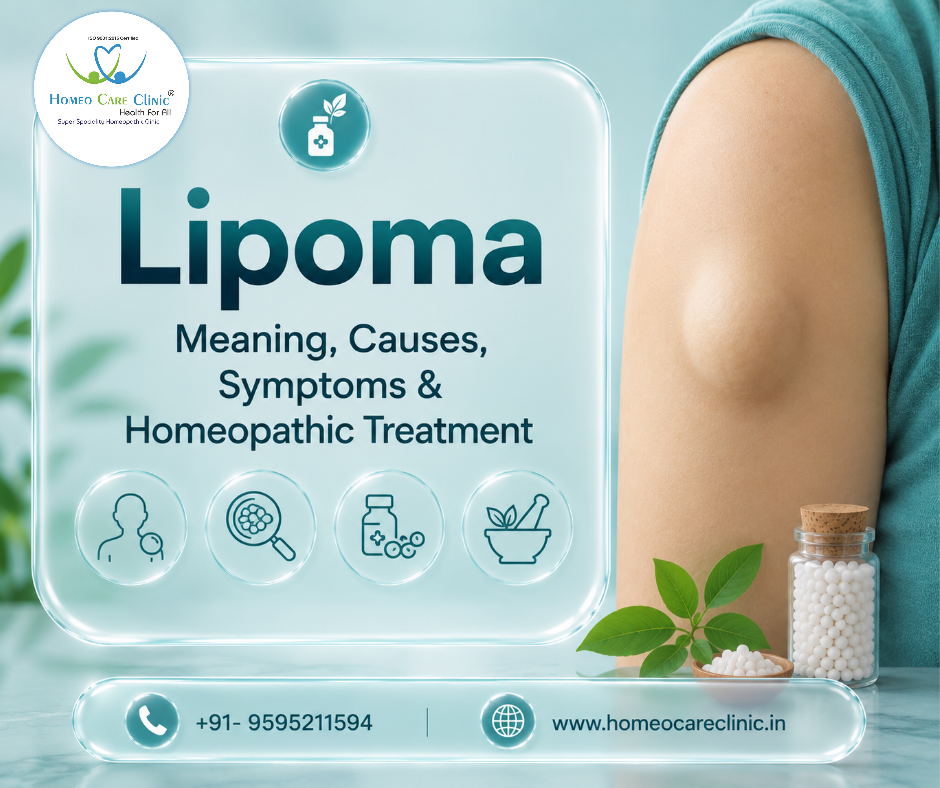
What Is a Lipoma?
MEDICAL DISCLAIMER
This content is for educational and informational purposes only and is NOT a substitute for professional medical advice, diagnosis, or treatment. Always consult Dr. Vaseem Choudhary or a qualified homeopathic practitioner before starting, changing, or stopping any treatment. Do NOT self-medicate with homeopathic remedies. In case of emergency, contact your nearest hospital immediately.
A lipoma is a soft, usually painless lump that develops under the skin. It is made up primarily of mature fat cells and is generally benign, meaning it is not cancerous.
If you are searching for what is a lipoma, it is important to know that lipomas are usually slow-growing and may remain unchanged for years. They commonly occur on the shoulders, arms, back, neck, thighs, or trunk, although they can develop in other locations as well.
The lipoma meaning in simple language is a non-cancerous fatty lump that develops beneath the skin.
In Hindi, people commonly search lipoma kya hota hai. Simply explained, lipoma is called वसा की गांठ (fatty lump) that develops under the skin.
What Does Lipoma Mean?
The term lipoma refers to a benign tumor of fatty tissue. It is usually soft, movable under the skin and grows slowly.
A typical lipoma may feel:
- Soft or doughy
- Smooth
- Movable when pressed
- Usually painless
- Slowly increasing in size
Most lipomas do not cause serious health problems. However, any new lump should be properly assessed rather than automatically assumed to be a lipoma.
What Are the Causes of Lipoma?
The exact lipoma causes are not always known.
Several factors may contribute to the development of lipomas, including:
Genetic Factors
Some people have a family tendency to develop lipomas. When multiple family members develop similar fatty lumps, a genetic component may be involved.
Age
Lipomas are more commonly diagnosed in middle adulthood, although they can occur at different ages.
Family History
A person with a family history of multiple lipomas may have a greater tendency to develop them.
Certain Genetic Conditions
Multiple lipomas can sometimes occur as part of inherited conditions. These situations require appropriate medical evaluation.
Trauma
Some patients notice a lump after an injury, although the relationship between trauma and lipoma formation is not clearly established.
Importantly, lipomas are not simply caused by eating fatty foods or being overweight. A lean person can also develop lipomas.
What Are the Symptoms of Lipoma?
The typical lipoma symptoms are relatively mild because most lipomas are painless.
Common features include:
- A soft lump beneath the skin
- Slow growth
- A lump that moves slightly when pressed
- Usually painless
- Normal-looking skin over the lump
- One or multiple lumps
However, symptoms may vary depending on the size and location of the lipoma.
A larger lipoma may cause discomfort because it presses against surrounding tissues.
A lipoma located near a nerve may occasionally cause pain, tingling, numbness or other sensations.
What Are the Signs That a Lump May Not Be a Typical Lipoma?
Although most lipomas are harmless, certain features require medical evaluation.
Consult a lipoma specialist doctor if a lump:
- Grows rapidly
- Becomes painful
- Feels unusually hard
- Is fixed deeply to surrounding tissues
- Is larger than expected
- Changes significantly
- Causes weakness or numbness
- Is associated with unexplained symptoms
A rapidly growing or deep mass should not simply be labelled as a lipoma without appropriate assessment.
How Is Lipoma Diagnosed?
A doctor can often recognize a typical lipoma through physical examination.
Depending on the size, location and appearance of the lump, additional tests may sometimes be recommended.
These may include:
- Ultrasound
- MRI
- CT scan in selected situations
- Biopsy when the diagnosis is uncertain
Imaging can help determine whether a lump is superficial or deep and whether its characteristics are consistent with a lipoma.
A proper diagnosis is particularly important when a lump is growing rapidly, painful, firm or located deep beneath the skin.
What Is the Conventional Lipoma Treatment?
The appropriate lipoma treatment depends on factors such as size, location, symptoms and whether the diagnosis is certain.
Many small, asymptomatic lipomas do not require immediate treatment.
A doctor may recommend observation when:
- The lump is small
- It is painless
- It is not growing rapidly
- The diagnosis is clear
- It does not interfere with daily activities
If treatment is necessary, surgical removal is the most established method for completely removing a symptomatic or troublesome lipoma.
Surgery may be considered when a lipoma:
- Causes pain
- Restricts movement
- Becomes large
- Causes pressure on surrounding structures
- Is cosmetically concerning
- Continues to grow
- Has an uncertain diagnosis
Can Lipoma Treatment Be Done Without Surgery?
One of the most common questions patients ask is about lipoma treatment without surgery.
For a confirmed, typical lipoma, there is currently no reliably proven medicine that dissolves or permanently eliminates it.
Some lipomas can simply be monitored if they are harmless and do not cause symptoms.
Certain procedures may be considered in selected cases, but treatment depends on the individual lump.
It is important to be cautious about products or treatments claiming to “melt”, dissolve or permanently remove lipomas without proper medical assessment.
If you have a new or growing lump, getting the diagnosis confirmed is more important than immediately trying to remove it.
Can Homeopathy Treat Lipoma?
Homeopathy is often considered by patients looking for a natural approach to managing lipomas.
In homeopathic practice, treatment is individualized according to:
- Size and location of the lump
- Number of lipomas
- Duration
- Growth pattern
- General health
- Family history
- Other physical symptoms
- Emotional and lifestyle factors
The goal of homeopathic treatment is traditionally described as addressing the individual’s overall susceptibility rather than simply removing a lump.
However, there is not sufficient high-quality scientific evidence to establish homeopathy as an effective treatment for shrinking or eliminating lipomas.
Therefore, homeopathy should not be used as a substitute for proper diagnosis or necessary conventional treatment.
What Is Homoeopathic Medicine for Lipoma?
People searching for homoeopathic medicine for lipoma may come across remedies such as:
Calcarea Carbonica
Traditionally considered in homeopathic practice when fatty growths occur alongside a particular constitutional symptom pattern.
Thuja Occidentalis
Traditionally used by some homeopathic practitioners for various types of benign skin growths and lumps.
Phytolacca
Sometimes considered in homeopathic practice for glandular or fatty tissue complaints.
Graphites
Traditionally used when skin-related complaints and certain types of lumps occur together.
Silicea
Traditionally considered for various chronic skin and subcutaneous complaints.
These remedies should not be regarded as clinically proven medicines for removing lipomas. A homeopathic practitioner may select a remedy based on the complete individual case rather than simply prescribing one medicine for every lipoma.
Do not self-medicate or delay evaluation of a growing lump.
When Does Homeopathy Help in Lipoma?
Homeopathy may be sought as a complementary approach when a patient wants individualized care and the lump has already been appropriately assessed.
It is particularly important to distinguish between:
Managing the person:
Addressing general symptoms, lifestyle, stress and overall wellbeing.
and
Removing the lipoma:
There is currently insufficient evidence that homeopathic medicines can reliably shrink or eliminate a confirmed lipoma.
Patients should therefore have realistic expectations when considering homeopathy.
What Lifestyle Tips Can Help Someone With Lipoma?
There is no specific diet proven to make an existing lipoma disappear. However, maintaining a healthy lifestyle is beneficial for overall health.
Maintain a Balanced Diet
Include:
- Fresh vegetables
- Fruits
- Whole grains
- Pulses
- Adequate protein
- Nuts and seeds
- Healthy fats
Maintain a Healthy Weight
Although lipomas are not simply caused by obesity, maintaining a healthy weight supports overall metabolic health.
Exercise Regularly
Walking, yoga, strength training and other suitable physical activities can support general health.
Avoid Unnecessary Supplements
There is no proven supplement that reliably dissolves lipomas.
Monitor the Lump
Pay attention to:
- Size
- Shape
- Pain
- Changes in texture
- Rate of growth
If significant changes occur, consult a healthcare professional.
Can Diet Reduce Lipoma?
There is no specific lipoma diet proven to shrink an established lipoma.
However, a balanced diet can help maintain a healthy body composition and support overall metabolic health.
Choose:
- Vegetables
- Fruits
- Whole grains
- Lentils and pulses
- Fish
- Eggs
- Lean protein
- Nuts
- Seeds
- Adequate water
Limit excessive intake of:
- Highly processed foods
- Sugary beverages
- Trans fats
- Excessive fried foods
- Highly refined carbohydrates
Diet should be viewed as a component of general health rather than a proven treatment for lipoma.
Why Choose Homeo Care Clinic for Lipoma Consultation?
At Homeo Care Clinic, the focus is on individualized assessment rather than giving the same medicine to every patient.
Under the guidance of Dr. Vaseem Choudhary M.D., a consultation may consider:
- Medical history
- Duration of the lump
- Location
- Size
- Number of lumps
- Rate of growth
- Associated symptoms
- Family history
- Lifestyle
- Overall health
The objective is to understand the patient’s individual health picture and discuss appropriate treatment options.
If a lump has suspicious characteristics, appropriate referral for imaging or specialist evaluation is important before considering complementary treatment.
When Should You Consult a Lipoma Specialist Doctor?
A lipoma specialist doctor should be consulted if:
- The lump is rapidly increasing in size.
- It becomes painful.
- It feels hard or unusually firm.
- It is deep under the skin.
- It becomes fixed and difficult to move.
- It causes numbness or weakness.
- There are multiple rapidly developing lumps.
- The diagnosis is uncertain.
- You have noticed a new unexplained lump.
Do not assume every soft lump is a lipoma.
A proper diagnosis provides reassurance and ensures that conditions requiring different treatment are not overlooked.
Frequently Asked Questions About Lipoma
1. What is a lipoma?
A lipoma is a benign growth made primarily of mature fat cells. It usually develops beneath the skin and tends to be soft, mobile and slow-growing.
2. What is the lipoma meaning in simple language?
The lipoma meaning is a non-cancerous fatty lump that develops underneath the skin.
3. Lipoma kya hota hai?
If you are searching for lipoma kya hota hai, it simply means a fatty lump under the skin. In Hindi, it is commonly described as वसा की गांठ.
4. What are the main lipoma causes?
The exact lipoma causes are not always known. Genetics and family tendency appear to play an important role in some individuals.
5. What are the common lipoma symptoms?
Typical lipoma symptoms include a soft, slow-growing, movable lump beneath the skin. Most lipomas are painless.
6. Can lipoma become cancerous?
Typical lipomas are benign and do not usually become cancerous. However, another type of soft-tissue tumor called liposarcoma can resemble a lipoma in some situations. A rapidly growing, painful or deep mass should therefore be evaluated.
7. Can lipoma treatment be done without surgery?
For a confirmed lipoma, there is no reliably proven medicine that permanently dissolves it. Small, asymptomatic lipomas may simply be observed, while troublesome or uncertain masses may require procedural or surgical treatment.
8. Is there any homoeopathic medicine for lipoma?
Several remedies, including Thuja, Calcarea Carbonica, Phytolacca, Graphites and Silicea, are traditionally used in homeopathic practice for various types of lumps and skin complaints.
However, there is insufficient scientific evidence that these medicines can reliably shrink or remove lipomas.
9. Can homeopathy cure lipoma permanently?
There is currently insufficient high-quality evidence to establish homeopathy as a treatment that permanently removes lipomas. Patients considering homeopathy should first have the lump properly diagnosed.
10. What is the best lipoma treatment?
The appropriate lipoma treatment depends on the size, location, symptoms and diagnostic certainty. Observation may be appropriate for a typical, asymptomatic lipoma. Surgical removal is an established option when treatment is necessary.
11. Can diet dissolve a lipoma?
There is no scientifically proven diet that dissolves an established lipoma. A balanced diet can support general health but should not be considered a replacement for medical assessment.
12. When should I see a lipoma specialist doctor?
See a lipoma specialist doctor or appropriate medical professional when the lump grows quickly, becomes painful, feels hard or fixed, is deep, causes neurological symptoms, or has an uncertain diagnosis.
Conclusion
Understanding the lipoma meaning, lipoma causes, and lipoma symptoms can help patients make informed decisions about an unexplained lump.
If you are searching what is a lipoma, remember that a typical lipoma is a benign fatty growth that is generally slow-growing and painless. However, not every lump is a lipoma, so proper diagnosis is important.
For patients looking for lipoma treatment without surgery, it is important to have realistic expectations. There is currently no reliably proven medicine or diet that dissolves an established lipoma. Observation may be appropriate for some harmless lipomas, while symptomatic, enlarging or uncertain masses may require conventional medical treatment.
Homeopathy may be considered as a complementary, individualized approach, but homoeopathic medicine for lipoma has not been proven in high-quality clinical research to reliably eliminate or shrink lipomas.
At Homeo Care Clinic, Dr. Vaseem Choudhary M.D. and his team can provide an individualized consultation and help patients understand their options while encouraging appropriate specialist evaluation whenever necessary.
A lump should never be judged by appearance alone—accurate diagnosis is the first step toward safe treatment.
“Your health deserves more than temporary relief. Choose homeopathy for lasting results”
Start your journey towards better focus today.
About the Author Bio:
Dr. Vaseem Choudhary M.D is a seasoned classical homeopath with over 16+ years of experience, dedicated to treating patients with compassion, precision and holistic care. Mainly in Pune & Mumbai, serving both national and international patients from UK, USA, Germany, France, Canada, Bhutan, Dubai and China. With a wide range of acute and chronic conditions—from skin disorders, hormonal issues, and digestive problems to autoimmune diseases and mental health concerns.
Dr. Vaseem is widely respected for his unique approach that combines classical homeopathy, personalized diet planning, lifestyle guidance, and a spiritual perspective on healing. He is known for his detailed and empathetic case-taking process, which focuses on treating the root cause rather than just symptoms.
In recognition of his dedication and clinical excellence, Dr. Vaseem Choudhary MD has been honored with the Best Homeopathic Doctor in Pune award by leading platforms such as:
- Awarded for International Excellence in Autism & ADHD Treatment 2026 in UK Parliament, London
- Dr. Vaseem Choudhary honoured at the UK Parliament, receiving International recognition PG from the London College of Homeopathy 2026
- Dr. Vaseem Choudhary, MD, was further acknowledged in Dubai in 2026 for his expertise in Autism and ADHD, reinforcing his growing international recognition in this field
- Best Homeopathy Doctor in Pune – National Healthcare Service Excellence Awards 2024
- Most Trusted Centre for Autism and ADHD in India 2025 – Healthcare Excellence & Leadership Awards
- Best Homeopathy Doctor in Pune – Dr. Vaseem Choudhary Shines at Ayush 2nd International Conference, Dubai
- Recognized for spearheading homeopathic treatment protocols, improving patient satisfaction, and healthcare advancements.
He is also a contributing author to the International Journal of Homeopathy and Natural Medicines (IJHNM), where he shares his research and clinical experiences with the global medical community.
With a passion to take homeopathy to new heights, Dr. Vaseem continues to guide patients towards natural, safe, and sustainable healing.
Homeo Care Clinic offers a holistic approach to treating the disease. The remedies mentioned above can treat the underlying causes of the condition and offer relief from the discomfort. However, it is important to consult a qualified homeopathic practitioner for the correct dosage and duration of treatment. Homeo Care Clinic provides comprehensive care for various ailments, and offers customized treatment plans based on individual requirements.
To schedule an appointment or learn more about our treatment, please visit our website or give us a call +91 9595211594 our best homeopathy doctor will be here to help.
- Success Stories of Patients –https://www.homeocareclinic.in/category/case-study/
- Patient Testimonials – https://www.homeocareclinic.in/testimonial/
Chat with a best homeopathic doctor privately:
If you have any queries regarding your disease or any symptoms, click to send a What‘s App message. Our best homeopathy doctor will be happy to answer you. About Us Click
Book an Appointment:
If you want to visit our clinic, click to book an appointment.
Online treatment:
If you are a busy professional, or you are living in a remote town or city, with no best homeopathic doctor near you, Click to start an online homeopathic treatment with the world’s exclusive, most experienced and best homeopathic clinic, managed by Dr. Vaseem Choudhary world-renowned homeopathic doctor expert
- Our Doctors –https://www.homeocareclinic.in/team/