

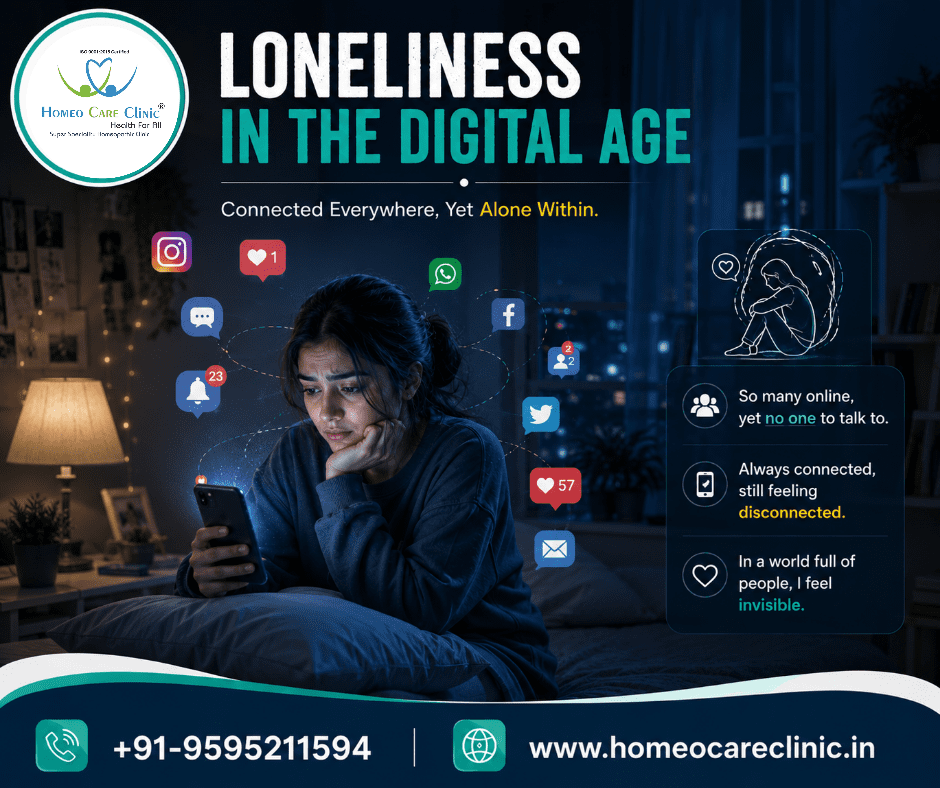
I had a twenty-four-year-old young man sit in my clinic just last Tuesday. He was articulate, well-dressed, and had recently moved to Pune for a highly coveted tech job in Magarpatta. By all conventional societal metrics, he was doing incredibly well for his age.
But when I asked him about his support system, his confident posture completely crumbled.
He pulled out his phone and showed me his Instagram profile. He had over three thousand followers. He showed me his WhatsApp; he had dozens of active group chats buzzing with memes, reels, and forwarded messages. Then, he put the phone face down on my desk, looked me dead in the eye, and said, “I haven’t heard another human being say my name out loud since Thursday.”
He told me about his weekend. He ordered his groceries through an app so he didn’t have to talk to a cashier. He ordered his dinner through an app so he didn’t have to talk to a waiter. He spent forty-eight solid hours in his apartment, swiping through dating apps, watching other people’s highlight reels on social media, and texting his college friends who live in different cities. He was communicating with hundreds of people, yet he was completely, utterly, and devastatingly alone.
He sat in my office and wept because the physical ache in his chest was becoming unbearable.
This is the great, terrifying paradox of modern human existence. We are the most technologically connected generation in the entire history of the human species, yet we are experiencing a catastrophic famine of actual human intimacy. Parents are watching their teenagers isolate themselves in their bedrooms. Young professionals are drowning in empty apartments. Elderly individuals are being left behind in a world that requires a smartphone to function.
People are desperately trying to figure out how to navigate Loneliness in the digital age because it is slowly eroding their mental health, their physical health, and their will to engage with the world.
So let’s sit down and pull the curtain back on this entirely modern nightmare. We are going to look at the brutal biological mechanics of why a text message cannot replace a hug, the exact reasons why the internet makes us feel more isolated, what a socially starved brain actually looks like in your daily life, and how we can use deep, constitutional homeopathy to repair your nervous system and help you step back into the real world. Grab a massive cup of coffee. We have a lot of ground to cover today.
The Causes: Why Are We So Connected but So Alone?
To fix the isolation, you have to understand exactly what the digital world has done to human biology and sociology. You are not lonely because you are unlovable or broken. You are lonely because you are a biological organism living in an environment that actively discourages true connection.
The causes of Loneliness in the digital age are systemic, predatory, and deeply unnatural.
The Biological Starvation of Texting
Human beings evolved in close-knit tribes. For hundreds of thousands of years, communication was entirely physical. When you talk to someone face-to-face, your nervous system is working incredibly hard. You are reading their micro-expressions, hearing the subtle changes in the tone of their voice, observing their body language, and smelling their pheromones. This rich, multi-sensory physical interaction triggers your brain to release oxytocin—the “bonding hormone”—and endorphins, which physically lower your heart rate and make you feel safe.
Texting, messaging, and commenting strip all of that away. You are communicating, but your nervous system is starving. An emoji of a heart does not trigger an oxytocin release. Your brain is receiving data, but it is not receiving intimacy. You can text fifty people a day and still go to bed biologically starved for human connection.
The Death of the “Third Space”
Sociologists talk about the importance of the “Third Space.” The First Space is your home. The Second Space is your workplace. The Third Space is the community hub—the local park, the neighborhood cafe, the community center, the library. It is where you go to exist around other people without an agenda.
The digital age has systematically destroyed the Third Space. We don’t go to the movies; we stream Netflix on our couches. We don’t go to the cafe to chat; we go to the cafe, put on noise-canceling headphones, and stare at our laptops. We don’t strike up conversations with strangers on the bus; we stare at our phones. The opportunities for spontaneous, low-stakes human connection have almost entirely evaporated.
The Algorithmic Echo Chamber
Social media platforms are not designed to connect you to people; they are designed to keep your eyes on the screen so they can sell ad space. The algorithms quickly learn that outrage, fear, and extreme opinions drive the most engagement. Therefore, the internet divides us. It pushes us into tribal echo chambers where everyone agrees with us, and everyone outside the group is painted as an enemy. This breeds a deep, underlying paranoia and distrust of the general public. We become terrified to speak to strangers in real life because the internet has convinced us that everyone is hostile.
The Remote Work Trap
The shift to remote work, accelerated by recent global events, was praised for its convenience. But it severed a vital lifeline of human interaction. The casual “water cooler” conversations, the shared complaints about the boss, the quick lunches with colleagues—these small, seemingly insignificant interactions actually provided a massive daily dose of social grounding. Working in your pajamas in your living room for eight hours a day removes the friction of a commute, but it also removes the friction of human life. It leaves young professionals profoundly isolated.
The Signs and Symptoms: What Digital Isolation Looks Like
You cannot treat a fried, lonely nervous system if you do not know what the red flags look like. The symptoms of Loneliness in the digital age are insidious. They creep up on you, destroying your self-worth and your physical health before you even realize you are in crisis.
Here is what the fallout actually looks like in your living room:
Physical Somatization of Loneliness
Loneliness is not just a feeling; it is a biological state of alarm. Studies have shown that the brain processes social rejection and isolation using the exact same neural pathways that it uses to process physical pain. When you are chronically lonely, your body genuinely hurts. You feel a heavy, dull ache in the center of your chest. You suffer from chronic inflammation, a suppressed immune system (you catch every cold that goes around), and severe tension headaches. Your body is physically screaming that it needs a tribe to survive.
Social Atrophy and Agoraphobia
When you spend all your time online, you actually forget how to interact in the real world. Social skills are like muscles; if you do not use them, they atrophy. When you finally are invited to a party or a dinner, you experience intense, paralyzing social anxiety. You don’t know where to look, you don’t know how to make small talk, and you feel incredibly awkward. This awkwardness makes you want to go back home to the safety of your screen, creating a vicious cycle that eventually mimics agoraphobia (the fear of leaving the house).
The “Read Receipt” Paranoia
Because your entire social life lives on a screen, your self-worth becomes entirely tied to response times. If you send a message and you see that the person has “read” it but hasn’t replied within ten minutes, your anxiety skyrockets. You assume they hate you. You assume you did something wrong. You obsess over the digital silence, trapped in a state of hyper-vigilant paranoia.
Exhaustion and Apathy
Chronic loneliness is exhausting. Without the energizing exchange of human interaction, you fall into a state of profound apathy. You stop caring about your hobbies. You stop caring about your physical appearance because “no one is going to see me anyway.” Your personal hygiene might slip. You spend your weekends lying in bed, mindlessly scrolling, feeling like a ghost haunting your own life.
Conventional Treatment: The Limits of the Standard Approach
When the crushing weight of isolation becomes too much to handle, people eventually drag themselves to a conventional doctor or therapist, desperately looking for a way out.
Unfortunately, the standard medical and societal response to digital isolation is often entirely disconnected from reality.
The “Just Put Yourself Out There” Advice
The most common advice from well-meaning doctors or relatives is simply, “You just need to get out more! Join a club! Go to a bar!” This advice is completely useless to someone suffering from the profound social atrophy of Loneliness in the digital age. Telling a deeply isolated, anxious person to “just join a club” is like telling a person with a broken leg to just run a marathon. The physical and emotional bandwidth required to walk into a room full of strangers is completely depleted. It just makes the patient feel like even more of a failure when they can’t do it.
The Gamification of Dating and Friendship Apps
Society often points lonely people toward dating apps (Tinder, Bumble) or friendship apps. But these apps are a core part of the problem. They gamify human connection. They force you to judge a human being’s entire worth in a fraction of a second based on a 2D photograph. The constant swiping, the ghosting, and the superficial nature of these apps usually leave people feeling more discarded, worthless, and alienated than they did before they downloaded them.
The Rush to Chemical Numbing
If you complain of severe fatigue, isolation, and brain fog, the conventional psychiatric system will almost always offer you a Selective Serotonin Reuptake Inhibitor (SSRI) or an anti-anxiety medication.
While these drugs can absolutely save lives in severe, clinical psychiatric emergencies, using a heavy, brain-altering chemical to blunt the pain of societal isolation is a tragic misstep. These drugs often cause severe emotional numbing, weight gain, and a total loss of libido. They do not give you a friend. They do not teach you how to connect. They just put a thick, chemical blanket over the pain of your loneliness so you don’t feel anything at all. We need a way to heal the fundamental wound of isolation without turning the patient into an emotionless zombie.
Homeopathy Treatment: Healing the Nervous System and the Heart
This is exactly why high-achieving, deeply lonely individuals find themselves sitting in my clinic. They don’t want to be numb. They want to actually feel capable of connecting with another human being. They want the heavy, physical ache in their chest to go away.
Homeopathy offers a profound, structural reset for a brain and heart that have been battered by Loneliness in the digital age. We do not use medicine to suppress your personality or force you to be an extrovert. We use incredibly safe, highly diluted, constitutional nanomedicines to treat the physiological and psychological roots of your isolation.
We look at the exact flavor of your loneliness. Do you push people away to protect yourself? Do you weep and cling to anyone who gives you attention? Do you feel a dark, crushing sense of worthlessness? By matching your specific emotional pathology to the exact energetic frequency of the remedy, we can prompt the central nervous system to hit the reset button.
Here are 5 medicines from my clinical cabinet that we rely on constantly to treat severe social isolation and digital depression.
1. Natrum Muriaticum
- Indicated for: The isolated individual who builds a wall and pushes people away.
- Best suited for: The Natrum Mur patient is the classic victim of modern isolation. They are deeply, incredibly sensitive, but they hide it behind a massive, invisible fortress. If they have been hurt, rejected, or ghosted online, they decide that human connection is simply too dangerous. They isolate themselves entirely in their apartments. They dwell on past hurts constantly. They hate being pitied or comforted; if you try to hug them while they are crying, they will stiffen and pull away. They often suffer from stress-induced migraines and crave salty junk food while scrolling in the dark.
- Key actions: Natrum Mur safely dismantles the defensive emotional fortress. It softens the intense, bitter grief of feeling “left behind,” helping the individual actually process their sadness rather than trapping it in their body. It lowers the fear of rejection, allowing them to finally risk opening the door to connection again.
2. Pulsatilla Nigricans
- Indicated for: The deeply needy, weeping individual who craves constant reassurance.
- Best suited for: While Natrum Mur pushes people away, the Pulsatilla patient desperately clings. They feel the pain of Loneliness in the digital age as a deep, terrifying sense of abandonment. Their mood is incredibly changeable. They might send twenty texts in a row if someone doesn’t reply, driven by a panicked fear that they are unlovable. They weep easily and crave physical affection. They hate being alone in their room and feel much better if they can just sit in a cafe around other people, even if they aren’t talking to anyone.
- Key actions: Pulsatilla deeply grounds a needy, dependent nervous system. It takes away the desperate, weeping panic of separation, helping to build a sense of internal security and self-worth so they do not fall apart completely every time an app goes quiet.
3. Aurum Metallicum
- Indicated for: Profound, dark, crushing isolation leading to feelings of total worthlessness.
- Best suited for: This is a remedy for the absolute darkest depths of digital isolation. The Aurum patient looks at the curated success of everyone else on social media and concludes that they are a complete, fundamental failure. They feel a heavy, black cloud of depression over them. They feel that they have failed in their career, in their relationships, and in life. They lose all joy and may even experience passive thoughts of not wanting to exist. They often suffer from deep bone pains or severe cardiovascular tension from the stress.
- Key actions: Aurum acts as a powerful beacon of light in the darkest emotional terrain. It lifts the heavy, crushing weight of worthlessness and self-condemnation, restoring the individual’s sense of value and bringing them back from the edge of total despair.
4. Ignatia Amara
- Indicated for: Acute emotional shock, sudden ghosting, and hysterical grief.
- Best suited for: This is a crucial remedy for someone who has just experienced a sudden, massive digital trauma—like being brutally ghosted by someone they met on a dating app, or being suddenly exiled from an online friend group. The Ignatia patient is in a state of acute, hysterical shock. They sigh heavily. They get a literal lump in their throat. Their emotions are explosive—laughing hysterically one minute and sobbing uncontrollably the next. They try to suppress the trauma, but their nervous system betrays them.
- Key actions: Ignatia is the absolute premier remedy for acute grief and emotional suppression. It acts as a rapid stabilizer for the nervous system, helping the individual process the sudden shock and betrayal without spiraling into a long-term, isolating depressive episode.
5. Phosphoric Acid
- Indicated for: The person who has consumed so much screen time they are completely numb.
- Best suited for: This is the remedy for the final stage of digital burnout and isolation. After months of doomscrolling and living entirely through a screen, the person just breaks. The defining symptom is profound, crushing apathy. They do not care about anything. They answer questions with one-word syllables. They feel completely hollowed out. They are not angry or weeping; they just lie on the couch, staring blankly, feeling like their emotional capacity has been entirely erased by the internet.
- Key actions: It rebuilds the vital force after a devastating emotional or mental drain. It gently brings the physical and mental energy back online, slowly waking the brain up from that apathetic, isolated coma, allowing the person to actually feel the desire to participate in life again.
Why Choose Homeo Care Clinic
You cannot treat the deep, gnawing pain of profound isolation by reading self-help quotes and guessing which remedy to buy at a health food store. Human psychology is entirely too delicate for a trial-and-error approach.
This is exactly why exhausted, lonely individuals bring themselves to Homeo Care Clinic to sit down with Dr. Vaseem Choudhary.
- Deep Mastery of Psychological Pathology: Dr. Vaseem Choudhary has been practicing right here in Pune for nearly two decades. He has seen the absolute destruction caused by Loneliness in the digital age. He knows that social isolation is a biological state of panic. He listens to you without judgment. He observes your subtle physical quirks—the heavy sighs, the lack of eye contact, the slumped shoulders—to find the exact pathological root of your loneliness.
- Healing the Gut-Brain Axis: You cannot cure severe anxiety and isolation-induced depression if you have a destroyed gut. Chronic stress, sitting on a couch all day, and poor diet destroy the microbiome, leading to acid reflux, IBS, and terrible sleep. The mind and the body are one unit. We treat the sluggish, painful digestion at the exact same time we treat the mental fears, because a healthy gut creates the serotonin needed to actually give you the energy to leave the house.
- Accessible and Welcoming Clinics: When you are already paralyzed by social anxiety, you do not have the bandwidth for a chaotic, depressing commute to a doctor’s office. With established, fully staffed, and incredibly welcoming clinics strategically located in Viman Nagar, Hadapsar, and Magarpatta, you can access world-class constitutional care in a warm environment that respects your time and your mental space.
- Zero Toxic Chemicals or Numbing Agents: We absolutely refuse to put your brain on harsh psychiatric medications just to blunt the pain of modern life. Our nanomedicines are safe, non-toxic, and incredibly gentle. They simply provide the energetic frequency the body needs to hit the reset button, allowing you to heal naturally and regain your desire for connection.
The Transformative Benefits of Homeopathy
Why should you consider this holistic route instead of just relying entirely on conventional therapies or white-knuckling your way through life?
- It Restores Your Authentic Desire for Connection: If you just force yourself to go to a party when you are terrified, you are fighting a daily battle. Homeopathy actually lowers the internal alarm system. When the profound fear of rejection is healed, the natural, biological drive to connect with other humans naturally boots back up. You actually want to talk to people again.
- It Builds Real Emotional Bandwidth: Remedies like Natrum Mur and Phosphoric Acid do not numb you. They clear the static. You suddenly have the mental clarity and the physical energy to handle the friction of real-life social interactions without feeling instantly exhausted.
- No Rebound Panic or Side Effects: When the constitutional treatment has done its job, you stop taking the medicine. You do not experience rebound anxiety, brain zaps, or severe withdrawal symptoms, which are massive risks with conventional SSRIs. The healing is structural and permanent.
- Restores Your Physical Health: By turning off the chronic fight-or-flight response caused by isolation, your body can finally repair itself. The heavy ache in your chest disappears. Your digestion normalizes. Your immune system kicks back into gear.
Lifestyle Adjustments: How to Break the Digital Chains
Homeopathic medicine provides the biological spark to calm your nervous system. But you must act as the architect of your own environment. You cannot take a homeopathic remedy and then spend fourteen hours a day scrolling through TikTok in a dark apartment.
If you want to survive the brutal reality of Loneliness in the digital age, you must implement firm, structural changes in your life. And it is going to require profound discipline.
- The “Phone Stack” Rule: You have to force yourself to disconnect when you are actually around people. If you are at a dinner or a cafe with a friend, both of you must put your phones in a stack in the middle of the table, face down. The first person to touch their phone pays the bill. You must remove the digital safety net to force actual eye contact and conversation.
- Force Real-World Friction: You need to stop optimizing your life for convenience. Stop ordering your groceries on an app. Go to the actual grocery store. Talk to the cashier. Ask them how their day is going. These tiny, thirty-second micro-interactions build your social muscles back up and remind your brain that the world is full of safe, normal people.
- Find Your “Third Space”: You must leave your house. Find a local cafe, a library, a bookstore, or a park bench in Pune. Make it a habit to go there for one hour every single day. You don’t even have to talk to anyone at first. Just exist in the physical presence of other human beings. Let your nervous system recalibrate to the sound of real human voices instead of digital audio.
- Curate Your Feed with Ruthless Aggression: You cannot control the internet, but you can control your algorithm. If following a certain influencer, a former classmate, or a news site makes you feel a sharp pang of inadequacy or isolation in your chest, you must mute or unfollow them immediately. Protect your digital space like you protect your physical home.
Diet Adjustments for a Social Brain
You cannot feed your body processed garbage and caffeine and expect your nervous system to have the resilience to overcome deep social anxiety. A highly anxious, lonely brain requires premium construction materials.
- Stop the Blood Sugar Panic Attacks: An anxious, overwhelmed brain burns through glucose rapidly. If you skip breakfast or drink a massive, sugary iced coffee, your blood sugar spikes and crashes by 11:00 AM. A blood sugar crash mimics the exact physical symptoms of a panic attack—shaking, sweating, and extreme anxiety. Force yourself to eat heavy protein in the morning. Eggs, almonds, or meat. Keep the engine running flat and steady.
- Massive Omega-3 Support: The prefrontal cortex—the part of the brain responsible for empathy, reading social cues, and calming the emotional centers—is largely built out of fat. Chronic isolation actively fatigues this part of the brain. Take a very high-quality, heavy-metal-free liquid fish oil supplement every single day. It physically insulates the neural pathways, reducing sensory overwhelm.
- Magnesium for the Tension: Social anxiety causes massive physical tension. You clench your jaws, hunch your shoulders over your phone, and hold your breath when you feel awkward. Magnesium is the body’s natural muscle and nerve relaxer. Take a high-quality magnesium glycinate supplement right before bed to help you physically release the tension of the day and achieve deep, restorative sleep.
- Hydrate the Gray Matter: The human brain is 73% water. Even a 2% drop in hydration causes severe brain fog, memory loss, and a massive drop in executive function. If you are drinking coffee all day and no water, your brain is literally shrinking inside your skull. Keep a massive water bottle on your desk and force yourself to finish it.
5 Commonly Asked FAQs
1. Is it normal to feel lonely even when I am in a relationship or have friends?
- Absolutely. Loneliness in the digital age is rarely about the quantity of people around you; it is about the quality of intimacy. If you are with friends but everyone is staring at their phones, your nervous system registers that as profound isolation.
2. Should I just delete all my social media apps completely?
- For some people in severe crisis, a complete cold-turkey detox is exactly what they need to break the cycle.
- For others, it causes too much sudden social isolation. The goal is intentionality. Delete the apps from your phone and only log in from a desktop computer. Add friction to the process so you cannot mindlessly scroll when you are feeling vulnerable.
3. I have terrible social anxiety. How do I start making friends?
- Start incredibly small. Do not try to go to a massive party.
- Start by just saying “Good morning” to the security guard in your building. Start by making thirty seconds of small talk with a barista. You have to build the social muscle back up slowly before you try to lift heavy weights.
4. Can a homeopathic pill actually make me less lonely?
- Homeopathy does not magically teleport a best friend into your living room.
- What it does is remove the physical and energetic static of anxiety and deep grief. When your nervous system is no longer trapped in a state of chronic fear or apathy, your mind naturally clears. You gain the biological bandwidth and courage to actually step outside and engage with the world.
5. How long does it take to heal from severe digital isolation using homeopathy?
- For the acute, physical symptoms of anxiety (like tension headaches or panic attacks), you can often see relief within a few weeks.
- Deep constitutional healing to rewire your self-worth and dismantle years of defensive emotional walls usually takes several months of consistent treatment alongside strict lifestyle and digital boundaries.
Conclusion: Stepping Back into the Light
So here is the final takeaway.
Living in the modern world is a bizarre, deeply confusing experience. We have access to every single piece of human knowledge and billions of people in the palm of our hand, yet we have never been more emotionally starved. It is incredibly painful to wake up every single day, open a screen, and feel like you are standing on the outside of a glass window, watching the rest of the world live their lives without you.
When you read about the terrifying reality of Loneliness in the digital age, and you feel the physical, heavy ache of it in your own chest, it is easy to feel a profound sense of despair. You feel like you are trapped in a sterile, glowing cage.
But you do not have to stay in the cage.
When you finally step back and truly understand the biological mechanics of why your brain is aching for connection, the chaos starts to make sense. You realize that your feelings of isolation are not a reflection of your actual worth. You are not unlovable. You are simply a human being whose nervous system is desperate for a tribe, living in an environment that only offers pixels.
You do not have to just surrender to the loneliness. You don’t have to spend the rest of your life scrolling through other people’s highlight reels from the isolation of your dark apartment. And you definitely don’t have to resort to heavy psychiatric drugs just to blunt the pain of existence.
You can step outside. You can implement the “Phone Stack” rule. You can clean up your diet to stop the physical panic attacks. And by bringing yourself into Homeo Care Clinic for a deep, constitutional reset with Dr. Vaseem Choudhary, you can actually give your fragile, exhausted nervous system the exact biological push it needs to heal.
You have a beautiful, unique, powerful life waiting to be shared. You just need to feel secure enough in your own skin to put the phone down and say hello to the person standing next to you. Be patient, build your boundaries, give your body the right support, and watch what happens when you finally step back into the real world. You’ve got this.
“Your health deserves more than temporary relief. Choose homeopathy for lasting results”
Start your journey towards better focus today.
About the Author Bio:
Dr. Vaseem Choudhary M.D is a seasoned classical homeopath with over 16+ years of experience, dedicated to treating patients with compassion, precision and holistic care. Mainly in Pune & Mumbai, serving both national and international patients from UK, USA, Germany, France, Canada, Bhutan, Dubai and China. With a wide range of acute and chronic conditions—from skin disorders, hormonal issues, and digestive problems to autoimmune diseases and mental health concerns.
Dr. Vaseem is widely respected for his unique approach that combines classical homeopathy, personalized diet planning, lifestyle guidance, and a spiritual perspective on healing. He is known for his detailed and empathetic case-taking process, which focuses on treating the root cause rather than just symptoms.
In recognition of his dedication and clinical excellence, Dr. Vaseem Choudhary MD has been honored with the Best Homeopathic Doctor in Pune award by leading platforms such as:
- Awarded for International Excellence in Autism & ADHD Treatment 2026 in UK Parliament, London
- Dr. Vaseem Choudhary honoured at the UK Parliament, receiving International recognition PG from the London College of Homeopathy 2026
- Dr. Vaseem Choudhary, MD, was further acknowledged in Dubai in 2026 for his expertise in Autism and ADHD, reinforcing his growing international recognition in this field
- Best Homeopathy Doctor in Pune – National Healthcare Service Excellence Awards 2024
- Most Trusted Centre for Autism and ADHD in India 2025 – Healthcare Excellence & Leadership Awards
- Best Homeopathy Doctor in Pune – Dr. Vaseem Choudhary Shines at Ayush 2nd International Conference, Dubai
- Recognized for spearheading homeopathic treatment protocols, improving patient satisfaction, and healthcare advancements.
He is also a contributing author to the International Journal of Homeopathy and Natural Medicines (IJHNM), where he shares his research and clinical experiences with the global medical community.
With a passion to take homeopathy to new heights, Dr. Vaseem continues to guide patients towards natural, safe, and sustainable healing.
Homeo Care Clinic offers a holistic approach to treating the disease. The remedies mentioned above can treat the underlying causes of the condition and offer relief from the discomfort. However, it is important to consult a qualified homeopathic practitioner for the correct dosage and duration of treatment. Homeo Care Clinic provides comprehensive care for various ailments, and offers customized treatment plans based on individual requirements.
To schedule an appointment or learn more about our treatment, please visit our website or give us a call +91 9595211594 our best homeopathy doctor will be here to help.
Follow us on Facebook, Twitter and Instagram for valuable insights into the world of homeopathy and holistic health.
- Facebook– https://www.facebook.com/homeocareclinicpune
- Instagram– https://www.instagram.com/homeocareclinic_in
- Website– https://linktr.ee/homeocareclinic
- Success Stories of Patients –https://www.homeocareclinic.in/category/case-study/
- Patient Testimonials – https://www.homeocareclinic.in/testimonial/
Chat with a best homeopathic doctor privately:
If you have any queries regarding your disease or any symptoms, click to send a What‘s App message. Our best homeopathy doctor will be happy to answer you. About Us Click
Book an Appointment:
If you want to visit our clinic, click to book an appointment.
Online treatment:
If you are a busy professional, or you are living in a remote town or city, with no best homeopathic doctor near you, Click to start an online homeopathic treatment with the world’s exclusive, most experienced and best homeopathic clinic, managed by Dr. Vaseem Choudhary world-renowned homeopathic doctor expert
- About Us – https://www.homeocareclinic.in/about-us/
- Our Doctors –https://www.homeocareclinic.in/team/