

I was sitting in the parking lot of a local elementary school a few months ago, waiting to pick up my niece. The final bell rang, and the doors flew open. Hundreds of kids poured out into the afternoon heat.
I watched a boy, maybe eight years old, walk toward his mother’s car. He looked completely exhausted. His shoulders were slumped, and his face was pale. As soon as he opened the car door, his younger sister loudly asked him a question.
He didn’t just answer her. He absolutely exploded. He threw his heavy backpack onto the floor of the car, screamed at the top of his lungs to “shut up,” and then burst into violent, hysterical tears. His mother looked horrified, embarrassed, and completely defeated. She started scolding him for being disrespectful.
I sat there wishing I could just tap on her window and tell her to stop.
That boy wasn’t being a brat. He wasn’t trying to be disrespectful. His nervous system had simply completely collapsed. He had spent seven hours in a classroom under buzzing fluorescent lights, managing the chaotic social dynamics of thirty other children, trying to focus on math problems while a lawnmower ran outside the window. His sensory bucket was full to the absolute brim. The second his sister’s loud voice hit his ears, the bucket overflowed.
We live in an incredibly loud, fast-paced, brightly lit world. And we drag our children through it, expecting their immature nervous systems to process the chaos with the same efficiency as an adult. But they can’t.
Parents sit in my clinic constantly, totally overwhelmed. They see their older kids melting down after school, and they frantically search for the Signs of overstimulation in school-going kids. But it doesn’t just start in grade school. I have exhausted new mothers sitting across from me, crying because they can’t figure out the signs of overstimulated baby behaviors, terrified that their newborn hates them. They google the signs of overstimulation in 1 month old infants at 3:00 AM while bouncing a screaming, rigid infant on an exercise ball.
We need to talk about this. We need to strip away the guilt and look at the actual, biologi cal reality of what happens when a brain gets too much input. Let’s unpack the causes, what a sensory traffic jam actually looks like at every age, the massive limitations of conventional advice, and how we can use deep, constitutional homeopathy to repair the sensory filter. Grab a huge cup of coffee. We have a lot to cover today.
The Causes: Why Is the Brain Pulling the Fire Alarm?
To understand overstimulation, you have to understand the concept of the sensory filter.
For you and me, our brains have a highly developed filtering system. When we walk into a busy grocery store, we don’t actively listen to the hum of the refrigerator, the squeak of the shopping cart wheels, and the smell of the bakery all at once. Our brain filters out the background noise so we can focus on buying milk.
A child’s brain—and especially a baby’s brain—does not have this filter fully installed yet.
The School-Aged Brain Under Siege For school-going kids, the causes of overstimulation are largely environmental and social. Schools are sensory nightmares. The visual clutter on the walls is intense. The noise level in a cafeteria is physically deafening. On top of the physical input, they are managing massive cognitive and social loads. They have to sit perfectly still, suppress their natural urge to move, and focus on complex academic tasks. By 3 PM, their prefrontal cortex—the part of the brain that manages impulse control—is completely out of battery.
The Infant Brain in a Giant World When we look at babies, the causes are even more primal. A newborn just spent nine months in a dark, warm, muffled, fluid-filled sensory deprivation tank. Suddenly, they are pushed into a world with glaring LED lights, cold air, scratchy clothes, and loud dogs.
For a one-month-old, even staring at a ceiling fan for too long is a massive cognitive event. When well-meaning relatives come over, pass the baby around, speak in high-pitched voices, and bounce the baby on their knees, the infant’s fragile nervous system completely short-circuits. They do not have the neurological maturity to process that much data.
The Signs and Symptoms: Decoding the Meltdown
You cannot treat a problem if you do not know what you are looking at. Overstimulation rarely looks like a child calmly saying, “Excuse me, I am feeling a bit overwhelmed by the noise level.” It looks like bad behavior. It looks like colic. You have to learn to read the biological red flags.
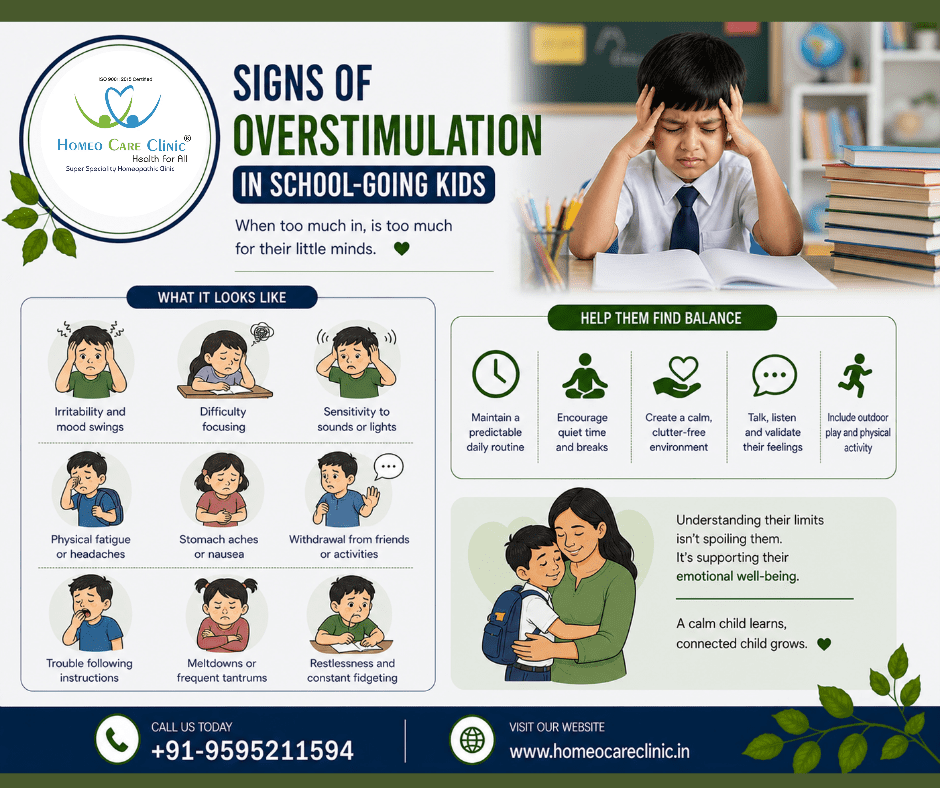
Recognizing the Signs of overstimulation in school-going kids
By the time a child is in elementary school, they have learned to mask some of their distress in public, which means you get the full explosion at home.
- The After-School Restraint Collapse: This is the hallmark sign. They hold their emotions together all day for their teachers, but the absolute second they get in the car or walk through the front door, they unleash pure hell. They cry over the way their sandwich is cut. They pick brutal fights with their siblings.
- Sensory Defensiveness: They suddenly cannot stand things touching them. They rip their socks off because the seam feels “wrong.” They complain that the tag on their shirt is scratching them. They cover their ears and scream if you turn the blender on.
- The “Zombie” Stare: Not every kid explodes; some implode. They come home, drop their bag, and just stare blankly at a wall or a screen. They refuse to answer questions. Their brain is actively shutting doors to block out any new information.
- Physical Somatization: Their sensory overwhelm turns into physical pain. They get tension headaches. They complain of stomach aches every morning before the bus comes because their body is dreading the sensory onslaught of the classroom.
- Hyperactivity and “The Zoomies”: Paradoxically, an overstimulated school kid often speeds up. They run laps around the living room, bounce off the couches, and speak incredibly fast. They are trying to burn off the massive dump of adrenaline their brain just produced.
Recognizing the signs of overstimulated baby (Older Infants/Toddlers)
When a baby is past the newborn stage but still lacks language, their entire body becomes a communication device.
- The Arching Back: This is a huge physical red flag. When you try to hold or feed an overstimulated baby, they will physically fight you. They arch their back rigidly away from your body. They are trying to create space and escape the physical input of being touched.
- Gaze Aversion: They refuse to look at your face. If you lean in to smile at them, they will aggressively turn their head to stare at a blank wall or the floor. They are actively trying to shut off visual input.
- The Unconsoled Scream: This is not the “I am hungry” cry. This is a shrill, hysterical, panicked scream. Even if you offer a bottle, a pacifier, or a diaper change, they just keep screaming because their central nervous system is in a state of panic.
- Clenched Fists and Jerky Movements: Their movements lose all smoothness. They clench their tiny fists until their knuckles are white, and they kick their legs in a frantic, jerky, uncoordinated bicycle motion.
Recognizing the signs of overstimulation in 1 month old Infants
A one-month-old has almost zero coping mechanisms. Their signs are tiny, subtle, and often misread as just normal “baby quirks.” If you miss these subtle signs, the baby will quickly escalate into the unconsoled screaming phase.
- Frequent Hiccups and Sneezing: This sounds strange, but it is deeply neurological. When a newborn’s nervous system is stressed by too much light or noise, it triggers involuntary reflexes. A sudden bout of hiccups or repetitive sneezing in a non-sick one-month-old is a massive sign of sensory stress.
- The Moro Reflex (Startle) on Overdrive: The Moro reflex is when a baby suddenly throws their arms out to the side like they are falling. An overstimulated newborn will exhibit this reflex constantly, even if there is no loud noise. Their nervous system is just constantly jumping.
- Splaying of Fingers and Toes: Instead of resting with softly curled hands, the infant will splay their fingers wide apart, holding their hands up near their face in a stiff, rigid posture.
- Yawning Without Sleepiness: They will yawn repeatedly, but they will not close their eyes to sleep. Yawning is a primal way the brain tries to take in more oxygen to calm the nervous system down.
- Skin Color Changes: In severe overstimulation, you might notice the skin around the newborn’s mouth turning slightly pale or bluish (circumoral cyanosis), or their skin might look mottled and splotchy due to the massive adrenaline spike altering their blood flow.
Conventional Treatment: The Limits of the Standard Approach
So, you realize your child is drowning in sensory input. You take them to a conventional pediatrician or speak to the school counselor. What is the standard advice?
For School-Aged Kids: The Labeling Trap If a school-aged child is constantly melting down, getting aggressive, or shutting down in class, the conventional medical system often rushes to label them. They are frequently misdiagnosed with Attention Deficit Hyperactivity Disorder (ADHD) or Oppositional Defiant Disorder (ODD).
If they get the ADHD label, they are often handed a prescription for a heavy chemical stimulant (like Ritalin or Adderall). And yes, the stimulant might force them to sit still in their chair. But it does absolutely nothing to heal the sensory overwhelm. It just masks it. Drugging a child because the classroom is too loud feels like a massive biological disservice.
For Babies: The “Colic” Dismissal If you bring a screaming one-month-old to a doctor, they will usually check for an ear infection, and if the ears are clear, they will shrug and say, “It’s just colic. They will outgrow it in a few months.”
Telling a severely sleep-deprived, weeping mother to “wait three months” while her baby screams for six hours a night is cruel and unhelpful. It leaves the parents feeling entirely unsupported. Or, worse, they diagnose the baby with silent acid reflux and put a tiny, four-week-old infant on heavy antacid medications, which completely destroys their developing gut microbiome.
Occupational Therapy The one shining light in the conventional world is Pediatric Occupational Therapy (OT). OTs are wizards. They use deep pressure, swinging, and sensory diets to help school-aged kids regulate their bodies. But OT waiting lists are often six to nine months long. Parents need tools to calm their children’s nervous systems today.
Homeopathy Treatment: Repairing the Sensory Filter
This is exactly why families end up sitting in my office, looking completely defeated.
They do not want to drug their eight-year-old. They do not want to put their newborn on acid blockers. They just want their child to feel comfortable in their own skin.
When we deal with sensory overstimulation, homeopathy is profound. We do not use medicine to suppress a child’s personality or force them to be quiet. We use highly diluted, incredibly safe nanomedicines to physically calm the hyper-reactive central nervous system. We help the brain build a better sensory filter.
We look at the exact nature of the meltdown. Does the child get red in the face? Do they weep? Do they hit? Their specific reaction tells us exactly which remedy their unique constitution requires.
Here are 5 medicines from my clinical cabinet that we rely on constantly to treat sensory overstimulation in children and babies.
1. Belladonna
- Indicated for: Sudden, violent meltdowns driven by light and noise, with a flushed red face.
- Best suited for: The school-aged child who goes to a loud birthday party, or a crowded mall, and suddenly completely loses their mind. Their face turns bright, tomato red. Their pupils dilate massively, making their eyes look black. Their meltdown is sudden, explosive, and physical—they might hit, bite, or throw things. The sensory input literally overheated their brain. They cannot stand bright lights or jarring noises.
- Key actions: Belladonna is the ultimate cooling remedy for an overheated, flushed nervous system. It acts rapidly to drop the frantic, pounding intensity, calming the vascular congestion in the head and stopping the violent sensory panic.
2. Nux Vomica
- Indicated for: The cranky, overworked school kid who is hypersensitive to everything.
- Best suited for: The child suffering from severe academic and extracurricular burnout. They are at school, then soccer practice, then piano lessons. They come home completely exhausted but wired. They are incredibly irritable. Every tiny noise annoys them. They complain endlessly about the tags on their shirts or the seams in their socks. They are snappy, bossy, and often suffer from severe constipation because their nervous system is too tense to digest food properly.
- Key actions: Nux Vomica detoxifies an exhausted, overworked sensory system. It acts as a massive reset button, cutting through the extreme, touchy irritability, relaxing the gut, and helping the child finally just crash and achieve deep, restorative sleep.
3. Phosphorus
- Indicated for: The highly sensitive “sponge” who absorbs everyone else’s energy.
- Best suited for: The deeply empathetic, sweet, bright child. They love people. But they have absolutely zero energetic boundaries. If they go to a loud classroom, they absorb the chaotic energy of all thirty kids. They come home completely wired, talking a million miles an hour, and then they crash into a puddle of tears. They jump at sudden noises, they are terrified of the dark, and they often get nosebleeds when they are overstimulated by the summer heat or excitement.
- Key actions: Phosphorus physically strengthens the child’s energetic boundary. It grounds that frantic, scattered energy. It stops them from acting like an emotional sponge in crowded rooms, so they don’t get completely drained and manic.
4. Chamomilla
- Indicated for: The angry, unpleasable baby who screams constantly.
- Best suited for: This is a premier remedy for the signs of overstimulated baby profiles. The baby is furious. They want to be picked up. The literal second you pick them up, they arch their back and want to be put down. They want a toy, you hand it to them, and they throw it. They are incredibly sensitive to physical discomfort, especially teething pain. The only thing that stops the screaming is being carried and walked around briskly. They often have one hot, red cheek and one pale cheek.
- Key actions: Chamomilla immediately cools down raw, hypersensitive pain receptors and nerve endings. It drops the irrational anger and stops the unpleasable screaming, allowing the baby to actually accept comfort and fall asleep.
5. Borax
- Indicated for: The infant with an extreme startle reflex and fear of downward motion.
- Best suited for: This is an absolute lifesaver when you are seeing the signs of overstimulation in 1 month old infants. This baby’s nervous system is incredibly jumpy. If a door shuts down the hall, they don’t just blink; they scream in terror. But the defining symptom is a profound fear of downward motion. If you rock them to sleep in your arms and then try to lower them into their crib, the sensation of moving downwards causes them to throw their arms out in a massive Moro reflex and wake up screaming in pure panic.
- Key actions: Borax specifically calms the exaggerated startle response and the hypersensitivity of the inner ear. It helps the newborn’s nervous system process sudden noises and physical movements without constantly hitting the panic button.
Why Choose Homeo Care Clinic
You cannot treat a fragile, developing nervous system by guessing. Reading a list of symptoms online and randomly giving a baby a remedy is not going to cure profound sensory overload. You need a professional who understands pediatric pathology.
This is exactly why desperate, exhausted parents bring their children into Homeo Care Clinic to sit down with Dr. Vaseem Choudhary.
- Deep Mastery of Pediatric Neurology: Dr. Vaseem Choudhary has been practicing right here in Pune for nearly twenty years. He knows that an eight-year-old having a meltdown is not a discipline problem; it is a sensory crash. He knows exactly how to read the tiny, subtle signs of overstimulation in 1 month old babies. He listens to the parents without judgment and identifies the specific constitutional blockage causing the hyper-reactivity.
- Healing the Gut-Brain Connection: You cannot separate the stomach from the mind. Children who are easily overstimulated almost always have terrible digestion. Babies with severe colic usually have a gut flora imbalance. Older kids get constipated from stress. We treat the digestive tract at the exact same time we treat the sensory anxiety, because a healthy gut creates the serotonin needed for a calm brain.
- Accessible and Calming Clinics: When you have a child who suffers from sensory overload, sitting in a crowded, noisy, chaotic waiting room for two hours is a recipe for a massive meltdown. With established, fully staffed, and welcoming clinics strategically located in Viman Nagar, Hadapsar, and Magarpatta, you can access world-class constitutional care in an environment that respects your child’s sensory boundaries.
- Zero Toxic Chemicals: We absolutely refuse to put a one-month-old on harsh acid blockers or a school-aged kid on heavy psychiatric stimulants to make them compliant. Our nanomedicines are safe, non-toxic, and incredibly gentle. They simply provide the energetic frequency the body needs to heal itself.
The Transformative Benefits of Homeopathy
Why should parents consider this holistic route instead of just riding out the storm and waiting for the child to grow up?
- It Treats the Root, Not the Symptom: If you just use timeouts for a kid who is melting down, you push the sensory anxiety deeper into their body. Homeopathy actually lowers the internal alarm system. When the nervous system is calm, the aggressive or hyperactive behavior naturally disappears.
- It Protects Their Personality: We do not want to numb your child. We want them to remain bright, empathetic, and energetic. Remedies like Phosphorus and Nux Vomica simply remove the static from the radio station, allowing their true, brilliant personality to shine through without the constant interference of sensory pain.
- Deep, Restorative Sleep: An overstimulated brain cannot sleep. It twitches, it wakes up terrified, it refuses to settle. The very first thing parents notice when homeopathic treatment begins is that their child finally sleeps deeply. And a sleeping brain is a healing brain.
- Safe for the Tiniest Patients: Because there is no chemical toxicity or risk of overdose, homeopathy is the absolute safest medical intervention available for a one-month-old infant struggling to adapt to the world.
Lifestyle Adjustments: How to Scaffold the Environment
Homeopathic medicine provides the biological spark to calm the nervous system. But you, the parent, must act as the architect. You have to build the external scaffolding. You cannot give your child a remedy and then drag them to a loud, flashing arcade for three hours.
You have to change how your household operates.
Scaffolding for School-Going Kids
If you are seeing the Signs of overstimulation in school-going kids, you must implement the decompression hour.
- The Silent Car Ride: When you pick them up from school, their brains are fried. Do not interrogate them. Do not ask them what they learned or who they played with. Keep the car ride totally silent. Play soft music. Let them stare out the window.
- The Dark Room Reset: When they get home, do not force them into homework immediately. Give them thirty minutes in a dimly lit room with zero screens. Screens are fast-paced and brightly lit; they do not calm a nervous system, they just hypnotize it. Let them lie on the floor.
- Heavy Work (Proprioception): If they are bouncing off the walls, they need heavy physical input to ground their bodies. Have them push a heavy laundry basket across the floor, or let them jump on a mini-trampoline. Deep pressure tells their joints exactly where their body is in space, which rapidly calms the central nervous system.
Scaffolding for Babies
If you are dealing with the signs of overstimulated baby profiles, or the tiny signs of overstimulation in 1 month old infants, you must become a bouncer for their sensory bucket.
- Dim the Lights: Humans are not meant to live under bright LED lights after the sun goes down. In the evening, turn off the overhead lights. Use warm, dim lamps.
- White Noise: The sudden slam of a door terrifies a baby. A loud white noise machine acts as an auditory blanket. It raises the baseline volume of the room so that sudden noises don’t shock their delicate inner ear.
- Limit the Pass-Around: If you have visitors, do not let them pass your newborn around like a football. Being handed to five different people means processing five different smells, voices, and holding styles. It is too much data. Wear your baby in a wrap against your chest to protect their sensory boundary.
Diet Adjustments for a Calm Brain
A brain that is constantly managing the stress of sensory overload needs premium fuel. You cannot feed a child processed garbage and expect their nervous system to remain calm.
- Stop the Blood Sugar Rollercoaster: An anxious, overwhelmed brain burns through glucose rapidly. If a child eats a bowl of sugary cereal for breakfast, their blood sugar spikes and crashes by 10:00 AM. A blood sugar crash feels exactly like a panic attack to the physical body. Feed them heavy protein—eggs, peanut butter, or meat—to keep their engine running perfectly steady and flat all day long.
- Eliminate Artificial Neurotoxins: Red 40, Yellow 5, and Blue 1 are petroleum-based artificial food dyes. In sensitive children, they act as literal neurotoxins, causing the nervous system to vibrate with frantic, uncontrollable energy. A hyperactive, vibrating child cannot process sensory input safely. Read every label and throw out the neon snacks, the brightly colored drinks, and the cheap candy.
- Massive Omega-3 Support: The myelin sheaths—the protective coating that insulates the nerves in the brain—are largely built out of fat. Give your school-aged child a very high-quality, heavy-metal-free liquid fish oil supplement every single day. It physically insulates the neural pathways, directly reducing sensory overwhelm.
- Magnesium for Muscle Tension: Sensory overload causes massive physical tension. Children clench their jaws and hold their breath when they are overwhelmed. Magnesium is the body’s natural muscle and nerve relaxer. Use a pediatric magnesium spray on the soles of their feet right before bed to help them physically release the tension of the day and achieve deep, restorative sleep.
5 Commonly Asked FAQs
1. Is it my fault my child is so easily overstimulated?
- No. Please let that guilt go immediately.
- While a chaotic household can make things worse, sensory processing is largely genetic and constitutional. You did not break your child; they simply have a nervous system that is wired to pick up more data than the average person.
2. Does a child outgrow sensory overstimulation?
- As the brain matures and the prefrontal cortex develops, their filtering system naturally gets stronger.
- However, highly sensitive children usually grow into highly sensitive adults. The goal is not to “cure” their sensitivity, but to give them the tools, routines, and constitutional support they need to manage it without melting down.
3. Is my overstimulated baby actually showing early signs of autism?
- Not necessarily.
- An infant crying at loud noises or bright lights is a completely normal biological reaction to a totally new world. Autism is a complex neurodevelopmental difference diagnosed much later. Do not jump to terrifying conclusions; your baby just needs a quieter environment right now.
4. How fast does the homeopathic medicine work for a sudden sensory meltdown?
- For acute, explosive meltdowns (like administering Belladonna after a loud birthday party), it can act incredibly rapidly, sometimes calming the child’s frantic physical state in a matter of minutes.
- Deep constitutional healing to raise their baseline tolerance for sensory input takes a few months of consistent treatment.
5. Should we just stop taking our child to crowded places?
- No, complete avoidance makes the anxiety worse in the long run.
- You must provide a solid, predictable routine, but gently and consistently expose them to the world in small, manageable doses. Put noise-canceling headphones on them in the grocery store. Limit the trip to twenty minutes. Accommodate their needs, but do not lock them in a dark house forever.
Conclusion: Turning Down the Volume
So here is the final takeaway.
Watching your child completely collapse under the weight of the world is a uniquely exhausting brand of parenting. It breaks your heart to see your school-aged child screaming in the car, and it fills you with profound anxiety when you watch your tiny baby arching their back and weeping in terror at the grocery store.
But when you finally step back and truly understand the biology behind the Signs of overstimulation in school-going kids, the chaos starts to make sense. You realize that your child is not trying to be difficult. They are not acting out to manipulate you. They are simply a tiny human whose internal alarm system is ringing, desperately searching for an anchor in a storm of noise and light.
When you learn to read the subtle signs of overstimulation in 1 month old infants, and you recognize the physical distress in the signs of overstimulated baby profiles, you change your entire approach. You stop viewing their crying as a behavioral flaw, and you start viewing it as a biological cry for a quieter room.
You don’t have to just suffer through the daily, violent meltdowns. You don’t have to watch your child miss out on the joy of childhood because they are paralyzed by the sensory load. And you definitely don’t have to resort to heavy psychiatric drugs just to get them to sit still in a classroom.
You can change how you structure your afternoons. You can dim the lights. You can clean up their diet to stop the blood sugar panic. And by bringing them into Homeo Care Clinic for a deep, constitutional reset with Dr. Vaseem Choudhary, you can actually give their fragile nervous system the exact biological push it needs to turn down the volume.
They have a beautiful, brilliant personality trapped underneath all that sensory static. They just need to feel safe enough to let it out. Be patient, build the routine, give their body the right support, and watch them finally take a deep, calm breath. You’ve got this.
“Your health deserves more than temporary relief. Choose homeopathy for lasting results”
Start your journey towards better focus today.
About the Author Bio:
Dr. Vaseem Choudhary M.D is a seasoned classical homeopath with over 16+ years of experience, dedicated to treating patients with compassion, precision and holistic care. Mainly in Pune & Mumbai, serving both national and international patients from UK, USA, Germany, France, Canada, Bhutan, Dubai and China. With a wide range of acute and chronic conditions—from skin disorders, hormonal issues, and digestive problems to autoimmune diseases and mental health concerns.
Dr. Vaseem is widely respected for his unique approach that combines classical homeopathy, personalized diet planning, lifestyle guidance, and a spiritual perspective on healing. He is known for his detailed and empathetic case-taking process, which focuses on treating the root cause rather than just symptoms.
In recognition of his dedication and clinical excellence, Dr. Vaseem Choudhary MD has been honored with the Best Homeopathic Doctor in Pune award by leading platforms such as:
- Awarded for International Excellence in Autism & ADHD Treatment 2026 in UK Parliament, London
- Dr. Vaseem Choudhary honoured at the UK Parliament, receiving International recognition PG from the London College of Homeopathy 2026
- Dr. Vaseem Choudhary, MD, was further acknowledged in Dubai in 2026 for his expertise in Autism and ADHD, reinforcing his growing international recognition in this field
- Best Homeopathy Doctor in Pune – National Healthcare Service Excellence Awards 2024
- Most Trusted Centre for Autism and ADHD in India 2025 – Healthcare Excellence & Leadership Awards
- Best Homeopathy Doctor in Pune – Dr. Vaseem Choudhary Shines at Ayush 2nd International Conference, Dubai
- Recognized for spearheading homeopathic treatment protocols, improving patient satisfaction, and healthcare advancements.
He is also a contributing author to the International Journal of Homeopathy and Natural Medicines (IJHNM), where he shares his research and clinical experiences with the global medical community.
With a passion to take homeopathy to new heights, Dr. Vaseem continues to guide patients towards natural, safe, and sustainable healing.
Homeo Care Clinic offers a holistic approach to treating the disease. The remedies mentioned above can treat the underlying causes of the condition and offer relief from the discomfort. However, it is important to consult a qualified homeopathic practitioner for the correct dosage and duration of treatment. Homeo Care Clinic provides comprehensive care for various ailments, and offers customized treatment plans based on individual requirements.
To schedule an appointment or learn more about our treatment, please visit our website or give us a call +91 9595211594 our best homeopathy doctor will be here to help.
Follow us on Facebook, Twitter and Instagram for valuable insights into the world of homeopathy and holistic health.
- Facebook– https://www.facebook.com/homeocareclinicpune
- Instagram– https://www.instagram.com/homeocareclinic_in
- Website– https://linktr.ee/homeocareclinic
- Success Stories of Patients –https://www.homeocareclinic.in/category/case-study/
- Patient Testimonials – https://www.homeocareclinic.in/testimonial/
Chat with a best homeopathic doctor privately:
If you have any queries regarding your disease or any symptoms, click to send a What‘s App message. Our best homeopathy doctor will be happy to answer you. About Us Click
Book an Appointment:
If you want to visit our clinic, click to book an appointment.
Online treatment:
If you are a busy professional, or you are living in a remote town or city, with no best homeopathic doctor near you, Click to start an online homeopathic treatment with the world’s exclusive, most experienced and best homeopathic clinic, managed by Dr. Vaseem Choudhary world-renowned homeopathic doctor expert
- About Us – https://www.homeocareclinic.in/about-us/
- Our Doctors –https://www.homeocareclinic.in/team/