

I was at a neighborhood park recently, sitting on a bench with a cup of coffee, just watching the absolute theater that is a toddler playground.
In the sandbox, there were two little boys. They were both around two and a half years old. They were sitting exactly six inches apart. One boy was intensely digging a hole with a bright yellow plastic shovel. The other boy was methodically filling a green bucket with sand and then dumping it out.
They sat there for twenty minutes. They never made eye contact. They never spoke a single word to each other. They didn’t share tools.
Suddenly, the mother of the boy with the bucket rushed over, looking totally embarrassed. She nudged her son and whispered loudly, “Say hi to your new friend! Why don’t you guys build a castle together? Share your bucket!”
The boy looked up, completely confused, clutched his green bucket to his chest, and started to cry. The “playdate” was officially ruined.
I see this exact scenario play out constantly. Parents are absolutely terrified that their toddlers are anti-social. They watch their kids completely ignore other children at the park, and they immediately jump to the worst possible conclusions. They start frantically googling developmental milestones, worried that their child lacks empathy, lacks social skills, or is showing early signs of a severe neurodevelopmental delay.
We are obsessed with forcing tiny children to act like miniature adults. We want them to shake hands, collaborate, and share everything they own. But that is not how a developing human brain actually works. The transition from playing entirely alone to playing collaboratively is a massive, complicated neurological bridge that takes years to build.
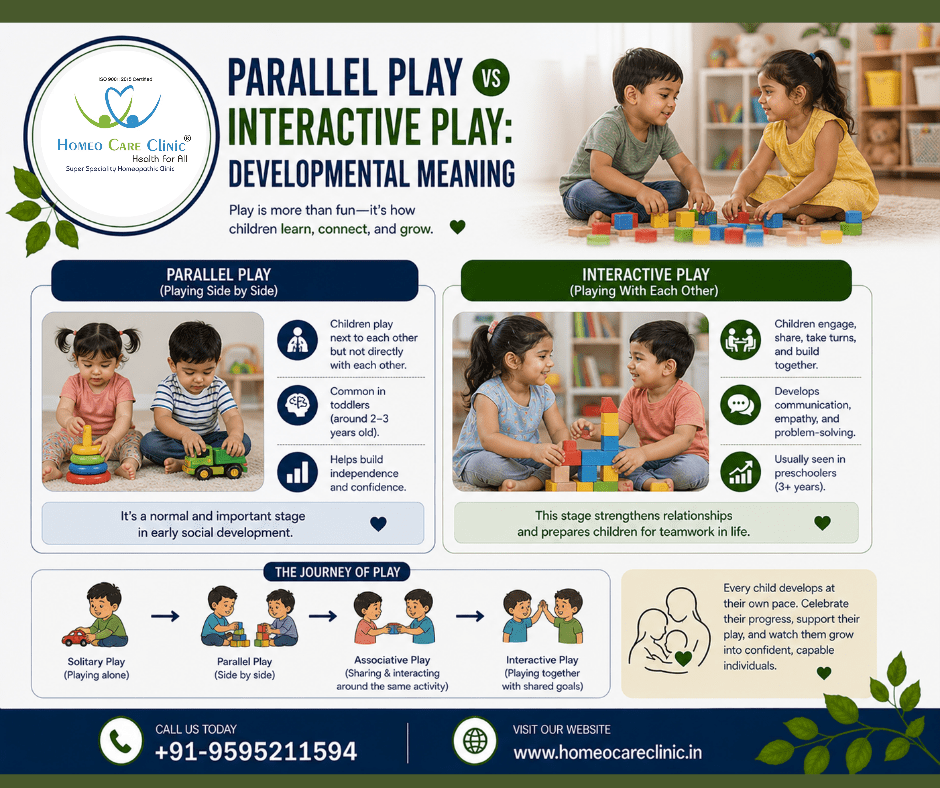
Parents sit in my clinic, exhausted and worried, asking me to explain the Parallel play vs interactive play: developmental meaning. They want to know if their child is normal, or if they need to intervene.
So let’s sit down and demystify the sandbox. Let’s look at what is actually happening inside your toddler’s brain when they ignore the kid sitting next to them. We are going to explore the definitions, the vital importance of these stages, what the actual red flags for a social delay look like, and how we can use constitutional homeopathy to gently support a child who is genuinely stuck and struggling to connect with the world around them. Grab a large cup of coffee. We have a lot of ground to cover.
Breaking Down the Stages: What is parallel play in child development?
To understand why your child is playing the way they are, you have to understand the blueprint of human social development. Back in the 1930s, a sociologist named Mildred Parten observed children and categorized play into six distinct stages. A child’s brain has to move through these stages in order; you cannot skip steps.
When parents ask me, what is parallel play, I tell them to imagine being at a coffee shop. You are sitting at a table typing on your laptop. A stranger is sitting at the table next to you, also typing on their laptop. You are sharing the same space. You might occasionally glance over to see what kind of computer they have. You are existing in parallel. But you are not co-writing a novel together.
That is exactly what a two-year-old is doing.
The parallel play meaning is simply when children play adjacent to each other, using similar toys or playing in a similar manner, but they do not try to influence or modify each other’s behavior. They are playing beside each other, not with each other.
This usually peaks between the ages of two and three.
The Bridge: The difference between parallel play and associative play
As the brain matures, the child crosses a bridge. They move from parallel play into associative play, and finally into interactive (or cooperative) play.
The difference between parallel play and associative play is all about acknowledging the other person’s existence.
- In Parallel Play (Age 2-3): The child is completely focused on their own toy. The other child is basically just a piece of moving furniture in the room.
- In Associative Play (Age 3-4): The children are doing the same activity, and they finally start talking to each other. They might swap toys. “Here, you use the red crayon, I want the blue one.” But there is still no common goal. They are just interacting while doing their own separate things.
- In Interactive / Cooperative Play (Age 4-5+): This is the final stage. The children are working together toward a shared goal. They are building a fort together. They are playing “House” where one is the mom and one is the baby. There are rules, compromises, and true social negotiation.
The Vital Importance: Parallel play benefits
Before we talk about delays, we have to respect the process. You should never try to force a two-year-old out of parallel play. There are massive, neurologically crucial parallel play benefits that have to occur before a child can ever learn to truly collaborate.
1. The Illusion of Safety Toddlers are easily overwhelmed by the world. Interacting with another human being requires a massive amount of mental energy—you have to read their face, guess what they are going to do next, and protect your own toys. Parallel play allows a child to safely observe another child from a close distance without the intense pressure of having to engage. They are learning how other people operate from the safety of their own little bubble.
2. Mirroring and Skill Acquisition During this stage, a child’s mirror neurons are firing rapidly. They are watching the kid next to them. If the other kid figures out how to make a sandcastle using a plastic cup, your child is watching, learning, and will likely try to copy that exact action five minutes later. They are stealing data.
3. Boundary Establishment Before you can share, you have to understand ownership. Parallel play is where kids learn “this is my space, and that is your space.” It builds the concept of self vs. other, which is the foundational building block for empathy later in life.
The Causes of a Stalled Engine: When They Get Stuck
Parallel play is perfectly healthy at age two. But what happens when your child is four or five years old, and they still refuse to look at or interact with other children? What happens when they are physically at the playground, but socially living on an isolated island?
When a child’s social development stalls out, there are usually deep, underlying biological or environmental causes.
Severe Sensory Overload A child with Sensory Processing Disorder (SPD) or autism often finds the world terrifyingly loud and bright. A playground full of screaming, unpredictable children is an absolute nightmare for their nervous system. They retreat into solitary or rigid parallel play not because they don’t want friends, but because interacting is physically painful and overwhelming to their senses. They play alone to survive the noise.
Extreme Anxiety and Shyness Some kids are just wired with a highly sensitive, anxious constitution. The thought of walking up to another child and saying “Can I play?” causes them to feel actual physical panic. Their heart races, their stomach hurts, and they freeze. They hover on the edges of the group, desperately wanting to join in, but paralyzed by the fear of rejection or unpredictability.
Lack of Exposure (The Pandemic Effect) We are still seeing the massive fallout from the 2020-2021 lockdowns. Children born during that time were kept in sterile bubbles. They did not experience normal, chaotic toddler friction. They didn’t go to music classes or crowded parks. Their brains simply did not get the repetitions required to build the neural pathways for associative and cooperative play. They are physically four years old, but socially they are acting like two-year-olds because they lack the data.
Speech and Language Delays If a child cannot articulate their thoughts, entering into interactive play is incredibly frustrating. Cooperative play requires constant verbal negotiation (“You be the dog, I’ll be the cat”). If a child has apraxia or a severe speech delay, they quickly learn that trying to play with others just leads to being misunderstood. They retreat into silent, parallel play because it is easier and less humiliating than trying to talk.
Signs and Symptoms: Identifying a True Social Delay
How do you know if your child is just a normal, independent toddler, or if they are genuinely struggling with a social developmental delay? You have to look at the nuance of their behavior, especially as they cross the three-and-a-half to four-year-old mark.
The Green Flags (Normal Independence)
- They play happily by themselves but will look up and smile if you call their name.
- They occasionally bring you a toy to show you what they built.
- They watch other children intently, even if they don’t join in.
- If another child hands them a toy, they accept it or acknowledge it, even if they don’t start a full game together.
The Red Flags (Symptoms of a Blocked Nervous System)
- Total Apathy to Peers: They do not seem to register that other children even exist. If another child bumps into them or tries to talk to them, they look right through them as if they are a ghost.
- Aggressive Guarding: They become violently territorial over their space. If another child even steps within five feet of their play area, they scream, hit, or throw things to protect their absolute isolation.
- Rigid, Scripted Play: They don’t use imagination. They line up their cars in a perfectly straight row. If you move one car, they suffer a catastrophic, hour-long meltdown. Their play is not about joy; it is about rigid control.
- No Joint Attention: If an airplane flies overhead and makes a loud noise, they do not point at it and look back at you to see if you heard it too. They are completely locked inside their own internal world.
Conventional Treatment: The Grind of Modern Therapy
When a parent finally voices their concerns to a pediatrician—usually right around the preschool transition when the child’s lack of interactive play becomes painfully obvious—the conventional medical machine kicks into gear.
The “Wait and See” Approach For children under three, many pediatricians will simply dismiss the parent’s anxiety. They will say, “He’s just an independent boy, let him be.” While we shouldn’t panic over normal parallel play, telling a parent to wait a year while a child’s brain is in its most plastic, critical developmental window is incredibly frustrating.
Occupational and Speech Therapy If a delay is formally diagnosed, the child is sent to therapy. A good pediatric occupational therapist (OT) is worth their weight in gold. They help the child regulate their sensory system so the playground isn’t so terrifying. Speech therapists help give the child the vocabulary they need to negotiate play.
Social Skills Groups and ABA Often, children are placed in structured social skills groups or subjected to Applied Behavior Analysis (ABA). While these can be helpful, the conventional approach sometimes focuses too heavily on forcing the behavior. They will force a child to make eye contact or use a token system to reward them for sharing a toy.
The problem with this approach is that it treats the symptom, not the root cause. If a child is refusing to play cooperatively because their nervous system is paralyzed by anxiety, bribing them with a sticker to share a truck does not cure the anxiety. It just teaches them to mask their discomfort to please the adult. We want the child to want to play, not just act like a trained seal.
Homeopathy Treatment: Unlocking the Social Brain
This is the exact point where parents walk into my clinic. They are exhausted by the therapies. They are heartbroken watching their child stand alone on the edge of the playground while all the other kids run around together. They know their child is smart, but they see that their child’s nervous system is totally blocked.
We do not use homeopathy to force a child to be an extrovert. If your child is naturally an introvert who prefers quiet play, that is a beautiful personality trait that should be protected.
But if your child is trapped in isolation due to fear, sensory overload, or developmental sluggishness, constitutional homeopathy can be the key that unlocks the door. We use highly diluted, incredibly safe nanomedicines to treat the physiological roots of the social anxiety. We calm the buzzing static in their brain. When a child’s internal environment feels safe, their natural, biological drive to connect with other humans naturally boots up.
Here are 5 medicines from my clinical cabinet that we rely on constantly to help children transition through the complex stages of social development.
1. Baryta Carbonica
- Indicated for: Severe developmental sluggishness and profound, hiding shyness.
- Best suited for: The child who just seems undeniably “behind” their peers in every aspect of maturity. They are usually physically smaller and catch colds constantly, often suffering from hugely swollen tonsils. But the defining feature is the absolute, paralyzing shyness. If a stranger says hello, they physically hide behind their mother’s legs and bury their face. They lack any confidence in their own abilities. They stay in solitary or parallel play way past the normal age simply because they feel entirely inadequate and terrified of being evaluated by other kids.
- Key actions: Baryta Carb acts deeply on the glandular system and the brain to mature a stunted nervous system. It pushes the child out of that infantile, fearful stage, building real internal grit and confidence so they aren’t afraid to step into the sandbox with the big kids.
2. Natrum Muriaticum
- Indicated for: The quiet, isolated, intensely observant child who holds grudges.
- Best suited for: This child is highly intelligent and their language skills are usually excellent, but they refuse to engage. They are the ultimate “onlooker” player. They will stand on the edge of the playground for an hour, intensely studying how the other kids play, but they will never join in. They are deeply emotional but hide it behind a massive, invisible wall. They hate being comforted; if they cry, they want to be left alone. They take perceived insults very seriously. If a child didn’t share with them a year ago, they still remember and will refuse to play with that child today.
- Key actions: Natrum Mur safely dismantles the defensive emotional fortress the child has built. It softens their intense fear of rejection and humiliation, allowing them to realize that minor social friction is safe, helping them transition into true interactive play.
3. Pulsatilla Nigricans
- Indicated for: The clingy, weeping child who wants to play but is too afraid to leave Mom.
- Best suited for: This is the child who desperately wants friends. They point at the other kids playing tag and smile. But the absolute second you try to encourage them to go join in, they panic, wrap their arms around your leg, and start weeping. Their mood is incredibly changeable. They are deeply dependent and crave constant physical affection. They usually hate stuffy rooms and feel much better in the open air. They whine instead of using their strong voice.
- Key actions: Pulsatilla deeply grounds a needy, dependent nervous system. It takes away the desperate panic of separation, helping to build a sense of internal security so the child can confidently leave the parent’s side and enter into cooperative play without feeling abandoned.
4. Calcarea Carbonica
- Indicated for: The slow-moving, stubborn, easily overwhelmed child.
- Best suited for: The classic “Calc Carb” child is usually a bit chunky, fair, and methodical. They sweat heavily on the back of their neck when they sleep. They prefer parallel play because they need absolute control over their environment. They are very slow to adapt. If they are building a block tower, and a fast, hyperactive child runs over and tries to “help,” the Calc Carb child will become completely overwhelmed, incredibly stubborn, and shut down entirely. They are terrified of chaos and fast-moving situations.
- Key actions: It supports overall bone, muscle, and nerve development. It gives the physical body stamina and softens that intense, immovable rigidity, helping the child become more flexible and willing to adapt to the unpredictable nature of interactive group play.
5. Lycopodium Clavatum
- Indicated for: The bossy, arrogant child who refuses to compromise in play.
- Best suited for: This child does not have a problem interacting; they have a problem cooperating. They are tiny dictators. They want to play “House,” but only if they get to be the boss, assign all the roles, and make all the rules. If another child suggests a different way to play, the Lycopodium child will throw a massive tantrum, yell at them, and storm off to play by themselves. They act incredibly arrogant and dominant with their peers or parents, but it is actually a mask covering deep internal insecurity and a fear of failure.
- Key actions: Lycopodium treats the hidden cowardice and insecurity. Once the child actually feels internally secure, they stop needing to violently dictate the terms of play. It allows them to learn how to compromise, share power, and engage in true, healthy cooperative play without feeling threatened.
Why Choose Homeo Care Clinic
You cannot fix a complex social delay by reading advice columns and guessing which remedy to buy at the health food store. A child’s developing brain is too delicate for a trial-and-error approach.
This is exactly why anxious parents bring their children to Homeo Care Clinic to sit down with Dr. Vaseem Choudhary.
- Mastery of Pediatric Behavior: Dr. Vaseem Choudhary has been practicing in Pune for nearly two decades. He has seen the entire spectrum of pediatric development. He knows how to differentiate between a child who is just enjoying the normal stages of Parallel play vs interactive play: developmental meaning and a child whose nervous system is genuinely stalled. He doesn’t judge the parents, and he doesn’t label the child unnecessarily.
- Treating the Physical Roadblocks: A child who is trapped in a state of social anxiety almost always has physical symptoms. They suffer from chronic constipation, terrible sleep regressions, or constant ear infections. The mind and the body are one unit. We treat the sluggish digestion at the exact same time we treat the shyness, because a healthy gut creates a calm, socially engaged brain.
- Accessible and State-of-the-Art: When you have a child who struggles with social anxiety, sitting in a crowded, chaotic waiting room for two hours is a nightmare. With established, fully staffed, and welcoming clinics strategically located in Viman Nagar, Hadapsar, and Magarpatta, you can access world-class constitutional care in an environment that respects your child’s sensory needs.
- Zero Harmful Chemicals: We absolutely refuse to use heavy sedatives or harsh psychiatric medications on a developing brain just to make a child more “social.” Our nanomedicines are safe, non-toxic, and incredibly gentle. They simply provide the energetic frequency the body needs to hit the reset button.
The Transformative Benefits of Homeopathy
Why should parents consider this holistic route instead of just relying entirely on behavioral therapies?
- It Treats the Fear, Not Just the Action: If you force a terrified child to share a toy, they learn to suppress their feelings. Homeopathy actually lowers the internal fear of the other child. When the fear is gone, sharing becomes a natural, joyful choice rather than a forced obligation.
- It Builds Real Confidence: Remedies like Baryta Carb and Lycopodium do not change a child’s personality; they remove the insecurity blocking their potential. The child suddenly feels brave enough to say, “Can I play with you?”
- No Rebound Anxiety: When you stop the homeopathic treatment after the constitution has healed, the child does not regress. The neural pathways for social interaction have been successfully built and the healing is permanent.
- Improves the Entire Family Dynamic: When a child transitions from rigid, aggressive parallel play to happy, cooperative play, the stress level in the entire house drops. Siblings stop fighting as much. Parents can finally relax at the playground instead of constantly hovering.
Lifestyle Adjustments: How to Scaffold the Bridge
Homeopathic medicine provides the biological spark to calm the nervous system. But you, the parent, must act as the architect. You have to build the bridge from parallel to interactive play. You cannot just throw them in a sandbox and expect a miracle.
- Stop Forcing It: The absolute worst thing you can do is force a child to share before their brain is ready. If they are in the parallel stage, protect their space. If another child grabs their toy, intervene and say, “He is playing with that right now. You can have a turn when he is done.” When a child trusts that you will protect their boundaries, they feel safe enough to eventually open up.
- Sportscast the Play: You need to become an announcer. Sit near them while they are in parallel play with another child and narrate what is happening without forcing interaction. “Wow, Leo is building a tall tower. And you are digging a deep hole. You are both working so hard in the sand.” You are verbally linking them together in the same space without demanding they collaborate.
- Parallel Play with Adults: Get down on the floor. Do not try to take over their game. If they are coloring, get your own piece of paper and color next to them. Let them experience the quiet, safe joy of shared space with an adult they trust before expecting them to do it with an unpredictable toddler.
- The Associative Bridge (Trading): When they seem ready, introduce the concept of trading, not sharing. “Sharing” means giving something up and getting nothing back, which terrifies toddlers. “Trading” makes sense. “I see you have the blue car. I have the red car. Do you want to trade for one minute?”
Diet Adjustments for a Social Brain
A brain that is attempting to build massively complex social neural pathways needs premium construction materials. A poor diet leads directly to a cranky, anti-social, dysregulated child.
- Massive Omega-3 Support: The prefrontal cortex—the part of the brain responsible for empathy, sharing, and impulse control—is largely built out of fat. Give your child a very high-quality, heavy-metal-free liquid fish oil supplement every single day. It physically insulates the neural pathways, reducing sensory overwhelm.
- Stop the Blood Sugar Crashes: An anxious, overwhelmed brain burns through glucose rapidly. If a child eats a bowl of sugary cereal, their blood sugar spikes and crashes. A blood sugar crash feels like a panic attack. A panicking child will never engage in cooperative play; they will just fight. Feed them heavy protein in the morning—eggs, peanut butter, or meat—to keep their engine running perfectly steady.
- Eliminate Artificial Neurotoxins: Red 40, Yellow 5, and Blue 1 are petroleum-based artificial food dyes. In sensitive children, they act as literal neurotoxins, causing the nervous system to vibrate with frantic, uncontrollable energy. A hyperactive, vibrating child cannot focus long enough to negotiate interactive play. Read every label and throw out the neon snacks.
- Magnesium for Muscle Tension: Social anxiety causes massive physical tension. Children clench their jaws and hold their breath when they are nervous around peers. Magnesium is the body’s natural muscle and nerve relaxer. Use a pediatric magnesium spray on the soles of their feet right before bed to help them physically release the tension of the day and achieve deep, restorative sleep.
5 Commonly Asked FAQs
1. Is it a sign of autism if my four-year-old prefers to play alone?
- Not automatically. Some highly intelligent, introverted children simply prefer their own rich, internal imagination over the chaotic play of other kids.
- It only becomes a red flag for autism if the solitary play is accompanied by a complete lack of eye contact, an inability to communicate their needs, intense repetitive physical movements, and severe rigidity if their routine is changed.
2. Should I intervene if my child is playing in parallel and another kid steals their toy?
- Yes. You must act as their prefrontal cortex.
- Calmly step in and say to the other child, “We are playing with this right now. I will let you know when we are done.” By protecting your child’s boundary, you teach them that the social world is safe and fair, which lowers their anxiety for future interactions.
3. Does putting a child in daycare early force them to learn interactive play faster?
- No. You cannot force brain development.
- Putting a one-year-old in a room with ten other one-year-olds just creates a room full of children engaging in parallel play. True interactive play requires neurological maturity (usually around age four), regardless of how early they are exposed to large groups.
4. How long does the homeopathic treatment take to show results in a child’s social behavior?
- It is not an overnight magic pill. You are rebuilding a constitution.
- Usually, within the first three to four weeks of a well-chosen remedy, parents notice the child sleeps deeper, seems less anxious, and throws fewer tantrums. The actual transition into confident, cooperative play usually builds steadily over a few months of consistent treatment.
5. How do I deal with my in-laws or friends who judge my child for not sharing?
- You must be a fierce advocate for your child’s developmental stage.
- Politely but firmly tell them, “He is still in the parallel play stage. He is learning how to protect his boundaries right now, and we are not forcing him to share until he feels ready.” Do not let other adults shame your child for normal brain development.
Conclusion: Honoring the Journey
So here is the final takeaway.
Raising a child is a terrifying, beautiful, chaotic journey, and it is entirely normal to feel a spike of anxiety when you watch your child sitting alone in a sandbox while the rest of the kids are building a castle together.
But when you finally step back and truly understand the reality of Parallel play vs interactive play: developmental meaning, you can let out a massive sigh of relief. You realize that learning what is parallel play is the key to unlocking your own parental peace. The parallel play meaning is not isolation; it is preparation. It is the vital, necessary foundation where they learn how to exist in the world.
When you learn what is parallel play in child development, and you recognize the profound parallel play benefits, you stop rushing them. You stop apologizing to the other moms at the park. You understand the subtle difference between parallel play and associative play, and you simply act as the gentle architect, waiting for them to be ready to cross the bridge.
And if they get stuck on the bridge? If the fear, the sensory overload, or the developmental sluggishness is holding them back from experiencing the joy of true friendship? You don’t have to just watch them suffer on the sidelines.
You can change their diet. You can change how you scaffold their playdates. And by bringing them into Homeo Care Clinic for a deep, constitutional reset with Dr. Vaseem Choudhary, you can actually give their fragile nervous system the exact biological push it needs to clear the static.
They have a beautiful, brilliant personality waiting to be shared with the world. They just need to feel safe enough to open the door. Be patient, give their body the right support, and watch them bloom on their own timeline. You’ve got this.
“Your health deserves more than temporary relief. Choose homeopathy for lasting results”
Start your journey towards better focus today.
About the Author Bio:
Dr. Vaseem Choudhary M.D is a seasoned classical homeopath with over 16+ years of experience, dedicated to treating patients with compassion, precision and holistic care. Mainly in Pune & Mumbai, serving both national and international patients from UK, USA, Germany, France, Canada, Bhutan, Dubai and China. With a wide range of acute and chronic conditions—from skin disorders, hormonal issues, and digestive problems to autoimmune diseases and mental health concerns.
Dr. Vaseem is widely respected for his unique approach that combines classical homeopathy, personalized diet planning, lifestyle guidance, and a spiritual perspective on healing. He is known for his detailed and empathetic case-taking process, which focuses on treating the root cause rather than just symptoms.
In recognition of his dedication and clinical excellence, Dr. Vaseem Choudhary MD has been honored with the Best Homeopathic Doctor in Pune award by leading platforms such as:
- Awarded for International Excellence in Autism & ADHD Treatment 2026 in UK Parliament, London
- Dr. Vaseem Choudhary honoured at the UK Parliament, receiving International recognition PG from the London College of Homeopathy 2026
- Dr. Vaseem Choudhary, MD, was further acknowledged in Dubai in 2026 for his expertise in Autism and ADHD, reinforcing his growing international recognition in this field
- Best Homeopathy Doctor in Pune – National Healthcare Service Excellence Awards 2024
- Most Trusted Centre for Autism and ADHD in India 2025 – Healthcare Excellence & Leadership Awards
- Best Homeopathy Doctor in Pune – Dr. Vaseem Choudhary Shines at Ayush 2nd International Conference, Dubai
- Recognized for spearheading homeopathic treatment protocols, improving patient satisfaction, and healthcare advancements.
He is also a contributing author to the International Journal of Homeopathy and Natural Medicines (IJHNM), where he shares his research and clinical experiences with the global medical community.
With a passion to take homeopathy to new heights, Dr. Vaseem continues to guide patients towards natural, safe, and sustainable healing.
Homeo Care Clinic offers a holistic approach to treating the disease. The remedies mentioned above can treat the underlying causes of the condition and offer relief from the discomfort. However, it is important to consult a qualified homeopathic practitioner for the correct dosage and duration of treatment. Homeo Care Clinic provides comprehensive care for various ailments, and offers customized treatment plans based on individual requirements.
To schedule an appointment or learn more about our treatment, please visit our website or give us a call +91 9595211594 our best homeopathy doctor will be here to help.
Follow us on Facebook, Twitter and Instagram for valuable insights into the world of homeopathy and holistic health.
- Facebook– https://www.facebook.com/homeocareclinicpune
- Instagram– https://www.instagram.com/homeocareclinic_in
- Website– https://linktr.ee/homeocareclinic
- Success Stories of Patients –https://www.homeocareclinic.in/category/case-study/
- Patient Testimonials – https://www.homeocareclinic.in/testimonial/
Chat with a best homeopathic doctor privately:
If you have any queries regarding your disease or any symptoms, click to send a What‘s App message. Our best homeopathy doctor will be happy to answer you. About Us Click
Book an Appointment:
If you want to visit our clinic, click to book an appointment.
Online treatment:
If you are a busy professional, or you are living in a remote town or city, with no best homeopathic doctor near you, Click to start an online homeopathic treatment with the world’s exclusive, most experienced and best homeopathic clinic, managed by Dr. Vaseem Choudhary world-renowned homeopathic doctor expert
- About Us – https://www.homeocareclinic.in/about-us/
Our Doctors –https://www.homeocareclinic.in/team/