

I had a twenty-eight-year-old architect sit across from my desk last Tuesday morning. She was incredibly sharp, highly successful, and completely exhausted. She had dark circles under her eyes that no amount of concealer could hide.
She pulled out her phone, her hands shaking slightly, and showed me an email she had sent to her boss the previous afternoon. It was a perfectly standard, professional update about a project deadline. But at the very end, she had made a tiny, microscopic typo. She had typed “regards” instead of “Regards” with a capital R.
She looked at me, tears welling up in her eyes, and said, “I noticed the typo at 6:00 PM yesterday. It is now 10:00 AM the next day. I have not slept. I spent the entire night staring at the ceiling, playing out a hundred different scenarios. I convinced myself that my boss is going to think I am sloppy, that I am going to be fired, that I won’t be able to pay my rent, and that I am going to end up homeless. I feel like my heart is going to beat out of my chest.”
She paused, took a ragged breath, and asked the question that millions of people are desperately searching for online every single day: “Am I just a chronic overthinker, or am I actually losing my mind to an anxiety disorder? I don’t know the difference anymore.”
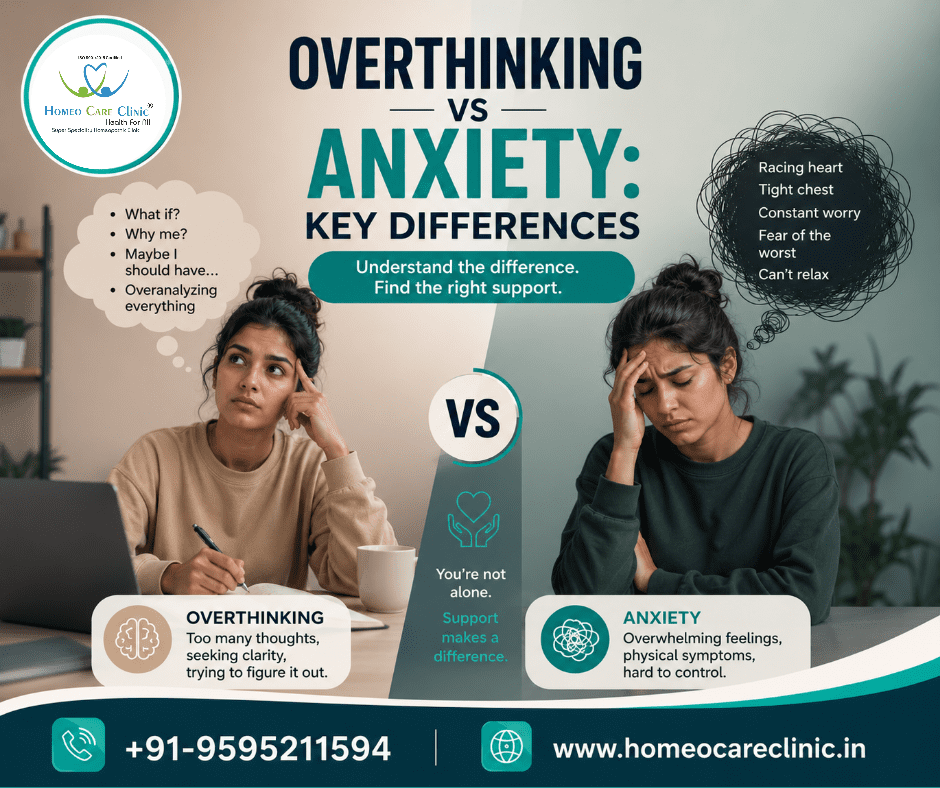
This is the hidden, agonizing reality of modern life. We live in an era where our brains are constantly processing an unnatural amount of data, and the lines between a busy mind and a clinical pathology have become incredibly blurred. People are desperate to understand the Overthinking vs anxiety: key differences because they feel like they are trapped in a mental prison, running on a hamster wheel that they cannot figure out how to stop.
The debate of overthinking vs anxiety is not just an academic discussion for psychiatrists. It is a daily, brutal reality for anyone who has ever stared at a ceiling at 3:00 AM, entirely paralyzed by their own thoughts.
So let’s sit down and pull the curtain back on this entirely modern psychological epidemic. We are going to look at the brutal biological mechanics of the human brain, dissect the exact differences between a thought loop and a panic disorder, explore why conventional medicine often dismisses this pain, and look at how we can use deep, constitutional homeopathy to turn the volume down in your head. Grab a massive cup of coffee. We have a mountain to climb today.
The Core Problem: Defining the Boundaries
To understand what is happening inside your skull, we have to establish the baseline definitions. The medical and psychological community treats these two concepts differently, even though they feel identical to the person suffering.
What is Overthinking? Overthinking (clinically referred to as rumination) is a cognitive process. It is a thought pattern. Your brain latches onto a specific event—something you said at a party, an email you sent, or a decision you have to make—and it refuses to let it go. You analyze the event from every conceivable angle. You replay the conversation fifty times, trying to decipher the exact tone of voice someone used.
Overthinking is like a car stuck in the mud, spinning its wheels. It uses a massive amount of mental energy, but it does not move you forward. However, it is primarily confined to the mind. You might feel frustrated and mentally exhausted, but you are not necessarily in a state of biological terror.
What is Clinical Anxiety? Anxiety is not just a thought process; it is a full-body biological alarm system. It is a physiological state. While overthinking is a car spinning its wheels, anxiety is a car whose engine has caught on fire.
Anxiety involves the amygdala—the primitive, survival center of the human brain. When you have an anxiety disorder, your brain perceives a non-lethal threat (like a typo in an email) and reacts exactly as if a tiger just walked into the room. It dumps massive amounts of adrenaline and cortisol into your bloodstream. Your heart races, your digestion shuts down, your muscles tense, and you experience a visceral, terrifying sense of impending doom.
The core of understanding Overthinking vs anxiety: key differences is this: Overthinking is something you do; anxiety is something you feel in your physical tissues.
The Causes: Why Does the Brain Loop and Panic?
To fix the exhaustion, you have to understand exactly why your brain decided that overanalyzing everything was the best way to survive the world. The roots of both rumination and clinical anxiety are complex, combining biology, modern environment, and childhood conditioning.
The Illusion of Control and Perfectionism
For many people, overthinking begins as a misguided survival strategy. If you grew up in a chaotic household, or if you were taught that love and safety were conditional upon your perfect performance, your brain developed a defense mechanism. It learned that if it could just predict every possible outcome, analyze every possible angle, and prepare for every possible disaster, you would be safe. Overthinking is the brain’s desperate attempt to control an uncontrollable universe. It feels productive, even though it is actually paralyzing.
The Cortisol Addiction
When you push the boundary from overthinking vs anxiety, you enter the realm of chemical addiction. Your brain is incredibly adaptable. When you constantly worry, your body constantly pumps out adrenaline to give you the energy to stay hyper-vigilant. Over time, your body actually becomes chemically addicted to this stress hormone cocktail. You forget how to function without a looming sense of urgency. When you try to sit on a couch and relax, the absence of adrenaline feels “wrong” to your nervous system, triggering a secondary wave of panic because your brain assumes you must be missing a threat.
The Exhaustion of the Prefrontal Cortex
Your prefrontal cortex is the logical, rational part of your brain. It acts as the brakes for your emotional amygdala. In the modern world, we bombard our prefrontal cortex with an unnatural amount of data: hundreds of emails, thousands of social media posts, constant news alerts, and endless micro-decisions. By the end of the day, your prefrontal cortex is completely out of fuel. The brakes fail. This is why overthinking and anxiety almost always peak at night; your logical brain is too tired to stop the emotional brain from spinning out of control.
The Trauma Response
We must also acknowledge that severe, chronic anxiety is often the biological footprint of unresolved trauma. If you experienced a significant emotional shock, a betrayal, or a period of intense danger, your nervous system’s baseline fundamentally shifted. Your brain decided that the world is inherently hostile. Therefore, it keeps the alarm system turned on 24/7 to ensure you are never caught off guard again.
The Signs and Symptoms: Decoding the Differences
You cannot treat a fried nervous system if you do not recognize the exact nature of the red flags. Because the lines blur so easily, people often misdiagnose themselves.
If you are trying to untangle the reality of Overthinking vs anxiety: key differences, here is the definitive breakdown of how they manifest in your daily life.
Symptoms of Overthinking (The Cognitive Trap)
- Paralysis by Analysis: You literally cannot make a decision. Even simple choices, like what to order at a restaurant or what font to use in a document, cause you to freeze because you are trying to calculate the absolute “perfect” choice.
- The “Should Have” Loop: You spend an enormous amount of time living in the past. You replay a conversation you had three weeks ago and mentally rehearse all the brilliant things you should have said instead.
- Insomnia Driven by Mental Chatter: You get into bed, and your body is perfectly relaxed, but your brain turns on like a television set. You aren’t necessarily sweating or panicked; you are just entirely unable to stop the loud, rapid-fire sequence of thoughts.
- Reading Between the Lines: You constantly assign complex motives to simple actions. If a friend replies to your text with “Okay.” instead of “Okay!”, you spend three hours convinced that they are secretly furious with you.
Symptoms of Clinical Anxiety (The Biological Fire)
- Physical Somatization: Your body keeps the score. You experience severe, unexplained stomach aches, Irritable Bowel Syndrome (IBS), or nausea. You get brutal tension headaches. You clench your jaw until your teeth hurt. You feel a permanent, heavy weight sitting on the center of your chest.
- The Fight, Flight, or Freeze Response: When triggered, you experience biological terror. Your palms sweat, your heart palpitates irregularly, and you feel short of breath. You feel an overwhelming urge to physically run away from the situation.
- Catastrophizing: While overthinking worries about making a mistake, anxiety immediately leaps to a catastrophic, life-ending conclusion. A headache isn’t just a headache; it is a brain tumor. A delayed text message means your spouse died in a car crash.
- Severe Avoidance Behavior: This is the ultimate marker of the overthinking vs anxiety divide. An overthinker will stress about a party but still go. A person with an anxiety disorder will experience such profound physical dread that they will completely isolate themselves, cancel the plans, and avoid the trigger entirely, shrinking the borders of their life until they feel safe.
Conventional Treatment: The Limits of the Standard Approach
When the exhaustion of the mental loop and the physical panic become too much to handle, people eventually drag themselves to a conventional doctor or therapist, desperately looking for a way to turn the volume down.
Unfortunately, the standard medical and societal response is often entirely disconnected from the reality of the condition.
The “Just Stop Worrying” Dismissal
If you go to a general physician and complain of overthinking, they will often dismiss you entirely. They will tell you to take a bath, do some yoga, or “just try to relax.” This advice is not just useless; it is deeply insulting. You cannot logic your way out of a biological survival mechanism. Telling a chronic overthinker to “just stop thinking” is like telling someone with asthma to “just breathe normally.” It invalidates their immense psychological pain and leaves them feeling completely unsupported.
Cognitive Behavioral Therapy (CBT) Limitations
CBT is the gold standard of modern psychology, and it is genuinely wonderful for identifying cognitive distortions. It is highly effective for pure overthinking. However, therapy takes an enormous amount of time, money, and mental energy. Furthermore, when overthinking bleeds into a full-blown biological panic attack, CBT hits a wall. When your nervous system is actively flooded with cortisol, the logical prefrontal cortex is offline. You cannot “reframe” your thoughts when your body believes you are about to die.
The Rush to Chemical Numbing
When talk therapy fails, the conventional medical system reaches for the prescription pad. Selective Serotonin Reuptake Inhibitors (SSRIs) and heavy anti-anxiety medications (benzodiazepines) are handed out freely.
While these drugs can save lives in severe, clinical psychiatric emergencies, using a heavy, brain-altering chemical to blunt the pain of an overactive mind is a tragic, heavy-handed intervention. These drugs carry severe side effects, including emotional numbing, weight gain, sleep disturbances, and physical dependency. They do not teach your brain how to process information safely; they just put a thick, chemical blanket over your entire personality so you don’t feel the panic—or the joy—anymore.
Homeopathy Treatment: Healing the Fried Nervous System
This is exactly why deeply exhausted, hyper-vigilant professionals find themselves sitting in my clinic. They know their brain is running too fast. They want to actually heal the physical exhaustion and the mental dread, but they absolutely refuse to be chemically numbed into a zombie.
Homeopathy offers a profound, structural reset for a brain that has been battered by chronic stress and endless thought loops. We do not use medicine to suppress your personality. We use incredibly safe, highly diluted, constitutional nanomedicines to treat the physiological and psychological roots of your condition.
We look at the exact flavor of your panic. Are you a perfectionist? Do you obsess over the past, or are you terrified of the future? Do you hide your fear behind anger, or do you just physically collapse? By matching your specific emotional pathology to the exact energetic frequency of the remedy, we can prompt the central nervous system to turn off the alarm bells.
Here are 5 medicines from my clinical cabinet that we rely on constantly to treat the severe fallout of the overthinking vs anxiety spectrum.
1. Argentum Nitricum
- Indicated for: Severe anticipatory anxiety, impulsive “What If” overthinking, and gastrointestinal distress.
- Best suited for: This individual is entirely ruled by the future. If they have a flight to catch on Friday, they will start packing on Monday, and they will have severe, explosive diarrhea starting on Wednesday. They overthink every possible future disaster. They are incredibly hurried—they walk fast, talk fast, and always feel like they are running out of time. They suffer from intense claustrophobia and fear of heights. They often have intense cravings for sugar and sweets to keep their nervous energy up, which usually makes their digestive issues much worse.
- Key actions: Argentum Nitricum acts powerfully on the gastrointestinal tract and the nervous system. It stops the physical somatization of the fear, clearing up the nervous diarrhea and slowing down the frantic, catastrophic, racing thoughts, allowing them to stay present in the current moment.
2. Arsenicum Album
- Indicated for: The micromanaging perfectionist terrified of losing control.
- Best suited for: The Arsenicum patient blurs the line of Overthinking vs anxiety: key differences constantly. They are impeccably organized and obsessed with cleanliness and order. Their overthinking is driven by a profound fear of chaos, disease, and financial ruin. They over-prepare for everything to an exhaustive degree. They are incredibly restless, often pacing the floors or reorganizing their desk when they are stressed. They demand reassurance from others but are rarely comforted by it. They often suffer from burning digestive pains and wake up in a state of sheer panic between midnight and 2:00 AM.
- Key actions: Arsenicum is the premier remedy for deep-seated, restless insecurity. It calms the obsessive need for perfection and control, soothing the extreme fear of the unknown, allowing them to finally delegate, stop overanalyzing, and trust the process.
3. Natrum Muriaticum
- Indicated for: The isolated brooder who overthinks past hurts and builds emotional walls.
- Best suited for: The Natrum Mur individual is trapped in the past. They overthink conversations they had years ago. They are deeply, incredibly sensitive, but they hide it behind a massive, impenetrable fortress of cold independence. They isolate themselves entirely when they are stressed. They dwell on past rejections constantly but refuse to speak about them to anyone. They project an image of being completely fine. They hate being pitied; if you try to hug them while they are struggling, they will stiffen and pull away. They often suffer from stress-induced migraines that feel like little hammers in their skull.
- Key actions: Natrum Mur safely dismantles the defensive emotional fortress. It softens the intense, bitter grief of the past, helping the individual stop ruminating on old wounds. It allows them to process their sadness rather than trapping it in their body as a migraine.
4. Nux Vomica
- Indicated for: The irritable, wired, angry overthinker who relies on stimulants.
- Best suited for: The Nux Vomica patient is a Type-A workaholic surviving on espresso, fast food, and pure competitive rage. They overthink their work projects endlessly. Their nervous system is totally overstimulated. Because they are so stressed, they usually drink too much coffee or alcohol to cope, which completely destroys their liver and gut. They suffer from severe acid reflux, chronic constipation, and wake up at 3:00 AM with their mind racing about work, completely unable to fall back asleep. They snap violently at anyone who interrupts their thought process.
- Key actions: Nux Vomica detoxifies the liver and an overworked, highly strung nervous system. It cuts through the raw impatience and aggressive irritability. It allows the individual to actually relax, detox from the constant need for chemical stimulation, and achieve deep sleep without waking up furious.
5. Coffea Cruda
- Indicated for: The pure overthinker whose brain refuses to shut off in the dark.
- Best suited for: The Coffea patient is the classic victim of the mental hamster wheel. They get into bed, turn off the lights, and their brain explodes with activity. They aren’t necessarily having a panic attack; they are just overwhelmed by a rush of ideas, plans, memories, and conversations. They feel wide awake, as if they just drank three shots of espresso, even though they are physically exhausted. The constant influx of data has put their brain in a state of hyper-arousal that they simply cannot turn off, leading to brutal, chronic insomnia.
- Key actions: Coffea Cruda directly targets an overactive, hyper-stimulated mind. It acts as a gentle, natural off-switch for racing thoughts, calming the frantic cerebral activity so the individual can finally drop into a deep, uninterrupted sleep without needing a heavy chemical sedative.
Why Choose Homeo Care Clinic
You cannot treat the deep, gnawing pain of a hyperactive brain by reading motivational quotes and guessing which remedy to buy at a health food store. Human psychology is entirely too delicate for a trial-and-error approach.
This is exactly why high-achieving, deeply exhausted individuals bring themselves to Homeo Care Clinic to sit down with Dr. Vaseem Choudhary.
- Deep Mastery of Psychological Pathology: Dr. Vaseem Choudhary has been practicing right here in Pune for nearly two decades. He has seen the absolute destruction caused by modern burnout. He knows how to expertly navigate the Overthinking vs anxiety: key differences. He listens to you without judgment. He observes your subtle physical quirks—the bouncing leg, the bitten nails, the shallow breathing—to find the exact pathological root of your mental loop.
- Healing the Gut-Brain Axis: You cannot cure severe anxiety if you have a destroyed gut. Chronic stress and sleep deprivation destroy the microbiome, leading to acid reflux, IBS, and terrible nutrient absorption. The mind and the body are one unit. We treat the sluggish, painful digestion at the exact same time we treat the racing thoughts, because a healthy gut creates the serotonin needed to actually calm the brain.
- Accessible and State-of-the-Art Clinics: When you are already overwhelmed by the pressure of your life, you do not have the bandwidth for a chaotic, depressing commute to a doctor’s office in heavy traffic. With established, fully staffed, and incredibly welcoming clinics strategically located in Viman Nagar, Hadapsar, and Magarpatta, you can access world-class constitutional care in an environment that respects your time and your mental space.
- Zero Toxic Chemicals or Numbing Agents: We absolutely refuse to put your brilliant, capable brain on harsh psychiatric medications just to blunt the pain of modern life. Our nanomedicines are safe, non-toxic, and incredibly gentle. They simply provide the energetic frequency the body needs to hit the reset button, allowing you to heal naturally and retain your full, vibrant cognitive abilities.
The Transformative Benefits of Homeopathy
Why should you consider this holistic route instead of just relying entirely on conventional therapies or white-knuckling your way through another sleepless night?
- It Restores Your Authentic Self: If you just try to ignore the anxiety, you are still fighting a daily, exhausting battle. Homeopathy actually lowers the internal alarm system. When the profound fear of failure is healed, the desperate, compulsive need to overanalyze everything naturally fades away. You finally feel comfortable in the present moment.
- It Builds Real Resilience: Remedies like Argentum Nitricum and Arsenicum do not numb you. They clear the static. You suddenly have the mental clarity to realize that a minor mistake is not a threat to your actual survival, giving you the emotional armor to make a decision and move forward.
- No Rebound Panic or Side Effects: When the constitutional treatment has done its job, you stop taking the medicine. You do not experience rebound anxiety, brain zaps, or severe withdrawal symptoms, which are massive risks with conventional SSRIs. The healing is structural and permanent.
- Restores Your Physical Health: By turning off the chronic fight-or-flight response, your body can finally repair itself. The tension headaches disappear. Your digestion normalizes. You finally achieve deep, restorative sleep without your brain waking you up at 3:00 AM.
Lifestyle Adjustments: How to Scaffold Your Mind
Homeopathic medicine provides the biological spark to calm your nervous system. But you must act as the architect of your own environment. You cannot take a homeopathic remedy and then spend four hours scrolling through worst-case scenarios on the internet.
If you want to survive the brutal reality of an overactive brain, you must implement firm, structural changes in your life. And it is going to require profound discipline.
- Schedule “Worry Time”: You cannot just tell your brain to stop overthinking; it will rebel. Instead, you must compartmentalize it. Schedule twenty minutes every single afternoon as your designated “Worry Time.” Sit down with a notebook and write out every single terrifying, paranoid, overanalyzed thought you have. When the timer goes off, you close the book. If you start overthinking at 9:00 PM, you tell your brain, “We are not doing this now. We will handle this tomorrow at 3:00 PM during Worry Time.” It gives the brain permission to let it go.
- The Brain Dump Protocol: Never get into bed with a full prefrontal cortex. Keep a notebook on your nightstand. Before you turn off the light, write down every single task you have to do tomorrow, every email you need to send, and every conversation you are stressing about. You must physically transfer the data from your biological hard drive onto a piece of paper so your brain doesn’t have to keep the files open all night long.
- Engage in “Friction” Hobbies: Overthinking is entirely cerebral. You must force your brain into your physical body. Engage in hobbies that require physical and mental friction, where you cannot possibly think about an email while doing them. Rock climbing, painting, martial arts, or complex cooking. These activities force your brain to focus linearly in the present moment, breaking the anxiety loop.
- The “Good Enough” Boundary: Perfectionism is the fast track to an anxiety disorder. You must stop trying to deliver 100% on every single task. Learn the art of delivering 80%. Most tasks in life only require a “good enough” effort. Send the email with a typo. Let the house be slightly messy. Expose your brain to the reality that imperfection does not result in death.
Diet Adjustments for a Calm Brain
You cannot feed your body processed garbage and massive amounts of caffeine and expect your nervous system to remain calm under the crushing weight of modern stress. A highly anxious brain requires premium construction materials.
- Stop the Blood Sugar Panic Attacks: An anxious, overwhelmed brain burns through glucose rapidly. If you skip breakfast or drink a massive, sugary iced coffee, your blood sugar spikes and crashes by 11:00 AM. A blood sugar crash mimics the exact physical symptoms of a panic attack—shaking, sweating, and extreme anxiety. Force yourself to eat heavy protein in the morning. Eggs, almonds, or meat. Keep the engine running flat and steady.
- The Caffeine Audit: Overthinkers use caffeine to mask their exhaustion from insomnia. But caffeine directly stimulates the adrenal glands to produce more adrenaline, pouring gasoline on the fire of your anxiety disorder. You must aggressively cut back. Limit yourself to one cup of coffee a day, consumed before 11:00 AM, and never, ever on an empty stomach.
- Massive Omega-3 Support: The prefrontal cortex—the part of the brain responsible for logic, decision making, and calming the emotional centers—is largely built out of fat. Chronic anxiety actively fatigues this part of the brain. Take a very high-quality, heavy-metal-free liquid fish oil supplement every single day. It physically insulates the neural pathways, reducing sensory overwhelm and improving focus.
- Magnesium for the Tension: Chronic overthinking and anxiety cause massive physical tension. You clench your jaws, hunch your shoulders over your desk, and hold your breath. Magnesium is the body’s natural muscle and nerve relaxer. Take a high-quality magnesium glycinate supplement right before bed to help you physically release the tension of the day and achieve deep, restorative sleep.
5 Commonly Asked FAQs
1. Can chronic overthinking eventually turn into an anxiety disorder?
- Yes, absolutely. Overthinking keeps the brain in a constant state of low-grade stress. Over time, this chronic stress fatigues the adrenal glands and rewires the neural pathways, making the brain more susceptible to triggering a full-blown biological panic attack. The mental loop creates the physical vulnerability.
2. How do I stop overthinking a conversation after it already happened?
- You have to use the “Stop” technique. When you catch yourself analyzing the tone of a past conversation, literally say the word “Stop” out loud. Then, immediately physically change your environment. Get up, walk into a different room, and splash cold water on your face. You have to physically break the neurological loop.
3. Is it possible to completely cure an anxiety disorder without pharmaceutical drugs?
- Yes. While extreme, life-threatening psychiatric emergencies require conventional intervention, the vast majority of generalized anxiety and panic disorders can be profoundly healed using constitutional homeopathy, deep lifestyle changes, gut repair, and somatic therapy.
4. How long does the homeopathic medicine take to calm a racing mind?
- For the acute, physical symptoms of an overactive brain (like severe insomnia or tension headaches), you can often see relief within the first week or two of a well-chosen remedy like Coffea Cruda or Nux Vomica.
- Deep constitutional healing to rewire your perfectionism and dismantle years of trauma usually takes several months of consistent treatment alongside strict lifestyle boundaries.
5. How do I explain to my partner that I am having a panic attack, not just being dramatic?
- You have to shift the conversation from emotions to biology.
- Do not say, “I am scared.” Say, “My autonomic nervous system is currently misfiring and dumping adrenaline into my bloodstream. I am experiencing a medical event called a panic attack. I am safe, but my body feels like it is in danger. I need you to just sit with me while the adrenaline processes out of my system.”
Conclusion: Stepping Off the Hamster Wheel
So here is the final takeaway.
Living inside a brain that refuses to turn off is a uniquely exhausting brand of torture. It is incredibly painful to wake up every single day, completely depleted, knowing that you are going to spend the next sixteen hours fighting a war against your own thoughts.
When you read about the terrifying reality of the Overthinking vs anxiety: key differences, and you watch the loops erode your joy, your physical health, and your ability to be present with your family, it is easy to feel a profound sense of despair. You feel like you are trapped in a rigged game, terrified that your own mind is your worst enemy.
But your mind is not your enemy.
When you finally step back and truly understand the biological mechanics of why your brain is panicking, the chaos starts to make sense. You realize that your endless loops and your desperate need for perfection are not a reflection of your character. They are simply the hallmarks of a nervous system that has been pushed beyond its biological limits, trying desperately to keep you safe in an unpredictable world.
You do not have to just surrender to the exhaustion. You don’t have to spend the rest of your life staring at the ceiling at 3:00 AM, wondering how to turn the lights off in your head. And you definitely don’t have to resort to heavy psychiatric drugs that numb the brilliant, capable edge of your mind.
You can step off the hamster wheel. You can schedule your worry time. You can implement the dietary changes required to rebuild your brain chemistry. And by bringing yourself into Homeo Care Clinic for a deep, constitutional reset with Dr. Vaseem Choudhary, you can actually give your fragile, exhausted nervous system the exact biological push it needs to heal.
You have a brilliant, sharp, powerful mind. You just need to feel secure enough in your own skin to take the armor off, slow down, and rest. Be patient, build your boundaries, give your biology the right support, and watch what happens when you finally realize that the present moment is actually perfectly safe. You’ve got this.
“Your health deserves more than temporary relief. Choose homeopathy for lasting results”
Start your journey towards better focus today.
About the Author Bio:
Dr. Vaseem Choudhary M.D is a seasoned classical homeopath with over 16+ years of experience, dedicated to treating patients with compassion, precision and holistic care. Mainly in Pune & Mumbai, serving both national and international patients from UK, USA, Germany, France, Canada, Bhutan, Dubai and China. With a wide range of acute and chronic conditions—from skin disorders, hormonal issues, and digestive problems to autoimmune diseases and mental health concerns.
Dr. Vaseem is widely respected for his unique approach that combines classical homeopathy, personalized diet planning, lifestyle guidance, and a spiritual perspective on healing. He is known for his detailed and empathetic case-taking process, which focuses on treating the root cause rather than just symptoms.
In recognition of his dedication and clinical excellence, Dr. Vaseem Choudhary MD has been honored with the Best Homeopathic Doctor in Pune award by leading platforms such as:
- Awarded for International Excellence in Autism & ADHD Treatment 2026 in UK Parliament, London
- Dr. Vaseem Choudhary honoured at the UK Parliament, receiving International recognition PG from the London College of Homeopathy 2026
- Dr. Vaseem Choudhary, MD, was further acknowledged in Dubai in 2026 for his expertise in Autism and ADHD, reinforcing his growing international recognition in this field
- Best Homeopathy Doctor in Pune – National Healthcare Service Excellence Awards 2024
- Most Trusted Centre for Autism and ADHD in India 2025 – Healthcare Excellence & Leadership Awards
- Best Homeopathy Doctor in Pune – Dr. Vaseem Choudhary Shines at Ayush 2nd International Conference, Dubai
- Recognized for spearheading homeopathic treatment protocols, improving patient satisfaction, and healthcare advancements.
He is also a contributing author to the International Journal of Homeopathy and Natural Medicines (IJHNM), where he shares his research and clinical experiences with the global medical community.
With a passion to take homeopathy to new heights, Dr. Vaseem continues to guide patients towards natural, safe, and sustainable healing.
Homeo Care Clinic offers a holistic approach to treating the disease. The remedies mentioned above can treat the underlying causes of the condition and offer relief from the discomfort. However, it is important to consult a qualified homeopathic practitioner for the correct dosage and duration of treatment. Homeo Care Clinic provides comprehensive care for various ailments, and offers customized treatment plans based on individual requirements.
To schedule an appointment or learn more about our treatment, please visit our website or give us a call +91 9595211594 our best homeopathy doctor will be here to help.
Follow us on Facebook, Twitter and Instagram for valuable insights into the world of homeopathy and holistic health.
- Facebook– https://www.facebook.com/homeocareclinicpune
- Instagram– https://www.instagram.com/homeocareclinic_in
- Website– https://linktr.ee/homeocareclinic
- Success Stories of Patients –https://www.homeocareclinic.in/category/case-study/
- Patient Testimonials – https://www.homeocareclinic.in/testimonial/
Chat with a best homeopathic doctor privately:
If you have any queries regarding your disease or any symptoms, click to send a What‘s App message. Our best homeopathy doctor will be happy to answer you. About Us Click
Book an Appointment:
If you want to visit our clinic, click to book an appointment.
Online treatment:
If you are a busy professional, or you are living in a remote town or city, with no best homeopathic doctor near you, Click to start an online homeopathic treatment with the world’s exclusive, most experienced and best homeopathic clinic, managed by Dr. Vaseem Choudhary world-renowned homeopathic doctor expert
- About Us – https://www.homeocareclinic.in/about-us/
- Our Doctors –https://www.homeocareclinic.in/team/