

Introduction
Imagine taking your kid to a typical, fun birthday party. But instead of running off to play with the others, they clamp their hands over their ears, drop to the floor, and start screaming. The background music is just too loud for them. Or maybe your morning routine is a nightmare—getting them dressed for school takes an hour of tears because the tag on their shirt literally feels like needles scratching their skin.
You’re probably exhausted. You see the other parents staring, and you might even start wondering if you’re just doing a bad job at discipline.
Let’s talk about the raw, emotional reality of your child’s nervous system. It’s incredibly frustrating, mostly because the rest of the world just looks at your kid and assumes they are “naughty” or “picky.” Parents sit in my clinic, totally drained from the daily meltdowns, and ask me straight up: exactly what is sensory processing disorder?
The easiest way to explain it is a massive neurological traffic jam. The brain gets information from the senses—hearing, touch, taste, sight—but it completely fails to organize that data into a normal behavioral response. And let me be clear: it has absolutely nothing to do with bad parenting.
Here in Pune, the sensory environment is intense. The loud traffic, the bright mall lights, the crowded markets. If a child’s brain can’t filter out all that heavy sensory data, society is quick to label them as difficult or overly anxious. That leads to severe emotional burnout for both the child and the parent.
We need to figure out exactly where your child’s brain is jamming up. We’ll look at the real, neurological triggers. I’ll show you how to spot the daily sensory processing disorder symptoms before your child reaches a total meltdown. We’ll break down the different types of sensory processing disorder because this condition looks entirely different in a kid who covers their ears versus one who constantly crashes into walls. We’ll also explore the heavy connection between sensory processing disorder autism, and how a daily nightmare involving sensory processing disorder food aversions actually happens. Most importantly, we’ll look at how a deep sensory processing disorder treatment using homeopathy can calm the raw nervous system naturally.
Let’s turn down the volume. At Homeo Care Clinic, we help children balance their nervous systems so they can finally feel safe in the world.
Why the Brain’s Traffic Lights Break Down
To truly help your child, you have to understand that they aren’t just throwing a tantrum to get their way. They literally feel, hear, and experience the world completely differently than you do.
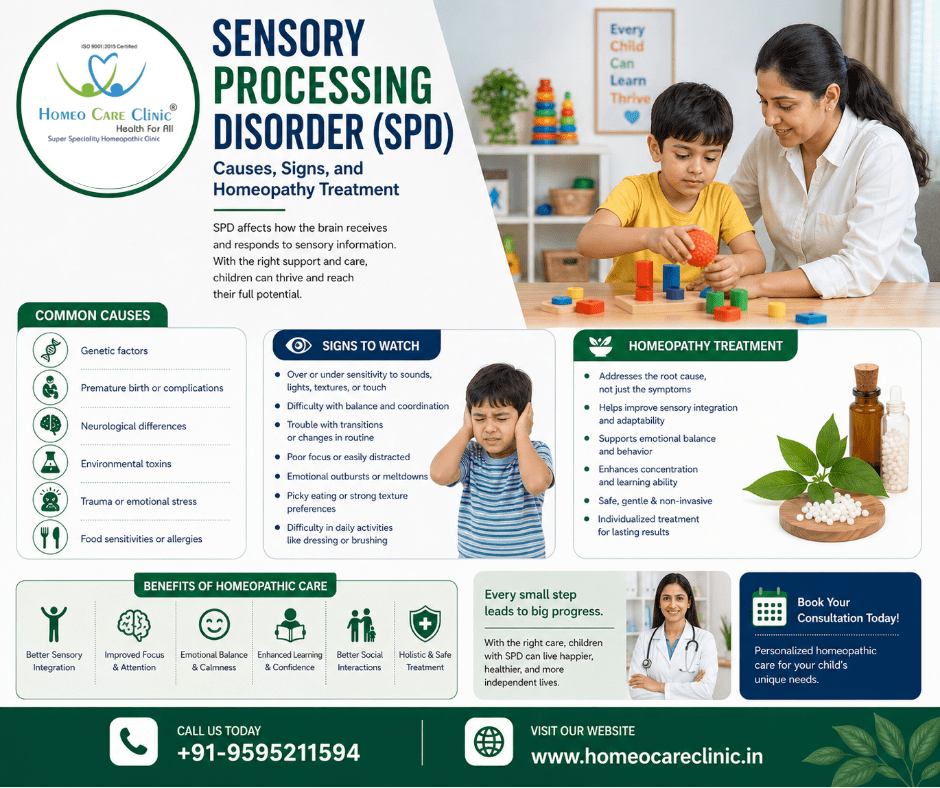
If your child is constantly melting down or bouncing off the walls, here are the actual biological reasons why:
- The Neurological Traffic Jam: This is the core issue. A healthy brain receives a signal (like the hum of a refrigerator) and immediately filters it out as “unimportant background noise.” A child with SPD can’t do that. Their brain registers the fridge’s hum as a blaring siren. The nervous system becomes totally overloaded and triggers a “fight or flight” panic response.
- Vestibular and Proprioceptive Glitches: We actually have more than five senses. We have senses that tell us where our body is in space (proprioception) and keep us balanced (vestibular). If these are misfiring, a kid might feel like they’re constantly falling, or they might not even register pain when they bump into things.
- Genetic and Environmental Factors: There’s a strong hereditary link here. Also, things like low birth weight, prematurity, or a lack of sensory stimulation in early infancy can alter how the nerve pathways wire themselves up.
In homeopathy, we don’t just force a child to wear a scratchy shirt to “toughen them up.” We look closely at the nervous system. Is the child screaming because their nerve endings are hypersensitive? We have to treat the exact root of the overwhelm.
Recognizing the Different Types of Sensory Processing Disorder
Sensory issues are incredibly complex. How do you figure out what specifically is going wrong inside your child’s head? Clinically, occupational therapists break this down into specific types of sensory processing disorder.
1. Sensory Over-Responsivity (Hypersensitive)
This child feels everything way too much. Their brain amplifies normal signals into painful ones.
- They scream when you brush their hair or cut their nails.
- They cover their ears when a blender or vacuum turns on.
- They refuse to wear jeans or anything with a tag.
2. Sensory Under-Responsivity (Hyposensitive)
This child’s brain is sluggish when it comes to registering sensory input. They seem somewhat disconnected from their environment.
- They don’t seem to notice when their face is messy or their nose is running.
- They have a very high pain tolerance and might not even cry after a bad scrape.
- They seem clumsy and are slow to respond when you call their name.
3. Sensory Craving (Seeking)
This child’s nervous system is constantly starved for input, so they aggressively seek it out.
- They’re constantly crashing into furniture, jumping off high places, and roughhousing.
- They touch everything and everyone, constantly invading personal space.
- They just cannot stop fidgeting, spinning, or making loud noises.
Signs Your Child is Struggling (and the Food Battle)
How do you tell if they’re just being a typical toddler or if they have a true neurological block? Their behavior leaves massive clues.
Here are the primary sensory processing disorder symptoms you need to watch out for on a daily basis:
- The Agonizing Clothing Battle: You have to buy ten pairs of socks before finding just one they’ll wear without screaming about the seam.
- The Playground Panic: They are absolutely terrified of swings or slides because their vestibular system makes them feel like they’re falling out of the sky.
- Severe Struggles with Sensory Processing Disorder Food: This is a massive, everyday issue. They don’t just “dislike” broccoli; they gag and physically vomit if a food has a slimy or crunchy texture. They might limit their entire diet to three beige, crunchy foods (like crackers or fries) because those foods feel “safe” and predictable in their mouth.
- The “Meltdown” vs. “Tantrum”: A tantrum stops when the kid gets what they want. A sensory meltdown does not. The child’s nervous system has completely crashed, and they are in pure survival mode.
The Overlap: Sensory Processing Disorder Autism
Parents often come into the clinic terrified, asking if sensory issues automatically mean their child is on the spectrum. Let’s clarify the link regarding sensory processing disorder autism:
- Almost all children on the Autism Spectrum have sensory processing issues. It is a core diagnostic feature of autism.
- However, a child can have severe Sensory Processing Disorder without being autistic.
If your child makes great eye contact, understands social cues, engages in imaginative play, and desperately wants to connect with peers—but just can’t handle loud noises or sticky hands—they likely have standalone SPD, not autism.
Conventional Therapy vs. The Internal Storm
Go to a pediatrician, and the standard advice is usually focused on behavioral and physical therapies.
- Occupational Therapy (OT): This is the gold standard. An OT uses a “sensory gym” (swings, trampolines, deep pressure brushes) to help rewire the child’s brain to process sensory input correctly.
Let me be absolutely clear: Occupational Therapy is miraculous and entirely necessary.
But there’s a big gap here. You can put a child into OT for two hours a week. But if that kid’s nervous system is completely raw, highly inflamed, and paralyzed by anxiety, they will just scream through the entire therapy session. Parents sit across from me completely drained. They want to know about homeopathy for sensory processing disorder because they need something that actually primes the nervous system from the inside out so the therapy can actually work.
Homeopathy Treatment for Sensory Regulation
Homeopathy views sensory overload quite differently. We don’t just force the child to eat the slimy food. We certainly don’t ignore the severe physical exhaustion they feel after a meltdown.
We focus heavily on the internal nervous system. By utilizing targeted constitutional medicine, we actively calm those raw nerve endings. We soothe the hyperactive brain so the child can actually process their environment without panicking. When the brain is biologically regulated, occupational therapy works ten times faster.
Key Homeopathic Medicines for Sensory Repair
Here are the remedies we frequently use for homeopathy for sensory processing disorder.
Tarentula Hispanica
- Indicated for: The extreme sensory seeker and craving profile.
- Best suited for: The child who literally cannot stop moving. They run constantly, crash into walls, and seem to have endless, destructive energy. Music makes them wildly hyperactive.
- Key action: Aggressively settles the wildly hyperactive, restless nervous system, helping the sensory-seeking child find physical grounding.
Calcarea Carbonica
- Indicated for: The sluggish, easily overwhelmed child with severe food aversions.
- Best suited for: The child who is very stubborn and deeply anxious about any change in routine. They sweat heavily on their head at night. They suffer massively from sensory processing disorder food issues, eating only highly specific, bland textures.
- Key action: A deep constitutional builder. It helps the sluggish, anxious nervous system feel safe and slowly reduces the extreme sensitivity to textures.
Stramonium
- Indicated for: Severe sensory overload resulting in violent night terrors or intense meltdowns.
- Best suited for: The child who gets completely terrified by the dark, shiny objects, or loud noises. When they hit a sensory meltdown, they might bite, kick, or scream in pure panic.
- Key action: Calms the severe “fight or flight” panic response in the brain, dropping the intensity of the sensory-induced terror.
Chamomilla
- Indicated for: Absolute hypersensitivity to pain and touch.
- Best suited for: The child who screams if you simply try to brush their hair or cut their nails. They are highly irritable, angry, and nothing you do consoles them during a meltdown.
- Key action: Directly dulls the extreme hyper-reactivity of the nerve endings, making daily grooming and physical touch tolerable.
Silicea
- Indicated for: The very timid, highly sensitive child who is malnourished due to sensory food issues.
- Best suited for: Children who are physically weak, catch colds easily, and completely refuse new foods due to texture. They hate being touched or approached by strangers.
- Key action: Strengthens a fragile, exhausted nervous system and deeply improves gut health and nutrient absorption for the extremely picky eater.
Don’t try guessing the remedy yourself. A medicine for a wild, crashing child won’t do anything for a terrified, highly sensitive child. You need a trained doctor to map out the exact neurological pathology.
Why Choose Homeo Care Clinic for Your Child?
Watching your child scream because the world feels too loud breaks your heart. I run my own multi-speciality setup right here in Pune, and I talk to countless parents who are terrified to take their child to a restaurant or a mall because a meltdown is inevitable. I know what it feels like when you just want your family life to feel normal again.
Standard doctors usually just hand over an ADHD questionnaire or tell you they’ll “outgrow it.” We do things entirely differently at Homeo Care Clinic under Dr. Vaseem Choudhary.
- We map the exact origin: We don’t just look at the tantrum. Are they covering their ears? Do they hate the feeling of sand? We find the actual sensory roadblock.
- We heal the tissue natively: We know you’re tired of watching them cry over socks. We support the body’s neural pathways. We use remedies to actively prime the brain so it can finally filter out the noise.
- Understanding the local lifestyle: We see these sensory crashes every single day. The loud Pune traffic, massive academic pressure, exhausted parents. We deeply understand how modern life stresses a developing brain.
- Listening to the details: Your child’s specific trigger really matters. Do they gag on soft food? Do they spin in circles? That specific detail points us straight to the exact remedy their brain needs.
You don’t have to watch them struggle in silence. Let’s turn down the volume safely.
Lifestyle and Diet Tips for Sensory Regulation
Medicine fixes the internal engine. But if you force a hypersensitive child into a screaming, crowded mall for three hours, their brain will completely shut down. You have to manage their environment.
Managing the Mechanics
What you MUST do immediately:
- Implement a Sensory Diet: Work with an OT to create a “sensory diet.” If your child is a seeker, they need “heavy work” before school—like pushing a heavy laundry basket or jumping on a trampoline—to regulate their brain. If they are hypersensitive, they need deep pressure (like a weighted blanket) to calm their nerves.
- Respect the Clothing: Do not fight over the jeans. It just isn’t worth the meltdown. Buy seamless socks, cut the tags out of their shirts, and let them wear soft cotton. Comfort equals a calm nervous system.
- Create a Safe Zone: Set up a small, dark tent in their bedroom with soft pillows and zero noise. When they feel a sensory crash coming, teach them to retreat to the safe zone to reset their brain.
Diet Recommendations (The Neural Reset)
What you MUST stop eating:
- Artificial Dyes and Preservatives: Red 40 and artificial colors act as literal neurotoxins in developing brains. They violently amplify hyperactivity and sensory-seeking behaviors. Cut them out entirely.
What to eat:
- Gut-Brain Support: For children with severe sensory processing disorder food aversions, their gut microbiome is often severely compromised. Sneak high-quality probiotics into their safe foods (like a tasteless powder in yogurt or a smoothie) to reduce systemic inflammation.
- Omega-3 Fatty Acids (DHA): The nerve sheaths require massive amounts of high-quality DHA to fire correctly and filter signals. Give your child pure cow’s ghee or a heavy-metal-free fish oil supplement daily.
5 Most Commonly Asked Questions
Parents come in completely overwhelmed and judged by society. Here is the actual clinical reality.
1. Will my child ever outgrow Sensory Processing Disorder?
A child doesn’t magically “outgrow” the neurological wiring, but they do learn to manage it brilliantly. With early OT and homeopathic sensory processing disorder treatment, the brain learns how to adapt, filter, and cope. A hypersensitive child can grow into a perfectly functioning, calm adult.
2. How do I know if it is a sensory meltdown or just a behavioral tantrum?
A child having a behavioral tantrum is watching you to see your reaction. If you give them the toy, the crying stops instantly. A sensory meltdown is totally out of their control. They aren’t looking at you. Giving them a toy won’t stop it because their nervous system is in pure panic mode. They need a dark, quiet room to recover.
3. Should I force my child to eat foods with textures they hate?
Absolutely not. Forcing a child with SPD to eat a texture that makes them gag creates severe food trauma and eating disorders later in life. Introduce new foods very slowly beside their “safe” foods, without any pressure to actually swallow it. Let them just touch it or smell it first.
4. Can screen time make sensory issues worse?
Yes, massively. Screens provide extreme, fast-paced visual and auditory input while keeping the physical body completely stagnant. It violently overstimulates the brain and leaves the vestibular system totally dysregulated.
5. How fast will homeopathy help calm my child’s nervous system?
This isn’t an overnight magical pill. For acute issues like violent night terrors, remedies act quickly to calm the nervous system within a few weeks. But deeply regulating a raw, hypersensitive nerve network takes sustained, constitutional treatment over 4 to 6 months. We look for shorter meltdowns, better sleep, and less intense reactions to clothing first.
Conclusion
It completely breaks your heart to watch your kid scream in terror over something as simple as the sound of a vacuum cleaner. The cycle of watching them get overwhelmed, leaving grocery stores in tears, and worrying about how they’ll survive in a loud world is a truly exhausting way to parent. Purely external discipline completely misses the internal neurological roadblock.
Time-outs don’t fix an exhausted, overwhelmed nervous system. Homeopathy offers a real shift here. It works deeply at the cellular level, nourishing raw nerve tissue, clearing the sensory blockages natively, dropping the extreme panic response, and giving your child’s brain the biological support it needs to finally feel safe in their own skin.
You deserve to see them calm. They deserve to feel comfortable. We are ready, listening to your daily struggles, and helping your family heal.
“Your health deserves more than temporary relief. Choose homeopathy for lasting results”
Start your journey towards better focus today.
About the Author Bio:
Dr. Vaseem Choudhary M.D is a seasoned classical homeopath with over 16+ years of experience, dedicated to treating patients with compassion, precision and holistic care. Mainly in Pune & Mumbai, serving both national and international patients from UK, USA, Germany, France, Canada, Bhutan, Dubai and China. With a wide range of acute and chronic conditions—from skin disorders, hormonal issues, and digestive problems to autoimmune diseases and mental health concerns.
Dr. Vaseem is widely respected for his unique approach that combines classical homeopathy, personalized diet planning, lifestyle guidance, and a spiritual perspective on healing. He is known for his detailed and empathetic case-taking process, which focuses on treating the root cause rather than just symptoms.
In recognition of his dedication and clinical excellence, Dr. Vaseem Choudhary MD has been honored with the Best Homeopathic Doctor in Pune award by leading platforms such as:
- Best Homeopathy Doctor in Pune – National Healthcare Service Excellence Awards 2024
- Most Trusted Centre for Autism and ADHD in India 2025 – Healthcare Excellence & Leadership Awards
- Best Homeopathy Doctor in Pune – Dr. Vaseem Choudhary Shines at Ayush 2nd International Conference, Dubai
- Recognized for spearheading homeopathic treatment protocols, improving patient satisfaction, and healthcare advancements.
He is also a contributing author to the International Journal of Homeopathy and Natural Medicines (IJHNM), where he shares his research and clinical experiences with the global medical community.
With a passion to take homeopathy to new heights, Dr. Vaseem continues to guide patients towards natural, safe, and sustainable healing.
Homeo Care Clinic offers a holistic approach to treating the disease. The remedies mentioned above can treat the underlying causes of the condition and offer relief from the discomfort. However, it is important to consult a qualified homeopathic practitioner for the correct dosage and duration of treatment. Homeo Care Clinic provides comprehensive care for various ailments, and offers customized treatment plans based on individual requirements.
To schedule an appointment or learn more about our treatment, please visit our website or give us a call +91 9595211594 our best homeopathy doctor will be here to help.
Follow us on Facebook, Twitter and Instagram for valuable insights into the world of homeopathy and holistic health.
- Facebook– https://www.facebook.com/homeocareclinicpune
- Instagram– https://www.instagram.com/homeocareclinic_in
- Website– https://linktr.ee/homeocareclinic
- Success Stories of Patients –https://www.homeocareclinic.in/category/case-study/
- Patient Testimonials – https://www.homeocareclinic.in/testimonial/
Chat with a best homeopathic doctor privately:
If you have any queries regarding your disease or any symptoms, click to send a What‘s App message. Our best homeopathy doctor will be happy to answer you. About Us Click
Book an Appointment:
If you want to visit our clinic, click to book an appointment.
Online treatment:
If you are a busy professional, or you are living in a remote town or city, with no best homeopathic doctor near you, Click to start an online homeopathic treatment with the world’s exclusive, most experienced and best homeopathic clinic, managed by Dr. Vaseem Choudhary world-renowned homeopathic doctor expert
- About Us – https://www.homeocareclinic.in/about-us/
- Our Doctors –https://www.homeocareclinic.in/team/