

I was sitting in my car in a daycare parking lot a few months ago, just replying to some emails before heading into the clinic. Two cars down from me, a mother was unbuckling her three-year-old son from his car seat.
It was not going well.
The child was gripping the straps of his car seat with white knuckles. He was screaming, a high-pitched, terrifying wail, and tears were absolutely streaming down his red face. The mother looked like she was about to shatter into a million pieces. She was whispering to him, trying to pry his fingers off the plastic, looking around with this mix of profound embarrassment and soul-crushing guilt. She finally got him out, carried him kicking and screaming into the building, and walked out five minutes later.
When she got back to her car, she just slumped over the steering wheel and started sobbing.
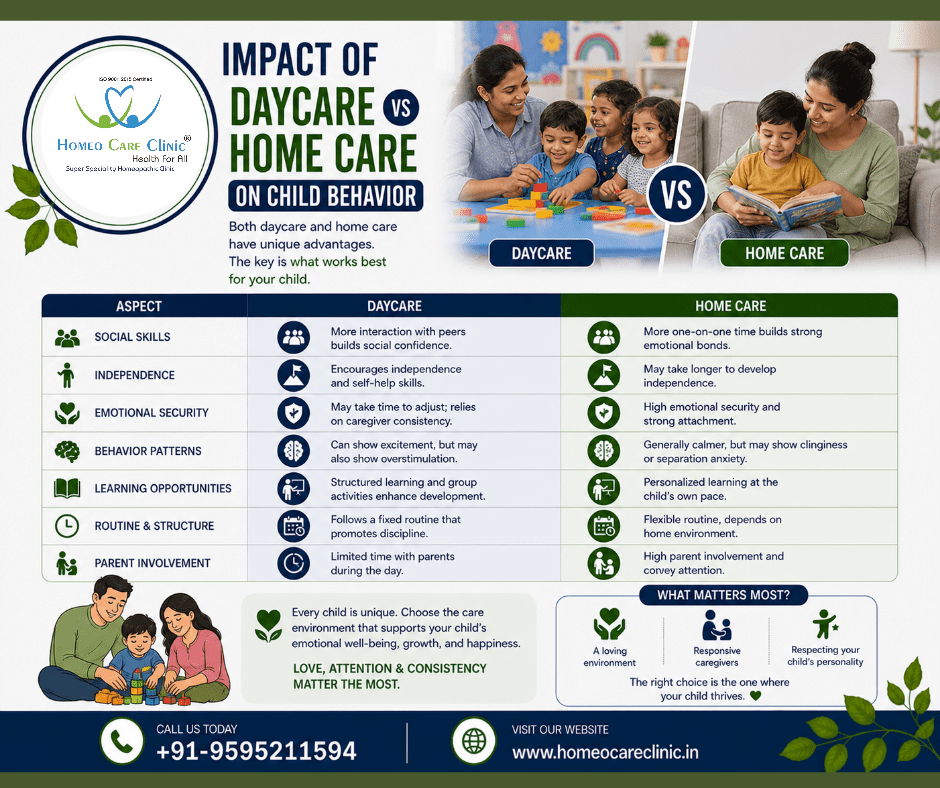
I see this all the time. It is the ugliest, hardest, most heartbreaking part of modern parenting. The debate over the Impact of daycare vs home care on child behavior is not just a scientific discussion; it is a highly emotional warzone that parents navigate every single day.
Mothers and fathers sit in my office, completely exhausted, and ask me if they are ruining their children. The working parents feel guilty that they are abandoning their kids to strangers. They see their toddlers coming home exhausted, biting, and throwing massive tantrums, and they panic. On the flip side, the stay-at-home parents sit in my office feeling totally burnt out, touched-out, and terrified that their child is going to be socially stunted because they aren’t interacting with twenty other kids every day.
Everyone feels like they are failing. Everyone is desperately googling the impact of daycare on child development at two in the morning, looking for someone to tell them that their child is going to be okay.
So let’s just turn the temperature down. Let’s take the guilt out of the equation and look at the actual, biological, neurological reality of what is happening in your child’s brain. We are going to look deeply at the impact of daycare on development of toddlers, the hidden sensory overwhelm, the behavioral fallout, and how you can actually support their fragile nervous systems whether they spend their days at home or at a center. Grab a large cup of coffee. We have a lot of ground to cover.
The Causes: Why the Environment Changes the Brain
To understand the impact of daycare on toddlers, you have to understand that a toddler’s brain is an incredibly sensitive radar dish. It is constantly scanning the environment for safety, for threats, and for sensory input. When you change the environment, you fundamentally change what the radar dish is picking up.
There is no “perfect” choice. Both daycare and home care present unique stressors and unique benefits to a developing nervous system. Let’s break down the actual causes of the behavioral friction you see at home.
The Daycare Dynamic: The Sensory and Social Pressure Cooker
When a child enters a daycare facility, they are stepping into an environment that is radically different from their living room.
The Cortisol Spike Studies have consistently shown that children in daycare experience elevated levels of cortisol (the stress hormone) throughout the afternoon. This isn’t necessarily because they are being abused or neglected. It is because group care is inherently stressful. At home, if a child wants a red block, they take the red block. At daycare, they have to negotiate for the red block with three other toddlers who lack impulse control. This constant, low-level social friction requires massive amounts of neurological energy. By 3 PM, their prefrontal cortex is completely drained.
Sensory Overload Daycares are loud. The fluorescent lights buzz. There are primary colors painted on every wall. Twenty children are crying, laughing, and running simultaneously. For a child with a highly sensitive nervous system, a daycare room is the equivalent of an adult spending nine hours on the floor of the New York Stock Exchange. The sensory bucket fills up and overflows long before you pick them up.
The Sickness Loop We cannot talk about the impact of daycare on child development without talking about the immune system. Kids in daycare get sick. Constantly. They pass around viral upper respiratory infections, stomach bugs, and ear infections. A child who is chronically fighting off a low-grade fever or dealing with fluid in their ears is going to be cranky, clingy, and prone to meltdowns. The behavioral issues are often just physical sickness in disguise.
The Home Care Dynamic: The Under-Stimulation Trap
Staying at home with a parent or a nanny removes the massive sensory overload of group care, but it introduces its own set of neurological challenges.
The Lack of Social Friction Children learn emotional regulation by experiencing friction. They learn how to share by having a toy snatched away from them and processing the anger. If a child is at home with an adult who constantly anticipates their needs and actively prevents conflict, the child never builds the neural pathways required to handle disappointment. When they finally do enter school, the shock to their system is massive, and they often react with extreme aggression or severe withdrawal.
The Parental Mirroring Effect Kids are emotional sponges. If a stay-at-home parent is profoundly depressed, isolated, or burnt out, the child will absorb that exact same frequency. A child at home with an exhausted, resentful parent is going to display way more behavioral issues than a child at a high-quality daycare with energetic, regulated teachers. The child’s nervous system simply mirrors the primary caregiver.
The Signs and Symptoms: What the Fallout Actually Looks Like
You don’t need a degree in child psychology to see the Impact of daycare vs home care on child behavior. The symptoms play out in your living room, at your dinner table, and in the middle of the night.
Whether your child is struggling to adapt to a bustling daycare or feeling isolated at home, their nervous system will wave red flags. Here is what you need to look out for.
Symptoms of Daycare Burnout
- After-School Restraint Collapse: This is the most common and terrifying symptom for working parents. The daycare teachers tell you your child is an absolute angel all day. They share, they smile, they nap. But the absolute second you put them in the car to go home, they unleash hell. They scream, they kick the seats, they throw their shoes, and they cry over the wrong shaped cracker. They hold their emotions together all day to survive the group setting, and they explode on you because you are their safe space.
- The Biting and Hitting Phase: When a toddler’s vocabulary fails them in a high-stress social situation, their body takes over. Biting is a primal, sensory-seeking behavior driven by massive frustration. If your child is constantly in the “timeout” chair at daycare for hitting, their environment is moving faster than their emotional processing speed.
- Severe Sleep Regressions: A brain that is flooded with cortisol all day has a very hard time shutting down at night. Daycare toddlers often suffer from night terrors, screaming in their sleep, or waking up at 3 AM completely wired and unable to self-soothe.
- The Sickness-Induced Clinginess: Because they are catching every virus known to mankind, they become intensely physically needy. They refuse to walk, demanding to be carried constantly, and they whine instead of using their words.
Symptoms of Home Care Under-Socialization
- Extreme Separation Anxiety: While some separation anxiety is a normal developmental milestone, home-cared children who are never exposed to other adults can develop a pathological fear of being apart from their mother. They will scream hysterically if the mother just walks into the bathroom and shuts the door.
- Rigidity and Lack of Adaptability: Because their home environment is totally predictable, they cannot handle surprises. If you take them to a new park, or if a friend drops by unexpectedly, they completely melt down. They need absolute control over their environment to feel safe.
- Delayed Expressive Language: While receptive language (understanding) is usually fine, some kids at home delay talking simply because they don’t have to. The parent knows exactly what the child wants before the child even points. There is no biological necessity to learn complex speech if a grunt gets them a cup of milk immediately.
Conventional Treatment: The Limits of Standard Advice
When the behavioral issues reach a boiling point, parents eventually drag themselves and their screaming toddler to a conventional pediatrician. They sit in the sterile room, explain the biting, the night terrors, and the after-school meltdowns, and ask for help.
What is the standard medical response?
“It’s Just a Phase” This is the most common answer. Doctors will tell you that the transition to daycare is hard, and that biting is a normal toddler behavior. They tell you to just wait it out. And while it is true that kids adapt, telling a parent to “wait it out” while they are getting kicked in the shins every night at 6 PM is incredibly unhelpful. It leaves the family drowning in daily chaos.
Behavioral Modification (Sticker Charts and Time-Outs) If the child is a bit older, the advice shifts to behavioral control. You are told to implement sticker charts for good days at daycare, or use strict time-outs when they hit their sibling at home.
Here is the massive flaw with this approach when dealing with the impact of daycare on toddlers: You cannot punish a nervous system into feeling safe. If a child is biting because they are completely overstimulated by a loud classroom, putting them in a time-out chair does not lower the volume in the classroom. It doesn’t treat the sensory overload. It just teaches the child that their overwhelm is “bad,” leading to them suppressing their anxiety until it erupts into worse behaviors later.
Psychiatric Evaluation for Extreme Cases If a child is getting kicked out of daycare centers for severe aggression, the conventional system might push for early evaluations for ADHD, Oppositional Defiant Disorder (ODD), or Autism. While early intervention is crucial for true neurodivergence, we are often misdiagnosing children who are simply experiencing profound environmental burnout. Slapping a psychiatric label on a three-year-old because they can’t handle a chaotic daycare center is a dangerous path.
Homeopathy Treatment: Resetting the Biological Foundation
This is exactly why families who are at the end of their rope eventually walk through the doors of my clinic.
They do not want to drug their child. They do not want to use harsh, punitive timeouts. They recognize that the Impact of daycare vs home care on child behavior is real, and they want to support their child’s fragile biology so they can adapt to whatever environment the family has chosen.
Homeopathy is a game-changer here. We do not use medicine to suppress a child’s personality. We do not use it to make them “compliant.” We use incredibly safe, highly diluted, constitutional nanomedicines to treat the physiological effects of stress. We calm the static in the nervous system. We help the body process the cortisol spikes so the child can actually relax when they come home.
We look at the exact nature of the child’s reaction. Do they weep when you leave them? Do they get violent when they come home? Do they suffer from chronic ear infections? Their specific symptoms lead us to the exact remedy their body needs to heal.
Here are 5 homeopathic medicines we rely on constantly to treat the fallout of modern childcare dynamics.
1. Pulsatilla Nigricans
- Indicated for: Severe separation anxiety and the weeping, clingy child.
- Best suited for: This is the classic remedy for the child who is traumatized by daycare drop-offs. The Pulsatilla child’s mood is incredibly changeable—laughing one minute, sobbing the next. They are terrified of being abandoned. When you try to leave them at the center, they wrap themselves around your leg and weep pitifully. They want constant physical reassurance, hugs, and to be carried. Interestingly, they usually hate hot, stuffy rooms and crave open fresh air. They are thirstless, even in the summer.
- Key actions: Pulsatilla deeply grounds an anxious, needy nervous system. It takes away the desperate panic of abandonment, helping build a sense of internal security so the child can separate from the parent without feeling like their world is ending.
2. Ignatia Amara
- Indicated for: Acute emotional shock, silent grief, and hysterical mood swings.
- Best suited for: The child who holds their emotions in all day and then cracks. If a child is grieving the loss of their mother’s constant presence because they just started a new daycare, they might exhibit Ignatia symptoms. They sigh heavily. They try to be good, but the emotional pressure builds up until they have a hysterical, unpredictable meltdown where they are laughing and crying simultaneously. They might get a physical lump in their throat or develop stress-induced stomach cramps.
- Key actions: Ignatia is the premier remedy for acute grief and emotional suppression. It stabilizes the nervous system, helping the child actually process the sadness of the transition rather than trapping it in their physical body as tension.
3. Chamomilla
- Indicated for: The highly overstimulated, enraged, unpleasable child.
- Best suited for: The child suffering from severe “after-school restraint collapse.” They hold it together at daycare, but the absolute second you put them in the car, they unleash pure rage. They hit, they bite, they kick. They demand a toy, and when you hand it to them, they throw it across the room. They are incredibly sensitive to physical pain—a tiny scratch causes a massive screaming fit. They run hot, often having one red cheek, and the only thing that temporarily calms them is being carried and walked around briskly.
- Key actions: Chamomilla immediately cools down raw, hypersensitive nerve endings. It acts like a wet blanket on a burning fire, dropping the aggressive, irrational irritability so the child can actually tolerate minor physical and emotional discomfort without exploding.
4. Staphysagria
- Indicated for: The child who is bullied or suppresses anger until they explode.
- Best suited for: The “good kid” who gets taken advantage of. At daycare, this child might get their toys stolen, get pushed around, or get yelled at by a teacher, and they do not defend themselves. They swallow their anger because they are terrified of getting in trouble. But when they come home to a safe environment, the suppressed rage erupts. They might throw things, break their own toys, or hit their younger siblings. They internalize the stress to the point where they often get styes on their eyes or chronic urinary tract infections.
- Key actions: Staphysagria is a massive emotional release valve. It gives the child the internal fortitude to establish boundaries at daycare, stopping them from internalizing the stress and acting like an emotional punching bag for the rest of the world.
5. Calcarea Phosphorica
- Indicated for: The child caught in a loop of sickness, exhaustion, and whining.
- Best suited for: The child who is bearing the physical brunt of the impact of daycare on child development. They are growing rapidly (often tall and thin) but they are completely exhausted by the daycare environment. They catch every single cold, cough, and stomach bug. Because they are chronically sick and tired, they whine constantly. They complain of vague headaches or stomach aches when it is time to go to school. They lack the physical and mental stamina to handle the long days.
- Key actions: Calcarea Phos rebuilds the vital force on a cellular level. It strengthens the physical constitution, massively boosts the immune system to break the sickness loop, and gives the nervous system the actual physical energy required to thrive in a busy environment.
Why Choose Homeo Care Clinic
You cannot treat the complex neurological and emotional fallout of a child’s environment by guessing which remedy to buy off the internet. A child’s biology is entirely too sensitive for a trial-and-error approach.
This is exactly why stressed, exhausted families bring their children into Homeo Care Clinic to sit down with Dr. Vaseem Choudhary.
- Deep Clinical Expertise: Dr. Vaseem Choudhary has been practicing right here in Pune for nearly twenty years. He has seen the entire spectrum of the Impact of daycare vs home care on child behavior. He knows that a child throwing a chair is not a “bad kid”; they are a dysregulated kid. He listens to the parents without judgment. He observes the child’s subtle quirks in the clinic to find the exact pathological root of the behavior.
- We Fix the Gut-Brain Connection: You cannot separate the stomach from the mind. Children in daycare are exposed to endless viruses and are frequently put on multiple rounds of antibiotics. This destroys their gut microbiome. A destroyed gut leads directly to anxiety, poor sleep, and behavioral meltdowns. We treat the digestive tract at the exact same time we treat the emotional dysregulation, creating true holistic healing.
- Accessible Pune Locations: When you are already managing a grueling work schedule, daycare drop-offs, and a screaming toddler, you do not have the bandwidth for a two-hour commute to a doctor’s office. With established, fully staffed clinics strategically located in Viman Nagar, Hadapsar, and Magarpatta, you can get world-class constitutional care without adding more stress to your week.
- Zero Toxic Side Effects: We refuse to use heavy sedatives or harsh chemical behavioral medications on developing brains. Our homeopathic nanomedicines are incredibly safe. They do not numb the child. They do not cause chemical dependency. They simply provide the energetic frequency the body needs to heal itself.
The Transformative Benefits of Homeopathy
Why should parents consider this gentle, constitutional approach instead of just waiting for the child to “grow out of it”?
- It Restores the Peace: You get your evenings back. When a child’s nervous system is balanced with the right remedy, the violent 6 PM meltdowns drastically reduce in intensity and frequency. The house stops feeling like a battleground.
- It Boosts the Baseline Immunity: This is perhaps the greatest physical benefit. By treating the whole constitution, homeopathy acts as a massive shield for the immune system. Daycare children stop catching back-to-back viruses. When they aren’t sick, they aren’t cranky, and their behavior naturally improves.
- It Protects Their Personality: We do not want to turn a vibrant, strong-willed child into a quiet, compliant robot. Your child will still have big feelings. But they won’t lose control so completely that they hurt themselves or others. They gain the ability to pause.
- No Rebound Tantrums: If you only use behavioral punishments to stop a child from crying, you are just pushing the anxiety deeper. Homeopathy actually heals the jittery nervous system, so the urge to explode just fades away naturally from the inside out.
Lifestyle and Diet: Building the External Scaffolding
Homeopathic medicine provides the biological spark. It calms the nerves so the child can breathe. But you, the parent, must build the external scaffolding. You have to adapt your lifestyle and your child’s diet to support the heavy lifting the medicine is doing.
If you want to mitigate the negative impact of daycare on development of toddlers, you must implement these non-negotiable rules in your house.
The Lifestyle Scaffolding
- The Silent Decompression Hour: This is mandatory for daycare kids. When you pick them up, their brains are fried. Do not interrogate them. Do not ask, “Did you have fun? Who did you play with? Did you eat your lunch?” Let the car ride be entirely silent. Play soft music. When you get home, do not immediately demand that they do a chore or play an educational game. Give them one solid hour of low-light, quiet, totally unbothered downtime to let their cortisol levels drop.
- 15 Minutes of Uninterrupted Connection: Children act out because they are desperately seeking connection after being separated from you all day. Set a timer for 15 minutes every single night. Put your phone in another room. Get on the floor. Let the child lead the play completely. Do whatever they want to do. This tiny, concentrated dose of undivided attention fills their emotional cup and massively reduces evening tantrums.
- Radical Screen Reduction: If your child has been highly stimulated at a daycare all day, coming home and staring at an iPad is the absolute worst thing for their brain. Screens provide cheap, rapid-fire dopamine that further exhausts the prefrontal cortex. Replace screen time with heavy physical work—let them push a heavy laundry basket around, or jump on a mattress. Proprioceptive input physically calms the nervous system.
The Dietary Scaffolding
A brain that is constantly managing the stress of group care needs premium fuel. You cannot feed them processed garbage and expect them to regulate their emotions.
- The Protein Buffer: An anxious, overwhelmed brain burns through glucose rapidly. If a child eats a sugary snack when they get home from daycare, their blood sugar will spike and then crash violently, leading to a catastrophic meltdown. You must feed them heavy protein the literal second they get in the car. Beef jerky, boiled eggs, almonds, or cheese. Keep the engine running steady to prevent the crash.
- Cut the Artificial Dyes: Red 40, Yellow 5, and Blue 1. These petroleum-based artificial food dyes act like literal neurotoxins in sensitive children. They cause the nervous system to vibrate with fake, manic energy. Read every single label in your pantry and throw out the bright blue drinks, the cheap fruit snacks, and the neon cereals.
- Massive Hydration: Daycares are notoriously bad at ensuring children drink enough water. Dehydration literally shrinks brain tissue and causes severe tension headaches. A toddler who has a headache but doesn’t have the words to tell you will just act aggressively. Force hydration the second they get home.
- Omega-3s and Magnesium: The brain’s neural pathways need fat to function smoothly. Give your child a high-quality liquid fish oil supplement every day to insulate their nerves. Furthermore, stress burns through the body’s magnesium reserves. Magnesium is the natural muscle relaxer. Use a pediatric magnesium spray on the soles of their feet before bed to help them physically release the tension of the day and achieve deep sleep.
5 Commonly Asked FAQs
1. Does going to daycare make a child more aggressive?
- Daycare itself does not “make” a child aggressive.
- However, the group environment places high demands on a child’s immature impulse control. If they do not have the vocabulary to negotiate, they will use physical actions (like hitting or biting) to protect their space. It is a symptom of sensory and social overload, not a permanent character flaw.
2. Are children who stay at home socially delayed?
- Not necessarily, but it requires effort to avoid.
- A child at home needs deliberate, consistent exposure to other children and adults to learn social friction, sharing, and adaptability. If a stay-at-home parent actively takes the child to playgroups, parks, and diverse environments, the child will develop perfectly normal social skills.
3. Is it normal for my child to cry every single morning at drop-off?
- It is normal for the first few weeks as they transition.
- However, if your child has been at the same daycare for six months and is still having hysterical, panic-attack-level meltdowns every single morning, their nervous system is waving a massive red flag. They are not adapting; they are living in chronic distress and need constitutional support.
4. Will the homeopathic remedies make my child sleepy during the day?
- No. Absolutely not.
- Homeopathic remedies are not chemical sedatives. They do not depress the central nervous system. They work energetically to restore balance. Your child will remain completely alert, playful, and energetic, just with a much longer fuse for frustration.
5. How long will it take to see a difference in my child’s after-school meltdowns?
- For acute, violent meltdowns (like using Chamomilla or Staphysagria), parents often notice a softening in the child’s reactivity within the first few weeks.
- Deep constitutional healing, especially if the child’s gut has been ruined by frequent daycare illnesses and antibiotics, takes a few months of consistent treatment and dietary adjustments to fully resolve.
Conclusion: Finding the Balance
So here we are.
At the end of the day, you have to look at the reality of modern life. Raising a child in today’s fast-paced, highly demanding world is incredibly difficult, and the agonizing guilt over the Impact of daycare vs home care on child behavior is a heavy burden that almost every parent carries.
You desperately research the impact of daycare on child development, terrified that every tear your child sheds at drop-off is causing permanent trauma. You watch the aggressive behavior, the biting, and the sleep regressions, and you wonder if the impact of daycare on development of toddlers is fundamentally changing who your child is.
But you have to let the guilt go.
Whether your child is navigating the loud, chaotic social dynamics of a daycare center, or dealing with the specific challenges of being at home, they are going to face friction. Friction is how humans grow. The impact of daycare on toddlers is not a life sentence of behavioral issues; it is simply a massive environmental stressor that requires an equally massive level of support.
You do not have to just grit your teeth and suffer through the violent 6 PM meltdowns. You do not have to accept that your child catching a new virus every ten days is just “part of growing up.” You have options.
By changing how you manage the transitions, cleaning up their diet to support their brain chemistry, and bringing them into Homeo Care Clinic for a deep, constitutional reset with Dr. Vaseem Choudhary, you can actually give their fragile nervous system the biological scaffolding it needs to thrive in any environment.
You can help them build a resilient brain. You can restore the peace in your home. They are going to adapt. They are going to be okay. So take a deep breath, leave the guilt at the door, and let’s get to work on healing that overwhelmed little body. You’ve got this.
“Your health deserves more than temporary relief. Choose homeopathy for lasting results”
Start your journey towards better focus today.
About the Author Bio:
Dr. Vaseem Choudhary M.D is a seasoned classical homeopath with over 16+ years of experience, dedicated to treating patients with compassion, precision and holistic care. Mainly in Pune & Mumbai, serving both national and international patients from UK, USA, Germany, France, Canada, Bhutan, Dubai and China. With a wide range of acute and chronic conditions—from skin disorders, hormonal issues, and digestive problems to autoimmune diseases and mental health concerns.
Dr. Vaseem is widely respected for his unique approach that combines classical homeopathy, personalized diet planning, lifestyle guidance, and a spiritual perspective on healing. He is known for his detailed and empathetic case-taking process, which focuses on treating the root cause rather than just symptoms.
In recognition of his dedication and clinical excellence, Dr. Vaseem Choudhary MD has been honored with the Best Homeopathic Doctor in Pune award by leading platforms such as:
- Awarded for International Excellence in Autism & ADHD Treatment 2026 in UK Parliament, London
- Dr. Vaseem Choudhary honoured at the UK Parliament, receiving International recognition PG from the London College of Homeopathy 2026
- Dr. Vaseem Choudhary, MD, was further acknowledged in Dubai in 2026 for his expertise in Autism and ADHD, reinforcing his growing international recognition in this field
- Best Homeopathy Doctor in Pune – National Healthcare Service Excellence Awards 2024
- Most Trusted Centre for Autism and ADHD in India 2025 – Healthcare Excellence & Leadership Awards
- Best Homeopathy Doctor in Pune – Dr. Vaseem Choudhary Shines at Ayush 2nd International Conference, Dubai
- Recognized for spearheading homeopathic treatment protocols, improving patient satisfaction, and healthcare advancements.
He is also a contributing author to the International Journal of Homeopathy and Natural Medicines (IJHNM), where he shares his research and clinical experiences with the global medical community.
With a passion to take homeopathy to new heights, Dr. Vaseem continues to guide patients towards natural, safe, and sustainable healing.
Homeo Care Clinic offers a holistic approach to treating the disease. The remedies mentioned above can treat the underlying causes of the condition and offer relief from the discomfort. However, it is important to consult a qualified homeopathic practitioner for the correct dosage and duration of treatment. Homeo Care Clinic provides comprehensive care for various ailments, and offers customized treatment plans based on individual requirements.
To schedule an appointment or learn more about our treatment, please visit our website or give us a call +91 9595211594 our best homeopathy doctor will be here to help.
Follow us on Facebook, Twitter and Instagram for valuable insights into the world of homeopathy and holistic health.
- Facebook– https://www.facebook.com/homeocareclinicpune
- Instagram– https://www.instagram.com/homeocareclinic_in
- Website– https://linktr.ee/homeocareclinic
- Success Stories of Patients –https://www.homeocareclinic.in/category/case-study/
- Patient Testimonials – https://www.homeocareclinic.in/testimonial/
Chat with a best homeopathic doctor privately:
If you have any queries regarding your disease or any symptoms, click to send a What‘s App message. Our best homeopathy doctor will be happy to answer you. About Us Click
Book an Appointment:
If you want to visit our clinic, click to book an appointment.
Online treatment:
If you are a busy professional, or you are living in a remote town or city, with no best homeopathic doctor near you, Click to start an online homeopathic treatment with the world’s exclusive, most experienced and best homeopathic clinic, managed by Dr. Vaseem Choudhary world-renowned homeopathic doctor expert
- About Us – https://www.homeocareclinic.in/about-us/
- Our Doctors –https://www.homeocareclinic.in/team/