

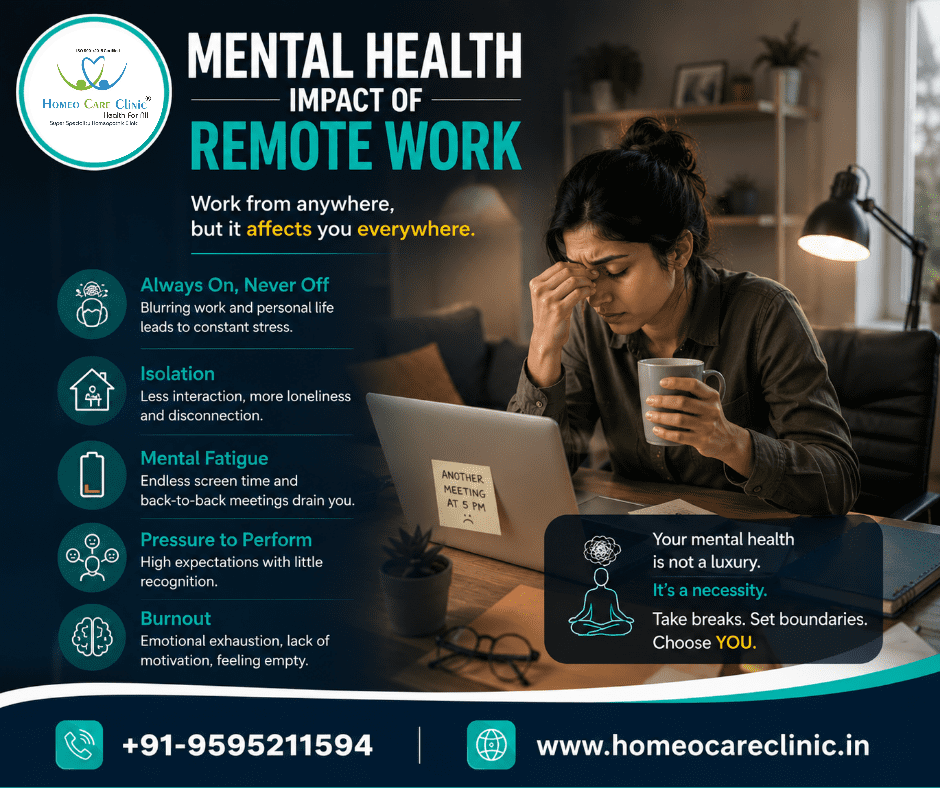
I had a thirty-five-year-old data analyst sit across from my desk last month. From the outside, he was living the absolute modern dream. He had a high-paying job with a multinational firm, a beautiful apartment in Pune, and he hadn’t had to commute through rush-hour traffic in over three years. He was permanently working from home.
But when he sat down in my clinic, he looked completely destroyed.
He rubbed his eyes—which were bloodshot and surrounded by deep, dark circles—and told me about his week. He said, “I wake up at 8:00 AM. I reach over to my nightstand, grab my laptop, and pull it into bed with me. I start running Python scripts and checking SQL databases before I have even brushed my teeth. At 1:00 PM, I move to the kitchen counter. At 6:00 PM, I move to the couch. I am building dashboards in Tableau until 10:00 PM. I realized on Thursday that I had not worn shoes, spoken to another human being out loud, or breathed outside air since Monday morning.”
He looked at me with a profound, quiet panic and said, “I have everything I ever wanted, but I feel like I am in solitary confinement. My apartment is my bedroom, my office, my cafeteria, and my prison cell. I don’t know how to turn it off.”
This is the great, dark paradox of our era.
When the world shifted to remote work, we celebrated. We thought we had finally hacked the system. We traded stiff office clothes for pajamas. We traded two-hour commutes for sleeping in. We thought we were gaining absolute freedom. But for millions of people, that freedom morphed into a deeply toxic, inescapable cage.
The profound Mental health impact of remote work is silently eroding an entire generation of professionals. People are drowning in isolation, burning out in their own living rooms, and slowly losing their grip on reality. They feel guilty for complaining because “working from home is a privilege,” so they suffer in total silence, staring at glowing screens until their nervous systems completely collapse.
So let’s sit down and pull the curtain back on this entirely modern nightmare. We are going to look at the brutal biological and psychological mechanics of what happens when you erase all the boundaries in your life. We will explore exactly what digital burnout looks like, why corporate wellness subscriptions are totally useless, and how we can use deep, constitutional homeopathy to rebuild your internal boundaries and help you reclaim your sanity. Grab a massive cup of coffee. We have a lot of ground to cover today.
The Causes: How the Living Room Became a Prison
To fix the exhaustion and the creeping depression, you have to understand exactly what the remote work environment has done to human biology and sociology. You are not losing your mind. You are a biological organism trying to survive in an environment that actively violates how the human brain is designed to function.
The causes of the Mental health impact of remote work are structural, psychological, and deeply unnatural.
1. The Evaporation of the Boundary and the “Third Space”
The human brain relies on physical environments to trigger specific neurological states. When you go to an office, the physical act of walking through the door tells your brain, “It is time to work.” When you come home, the front door tells your brain, “You are safe; it is time to rest.”
Remote work completely obliterated this geography. When your dining room table is your desk, your brain never receives the environmental cue to shut down. The boundaries bleed together. You eat where you code. You sleep where you stress. Furthermore, sociology dictates that humans need a “Third Space”—a cafe, a gym, a library—separate from home and work. When home and work become the exact same 500 square feet, the walls mentally close in. You live in a permanent, low-grade state of work-related anxiety 24/7.
2. The Death of the Commute (The Missing Buffer)
We all hated the commute. We hated the traffic in Hinjewadi or the crowded trains. But neurologically, the commute served a vital, life-saving purpose: it was a decompression buffer. It was thirty to sixty minutes where you were neither at work nor at home. You listened to a podcast. You stared out the window. You transitioned.
Without the commute, you go from dreaming in your bed to answering high-stakes emails in ten seconds flat. You go from a stressful Zoom meeting straight into cooking dinner for your kids, with zero seconds to bleed off the cortisol. The brain is violently whipped back and forth between professional crisis and personal life, causing severe emotional whiplash.
3. The “Green Dot” Paranoia and the Panopticon
In an office, your boss can physically see you sitting at your desk. They know you are working. In the remote world, your productivity is measured by your digital presence.
This has created a massive, society-wide epidemic of “Green Dot Anxiety.” You feel an intense, suffocating pressure to make sure the little status dot on your Slack or Microsoft Teams icon stays green. If you step away to make a sandwich or use the restroom, the dot turns yellow (Away), and you experience a spike of panic that your manager thinks you are slacking off. You are living in a digital panopticon—a state of constant, invisible surveillance that keeps your adrenal glands permanently flooded with fear.
4. Transactional Isolation
Remote work stripped away the friction of human connection. In an office, you have spontaneous conversations. You complain about the coffee machine. You chat about a movie before a meeting starts. This casual banter regulates the nervous system.
In a remote setting, every single interaction is scheduled and transactional. You only speak to people when there is a specific task to accomplish. You log onto a Zoom call, state the data, and log off. There is no warmth. There is no shared humanity. This transactional existence leaves remote workers feeling like isolated cogs in a massive, cold machine.
The Signs and Symptoms: What Digital Solitary Confinement Looks Like
You cannot treat a fried, isolated nervous system if you do not know what the red flags look like. The symptoms of the Mental health impact of remote work are incredibly insidious. Because you are physically safe on your couch, you dismiss the biological warning signs until your body forces you to stop.
Here is what the fallout actually looks like behind closed doors:
1. “Screen Apnea” and Shallow Breathing
This is a documented physiological phenomenon. When people are stressed and staring at a screen, especially reading emails or debugging complex code, they subconsciously hold their breath or take incredibly shallow, rapid breaths. This is called screen apnea. Over an eight-hour day, this shallow breathing signals to the vagus nerve that you are in a state of mortal danger, trapping your body in a chronic fight-or-flight response without you even realizing it.
2. Time Blindness and the “Endless Blursday”
When you don’t leave the house, and your routine consists of moving from the bed to the desk to the couch, your brain loses its temporal anchors. Tuesday feels like Thursday. The weekend bleeds into Monday. You experience “time blindness.” You look up and realize it is 8:00 PM, and you have been sitting in the exact same chair for eleven hours. Your life feels like one long, unbroken, monotonous tunnel.
3. Agoraphobia and Social Atrophy
When you spend all your time indoors communicating through a screen, the outside world starts to feel overwhelming. You order your groceries on an app to avoid the store. You cancel weekend plans because the thought of putting on hard pants and making small talk with people in real life feels like climbing Mount Everest. Your social muscles atrophy, and the isolation deepens into a mild form of agoraphobia (fear of leaving the house).
4. Severe Physical Somatization
The body always keeps the score. A remote worker’s physical health breaks down in highly predictable ways. You develop “tech neck”—a painful, rigid tension radiating from the base of your skull down into your shoulders from hunching over a laptop. Because your stress levels are chronically high, your digestion halts, leading to extreme bloating, acid reflux, and IBS. You suffer from intense eye strain and tension headaches that feel like a tight band wrapped around your head.
5. “Revenge Bedtime Procrastination”
You finish working at 7:00 PM, but you are too mentally exhausted to do anything meaningful. You desperately need to sleep. But when you get into bed, you refuse to turn the lights off. You stay awake until 2:00 AM doomscrolling on your phone or watching mindless videos. Why? Because you feel like work stole your entire day, and this late-night scrolling is the only time you actually have control over your own existence. You are stealing back your time, even though it destroys your health the next day.
Conventional Treatment: The Limits of Corporate Band-Aids
When the crushing weight of remote isolation and burnout becomes too much to handle, people eventually seek help. But the standard corporate and medical responses to this crisis are often laughably inadequate.
The Failure of “Corporate Wellness”
Companies recognize that their remote workforce is burning out, so they offer “wellness initiatives.” They give you a free subscription to a meditation app. They host mandatory “virtual happy hours” on Zoom. They tell you to practice self-care.
This is incredibly insulting. A 10-minute meditation app does not fix a toxic culture that expects you to answer Slack messages at 9:00 PM. A virtual happy hour just forces an exhausted employee to stare at a screen for another hour performing fake cheerfulness. It puts the burden of fixing a systemic workplace issue entirely onto the shoulders of the broken employee.
Cognitive Behavioral Therapy (CBT) Disconnect
Therapy is an essential tool. But CBT relies on identifying cognitive distortions and changing your thought patterns. If your anxiety is caused by the fact that your dining room is also your boardroom, and you haven’t seen the sun in three days, your thoughts are not distorted. They are a completely accurate reflection of a toxic environment. You cannot reframe your way out of biological isolation.
The Rush to Chemical Numbing
If you complain of severe fatigue, brain fog, and anxiety to a conventional psychiatrist, they will almost always offer you a Selective Serotonin Reuptake Inhibitor (SSRI) or a chemical stimulant like Adderall.
While these drugs can save lives in severe psychiatric emergencies, using them to chemically force an employee to endure an unnatural remote environment is a tragic misstep. You end up whipping your exhausted brain with stimulants during the day to hit your deadlines, and taking sleeping pills at night to force yourself to shut down. You become chemically dependent on a cycle that masks the actual collapse of your nervous system, while dealing with severe side effects like emotional numbing and weight gain.
Homeopathy Treatment: Rebuilding the Internal Boundary
This is exactly why high-achieving, deeply isolated professionals find themselves sitting in my clinic. They don’t want a chemical straightjacket. They want to actually feel capable of drawing a boundary. They want the heavy, physical ache in their neck and stomach to go away.
Homeopathy offers a profound, structural reset for a brain and body that have been battered by the Mental health impact of remote work. We do not use medicine to suppress your personality or artificially stimulate you. We use incredibly safe, highly diluted, constitutional nanomedicines to treat the physiological and psychological roots of your burnout.
We look at the exact flavor of your remote-work crisis. Are you angry and snapping at your family? Are you completely apathetic and staring at the wall? Does your mind race at 3:00 AM? By matching your specific emotional pathology to the exact energetic frequency of the remedy, we can prompt the central nervous system to hit the reset button.
Here are 5 medicines from my clinical cabinet that we rely on constantly to treat severe digital isolation and remote burnout.
1. Nux Vomica
- Indicated for: The wired, aggressive, over-caffeinated remote worker who cannot log off.
- Best suited for: The Nux Vomica patient is surviving on espresso, fast food delivery, and pure competitive rage. They are the ones answering emails at midnight and getting furiously angry at their laptop screen. They are incredibly ambitious, bossy, and impatient. Their nervous system is totally overstimulated. Because they are so stressed, they usually drink too much coffee or alcohol to cope, which completely destroys their gut. They suffer from severe acid reflux, chronic constipation, and wake up at 3:00 AM with their mind racing about tomorrow’s Zoom calls, completely unable to fall back asleep.
- Key actions: Nux Vomica detoxifies the liver and an overworked, highly strung nervous system. It cuts through the raw impatience and aggressive irritability. It allows the individual to actually relax, detox from the constant need for stimulation, and close their laptop without feeling a crushing sense of panic.
2. Phosphoric Acid
- Indicated for: The remote worker who has consumed so much screen time they are completely hollow.
- Best suited for: This is the remedy for the final stage of digital burnout. After months of waking up, staring at a screen, and going back to sleep, the person just breaks. The defining symptom is profound, crushing apathy. They do not care about their job anymore. They answer questions with one-word syllables. They feel completely hollowed out. Unlike the Nux Vomica patient who is angry, the Phosphoric Acid patient doesn’t even have the energy to be mad. They just lie on the couch, staring blankly, feeling like their emotional capacity has been entirely erased by the isolation.
- Key actions: It rebuilds the vital force after a devastating emotional or mental drain. It gently brings the physical and mental energy back online, slowly waking the brain up from that apathetic, isolated coma, allowing the person to actually feel the desire to participate in life again.
3. Kali Phosphoricum (Kali Phos)
- Indicated for: The absolute premier remedy for profound “brain fag” and severe mental fatigue.
- Best suited for: This is for the person whose brain has simply stopped computing. They have been staring at massive spreadsheets, debugging code, or managing complex digital projects for years, and the engine finally blew out. They suffer from severe brain fog. The slightest mental effort—like formulating a simple email reply—causes a literal tension headache. They feel deeply depressed, overwhelmed, and incredibly weak. They might startle easily at notifications (like the Slack “ping” sound) because their nerves are completely raw.
- Key actions: Kali Phos is literal nerve food. It feeds the depleted nervous system. It clears the thick brain fog, restores the working memory, and brings the actual cognitive sharpness back online after a long period of severe mental strain.
4. Sepia
- Indicated for: The remote-working parent who feels profound indifference to their family.
- Best suited for: The Sepia patient is carrying too heavy a load, trying to balance a demanding remote job while managing a household in the exact same physical space. The burnout makes them feel physically heavy; they literally drag their feet. The hallmark symptom is a terrifying, cold indifference to the people they love the most. After dealing with work crises all day, they look at their spouse or children and feel absolutely nothing but a desperate desire to be left entirely alone. They feel physically repulsed by the idea of being touched or having to care for anyone else.
- Key actions: Sepia acts as a massive reset for an exhausted, overwhelmed nervous system. It lifts the heavy, dragging physical fatigue and restores the emotional warmth, allowing the person to actually engage with their family without feeling completely suffocated.
5. Argentum Nitricum
- Indicated for: Severe anticipatory anxiety, “Green Dot” paranoia, and gastrointestinal distress.
- Best suited for: This individual is ruled by the “What ifs.” Their remote work anxiety is almost entirely focused on performance and surveillance. If they have a major Zoom presentation on Friday, they will have severe, explosive diarrhea starting on Wednesday. They are incredibly hurried and anxious. They obsessively check their phone and their status indicator, terrified that their boss thinks they are slacking. They often have intense cravings for sugar and sweets to keep their energy up, which usually makes their digestive issues much worse.
- Key actions: Argentum Nitricum acts powerfully on the gastrointestinal tract and the nervous system. It stops the physical somatization of the fear, clearing up the nervous diarrhea and slowing down the frantic, catastrophic, racing thoughts, allowing them to trust their own work ethic.
Why Choose Homeo Care Clinic
You cannot treat the deep, gnawing pain of profound digital isolation and burnout by reading self-help quotes and guessing which remedy to buy at a health food store. Human psychology is entirely too delicate for a trial-and-error approach.
This is exactly why exhausted, lonely professionals bring themselves to Homeo Care Clinic to sit down with Dr. Vaseem Choudhary.
- Deep Mastery of Psychological Pathology: Dr. Vaseem Choudhary has been practicing right here in Pune for nearly two decades. He has seen the absolute destruction caused by the sudden shift to remote work culture. He knows that staring at a wall in your pajamas while your brain melts is a biological emergency. He listens to you without judgment. He observes your subtle physical quirks—the heavy sighs, the tension in your jaw, the slumped shoulders—to find the exact pathological root of your burnout.
- Healing the Gut-Brain Axis: You cannot cure severe anxiety and isolation-induced depression if you have a destroyed gut. Chronic stress, sitting on a couch all day, and poor diet destroy the microbiome, leading to acid reflux, IBS, and terrible sleep. The mind and the body are one unit. We treat the sluggish, painful digestion at the exact same time we treat the mental fears, because a healthy gut creates the serotonin needed to actually give you the energy to leave the house.
- Accessible and Welcoming Clinics: When you are already paralyzed by social anxiety and exhaustion, you do not have the bandwidth for a chaotic, depressing commute to a doctor’s office. With established, fully staffed, and incredibly welcoming clinics strategically located in Viman Nagar, Hadapsar, and Magarpatta, you can access world-class constitutional care in a warm environment that respects your time and your mental space.
- Zero Toxic Chemicals or Numbing Agents: We absolutely refuse to put your brain on harsh psychiatric medications just to blunt the pain of your remote job. Our nanomedicines are safe, non-toxic, and incredibly gentle. They simply provide the energetic frequency the body needs to hit the reset button, allowing you to heal naturally.
The Transformative Benefits of Homeopathy
Why should you consider this holistic route instead of just relying entirely on conventional therapies or white-knuckling your way to the weekend?
- It Restores Your Real Energy: If you just force yourself to drink more coffee, you are whipping a tired horse. Homeopathy actually repairs the cellular exhaustion. When the nervous system is healed, your natural, sustainable energy returns. You wake up actually feeling rested.
- It Builds Real Emotional Bandwidth: Remedies like Nux Vomica and Phosphoric Acid do not numb you. They clear the static. You suddenly have the mental clarity and the physical energy to handle the friction of your job without feeling instantly destroyed. You can log off and actually enjoy your evening.
- No Rebound Panic or Side Effects: When the constitutional treatment has done its job, you stop taking the medicine. You do not experience rebound anxiety, brain zaps, or severe withdrawal symptoms, which are massive risks with conventional SSRIs. The healing is structural and permanent.
- Restores Your Physical Health: By turning off the chronic fight-or-flight response caused by digital surveillance, your body can finally repair itself. The heavy ache in your neck disappears. Your digestion normalizes. Your immune system kicks back into gear.
Lifestyle Adjustments: How to Break the Invisible Cage
Homeopathic medicine provides the biological spark to calm your nervous system. But you must act as the architect of your own environment. You cannot take a homeopathic remedy and then spend fourteen hours a day working from your mattress.
If you want to survive the brutal reality of remote work, you must implement firm, structural changes in your life. And it is going to require profound discipline.
- The “Fake Commute”: You must replace the buffer you lost. Do not go from your bed to your desk. Wake up, get dressed in real clothes (no sweatpants), walk out your front door, and walk around the block for fifteen minutes. When you return, walk to your desk. Do the exact same thing at 6:00 PM. This physical movement signals to your brain that the transition between personal life and work has occurred.
- The Sacred Bedroom Rule: Your bedroom is for sleep and intimacy. Period. Never, ever bring your laptop into your bed. If you work where you sleep, your brain will associate your mattress with cortisol and stress, and you will develop severe insomnia. If you live in a small apartment, dedicate one specific chair to work, and never sit in that chair when you are relaxing.
- Asynchronous Communication Boundaries: You must break the “Green Dot” paranoia. Turn off push notifications on your phone for Slack and Teams after 6:00 PM. Have a frank conversation with your manager about establishing “core hours” for immediate replies, and explicitly state that outside of those hours, your responses will be asynchronous. You have to train people how to treat you.
- The 20-20-20 Visual Reset: Mental fatigue is heavily linked to severe eye strain and screen apnea. When you stare at a screen, you forget to blink and you breathe shallowly. Every 20 minutes, you must look at something 20 feet away, for 20 solid seconds, and take a deep belly breath. It forces the muscles in your eyes to relax, which sends a powerful calming signal directly to your vagus nerve.
Diet Adjustments for a Sedentary Brain
You cannot feed your body processed food delivery and caffeine and expect your nervous system to have the resilience to overcome the isolation of remote work. A highly anxious, sedentary brain requires premium construction materials.
- Stop the Delivery Loop (Cook Your Food): When you work from home, it is incredibly easy to rely on Zomato or UberEats for every meal. Stop. The physical act of chopping vegetables, smelling spices, and cooking a meal engages your senses and pulls you out of the digital matrix. It is a grounding activity that forces you to exist in the physical world.
- Stop the Blood Sugar Panic Attacks: An anxious, overwhelmed brain burns through glucose rapidly. If you skip breakfast or drink a massive, sugary iced coffee, your blood sugar spikes and crashes by 11:00 AM. A blood sugar crash mimics the exact physical symptoms of a panic attack. Force yourself to eat heavy protein in the morning. Eggs, almonds, or meat. Keep the engine running flat and steady.
- Massive Omega-3 Support: The prefrontal cortex—the part of the brain responsible for executive function and calming the emotional centers—is largely built out of fat. Chronic screen time actively fatigues this part of the brain. Take a very high-quality, heavy-metal-free liquid fish oil supplement every single day to physically insulate the neural pathways.
- Magnesium for the Tension: Sitting hunched over a laptop causes massive physical tension. You clench your jaws, hunch your shoulders, and hold your breath. Magnesium is the body’s natural muscle and nerve relaxer. Take a high-quality magnesium glycinate supplement right before bed to help you physically release the tension of the day and achieve deep, restorative sleep.
5 Commonly Asked FAQs
1. Is it normal to feel more stressed working at home than I did in a busy office?
- Yes, absolutely. In an office, the stress was usually confined to the building. At home, the stress is in your living room, contaminating your safe space. Furthermore, the lack of micro-interactions (like chatting with a coworker) removes a massive biological stress-relief valve.
2. How do I prove to my boss that I am working without staring at my screen all day?
- Shift the conversation from “presence” to “output.” Have a clear meeting where you outline the deliverables and deadlines you are responsible for. If you are meeting your deadlines, the green dot on your screen shouldn’t matter. You have to actively communicate your achievements, rather than relying on your physical presence to prove your worth.
3. Will taking a homeopathic remedy make me less productive at my job?
- No. It actually does the opposite. By removing the crushing brain fog, the anxiety, and the exhaustion, your natural cognitive sharpness returns. You will likely be able to do your job faster and more efficiently because you aren’t fighting your own nervous system to focus.
4. What if my company culture expects me to be available 24/7?
- If you implement strict boundaries and the company punishes you for it, you are in a highly toxic environment. Homeopathy can give you the emotional strength and clarity to realize that the job is destroying you, and it can give you the grit required to start looking for a healthier workplace.
5. How long does it take to recover from severe remote-work burnout using homeopathy?
- For the acute, physical symptoms (like tension headaches, acid reflux, or severe insomnia), you can often see relief within the first week or two of a well-chosen remedy like Nux Vomica or Kali Phos.
- Deep constitutional healing to completely eradicate chronic brain fog and restore your baseline energy usually takes a few months of consistent treatment alongside the implementation of strict physical boundaries in your home.
Conclusion: Reclaiming Your Living Room
So here is the final takeaway.
Working from home was supposed to be the ultimate freedom, but for many, it became an invisible, suffocating cage. It is profoundly unsettling to wake up every single day, open a laptop in your bedroom, and feel like your entire existence has been reduced to answering emails in a state of absolute, quiet isolation.
When you read about the terrifying reality of the Mental health impact of remote work, and you feel the physical, heavy ache of it in your own neck and chest, it is easy to feel a profound sense of despair. You feel like you are trapped in a sterile, glowing loop.
But you do not have to stay in the loop.
When you finally step back and truly understand the biological mechanics of why your brain is aching for boundaries and connection, the chaos starts to make sense. You realize that your feelings of exhaustion, apathy, and irritability are not a reflection of your work ethic. You are simply a human being whose nervous system is desperate for a change of scenery, living in an environment that never lets you clock out.
You do not have to just surrender to the burnout. You don’t have to spend the rest of your life staring at a wall, wondering where your energy and your personality went. And you definitely don’t have to resort to heavy psychiatric drugs just to blunt the pain of your inbox.
You can step outside. You can implement the fake commute. You can draw a hard line at 6:00 PM. And by bringing yourself into Homeo Care Clinic for a deep, constitutional reset with Dr. Vaseem Choudhary, you can actually give your fragile, exhausted nervous system the exact biological push it needs to heal.
You have a beautiful, vibrant, powerful life waiting to be lived entirely outside the borders of your computer screen. You just need to feel secure enough in your own skin to close the laptop and walk away. Be patient, build your walls, give your body the right support, and watch what happens when you finally reclaim your home. You’ve got this.
“Your health deserves more than temporary relief. Choose homeopathy for lasting results”
Start your journey towards better focus today.
About the Author Bio:
Dr. Vaseem Choudhary M.D is a seasoned classical homeopath with over 16+ years of experience, dedicated to treating patients with compassion, precision and holistic care. Mainly in Pune & Mumbai, serving both national and international patients from UK, USA, Germany, France, Canada, Bhutan, Dubai and China. With a wide range of acute and chronic conditions—from skin disorders, hormonal issues, and digestive problems to autoimmune diseases and mental health concerns.
Dr. Vaseem is widely respected for his unique approach that combines classical homeopathy, personalized diet planning, lifestyle guidance, and a spiritual perspective on healing. He is known for his detailed and empathetic case-taking process, which focuses on treating the root cause rather than just symptoms.
In recognition of his dedication and clinical excellence, Dr. Vaseem Choudhary MD has been honored with the Best Homeopathic Doctor in Pune award by leading platforms such as:
- Awarded for International Excellence in Autism & ADHD Treatment 2026 in UK Parliament, London
- Dr. Vaseem Choudhary honoured at the UK Parliament, receiving International recognition PG from the London College of Homeopathy 2026
- Dr. Vaseem Choudhary, MD, was further acknowledged in Dubai in 2026 for his expertise in Autism and ADHD, reinforcing his growing international recognition in this field
- Best Homeopathy Doctor in Pune – National Healthcare Service Excellence Awards 2024
- Most Trusted Centre for Autism and ADHD in India 2025 – Healthcare Excellence & Leadership Awards
- Best Homeopathy Doctor in Pune – Dr. Vaseem Choudhary Shines at Ayush 2nd International Conference, Dubai
- Recognized for spearheading homeopathic treatment protocols, improving patient satisfaction, and healthcare advancements.
He is also a contributing author to the International Journal of Homeopathy and Natural Medicines (IJHNM), where he shares his research and clinical experiences with the global medical community.
With a passion to take homeopathy to new heights, Dr. Vaseem continues to guide patients towards natural, safe, and sustainable healing.
Homeo Care Clinic offers a holistic approach to treating the disease. The remedies mentioned above can treat the underlying causes of the condition and offer relief from the discomfort. However, it is important to consult a qualified homeopathic practitioner for the correct dosage and duration of treatment. Homeo Care Clinic provides comprehensive care for various ailments, and offers customized treatment plans based on individual requirements.
To schedule an appointment or learn more about our treatment, please visit our website or give us a call +91 9595211594 our best homeopathy doctor will be here to help.
Follow us on Facebook, Twitter and Instagram for valuable insights into the world of homeopathy and holistic health.
- Facebook– https://www.facebook.com/homeocareclinicpune
- Instagram– https://www.instagram.com/homeocareclinic_in
- Website– https://linktr.ee/homeocareclinic
- Success Stories of Patients –https://www.homeocareclinic.in/category/case-study/
- Patient Testimonials – https://www.homeocareclinic.in/testimonial/
Chat with a best homeopathic doctor privately:
If you have any queries regarding your disease or any symptoms, click to send a What‘s App message. Our best homeopathy doctor will be happy to answer you. About Us Click
Book an Appointment:
If you want to visit our clinic, click to book an appointment.
Online treatment:
If you are a busy professional, or you are living in a remote town or city, with no best homeopathic doctor near you, Click to start an online homeopathic treatment with the world’s exclusive, most experienced and best homeopathic clinic, managed by Dr. Vaseem Choudhary world-renowned homeopathic doctor expert
- About Us – https://www.homeocareclinic.in/about-us/
- Our Doctors –https://www.homeocareclinic.in/team/