

| MEDICAL DISCLAIMER This content is for educational and informational purposes only and is NOT a substitute for professional medical advice, diagnosis, or treatment. Always consult Dr. Vaseem Choudhary or a qualified homeopathic practitioner before starting, changing, or stopping any treatment. Do NOT self-medicate with homeopathic remedies. In case of emergency, contact your nearest hospital immediately. |
What Is Lycopodium Clavatum? A Deep Clinical Overview
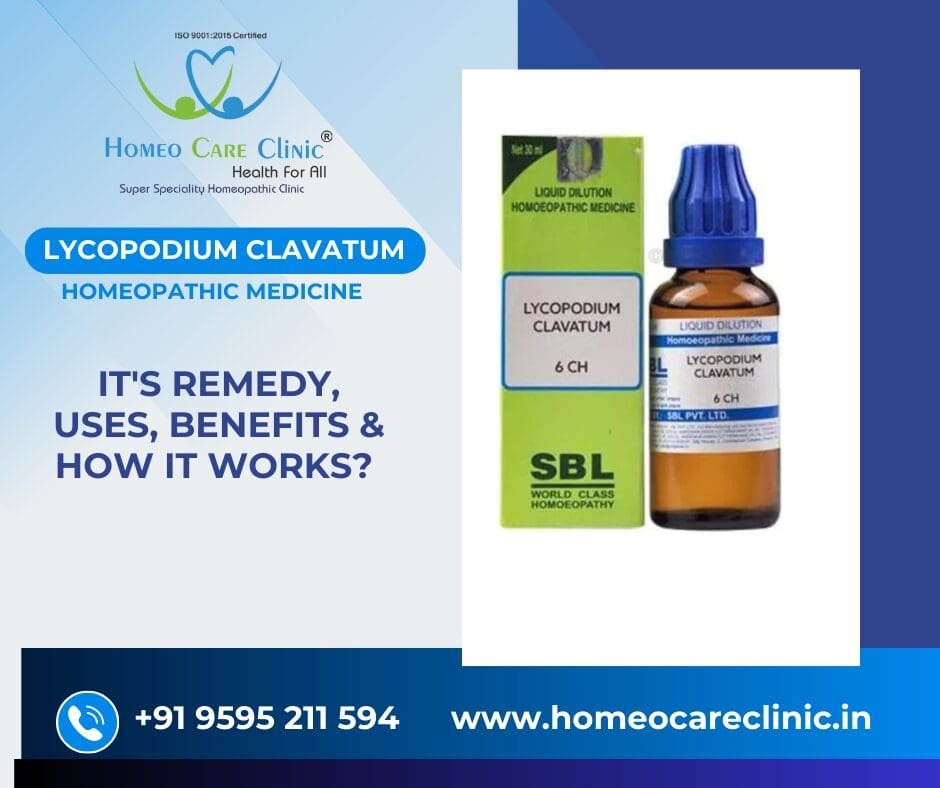
Lycopodium Clavatum, derived from the spores of the club moss plant Lycopodium clavatum (family Lycopodiaceae), is one of the most deeply acting polychrest remedies in classical homeopathy. Through the process of potentization, these inert spores are transformed into a powerful constitutional remedy capable of acting across multiple organ systems – primarily the liver, digestive system, urinary tract, and male reproductive system.
At Homeo Care Clinic, Lycopodium Clavatum holds a place of distinction in Dr. Vaseem Choudhary’s clinical practice. After treating thousands of patients over 16+ years, Dr. Vaseem has observed Lycopodium’s particular effectiveness in patients presenting with right-sided complaints, digestive weakness, liver dysfunction, premature aging, and the characteristic Lycopodium mental-emotional picture of intellectual confidence masking deep insecurity.
This comprehensive guide covers Lycopodium 30 uses, Lycopodium 200 uses, key differentiating symptoms, potency selection, dosage protocols, and the conditions most commonly addressed with this remarkable remedy in clinical practice at Homeo Care Clinic.
The Lycopodium Constitutional Type – Who Needs This Remedy?
In classical homeopathy, understanding the constitutional type is as important as identifying the disease. Lycopodium is not prescribed for a disease – it is prescribed for a person whose total symptom picture matches the remedy’s characteristic pattern.
Physical Characteristics
- Lean, thin, or wiry build – appears older than their actual age (premature grey hair, wrinkled forehead)
- Predominantly right-sided complaints, or symptoms that begin on the right and move to the left
- Symptoms typically aggravated between 4:00 PM and 8:00 PM – this modality is highly characteristic of Lycopodium
- Warm-blooded: dislikes warm stuffy rooms, feels better in open air and in moderate temperatures
- Strong desire for sweets despite digestive sensitivity to them
- Bloating immediately after eating – even a small meal causes a feeling of fullness and distension
- Excessive flatulence, particularly after meals and in the afternoon-evening period
Mental-Emotional Picture
- Intellectual superiority complex masking deep-seated insecurity and lack of self-confidence
- Anticipatory anxiety – extreme nervousness before public speaking, exams, or new situations, but performs well once begun
- Dictatorial at home with family but submissive and timid with authority figures
- Fear of responsibility and taking on new challenges due to deep-seated fear of failure
- Memory weakness – difficulty finding the right words, makes mistakes in writing or speaking
• Depression with aversion to company yet dread of being alone
Complete List of Lycopodium Clavatum Uses
Based on Dr. Vaseem Choudhary’s 16+ years of clinical experience at Homeo Care Clinic, Lycopodium Clavatum is most effectively indicated for the following conditions:
Digestive System
- Chronic indigestion, flatulence, and bloating: the foremost digestive remedy in homeopathy for gas and distension. Patient feels full after eating just a few bites.
- Irritable Bowel Syndrome (IBS): alternating constipation and diarrhoea, with characteristic right-sided abdominal pain and afternoon aggravation
- Liver disease and hepatitis: right-sided liver soreness, jaundice, fatty liver – Lycopodium has a deep affinity for hepatic tissue
- Hyperacidity and GERD: burning in the oesophagus and stomach, sour belching, worse after fatty foods or overeating
- Constipation: ineffectual urging, small hard stools, or large stools with straining; particularly in patients with Lycopodium constitution
- Piles (haemorrhoids): associated with constipation and straining; right-sided
Urinary System
- Kidney stones and renal colic: right-sided kidney stones (Lycopodium is second only to Berberis Vulgaris for renal colic); red sand-like deposits in the urine
- Urinary tract infections: burning before urination, slow flow, must strain to empty the bladder, urine contains sediment
- Enlarged prostate (BPH) in elderly men: difficulty initiating urination, weak stream, dribbling
Male Reproductive System
- Premature ejaculation: Lycopodium is one of the top homeopathic remedies for PE, particularly when associated with performance anxiety, digestive complaints, and the characteristic 4-8 PM aggravation
- Erectile dysfunction: weakness in sexual function, inability to maintain erection, desire present but physical weakness prevents performance
- Sexual neurasthenia from sexual excesses: young men who have indulged in masturbation or sexual excess and have developed weakness, memory loss, and physical debility
- Infertility in men: low sperm count or motility associated with the Lycopodium constitutional type and liver dysfunction
Respiratory System
- Chronic cough with right-sided lung involvement, yellow-green expectoration, worse in the afternoon
- Pleurisy (right-sided): stitching pains in the right side of the chest, worse from movement and breathing
- Pneumonia (right lower lobe): right-sided pneumonia with fan-like movement of the nostrils is a strong Lycopodium indication
- Bronchial asthma: breathlessness worse between 4-8 PM, improved in open air, associated with digestive complaints
Skin and Hair
- Hair fall and premature baldness: Lycopodium patients often experience early hair thinning, particularly after illness, childbirth (in women), or prolonged stress
- Seborrhoeic dermatitis: scaly, oily skin rashes on the scalp and face
- Chronic skin conditions associated with liver dysfunction: jaundiced, yellowish tinge to skin; urticarial rashes worsening in afternoon
- Warts and corns: especially on the palms and soles
Lycopodium 30 vs. Lycopodium 200 – When to Use Which Potency
One of the most common questions Dr. Vaseem Choudhary receives is about potency selection. This is a nuanced clinical decision that depends on the chronicity of the condition, the patient’s sensitivity, and the depth of pathology:
| Parameter | Lycopodium 30C | Lycopodium 200C |
| Best Used For | Acute presentations, functional complaints, mild-moderate chronic conditions | Deep constitutional cases, chronic diseases, emotional/psychological states |
| Repetition | Can be repeated twice daily for acute complaints, or once daily for chronic cases | Typically a single dose; may be repeated every 2-4 weeks under supervision |
| Sensitivity | Suitable for sensitive patients, children, elderly | Requires higher susceptibility; may cause strong initial aggravation in sensitive patients |
| Examples | Acute indigestion, gas/bloating, mild IBS, simple hair fall | Chronic liver disease, deep sexual weakness, recurrent kidney stones, constitutional hair loss |
| Monitoring | Can be self-monitored with basic symptoms tracking | Must be prescribed and monitored by Dr. Vaseem Choudhary due to deep action |
| Duration | 2-4 weeks typically | Effect lasts weeks to months from a single dose |
| Safety | Very safe with standard dosing | Should NOT be self-medicated; requires professional case supervision |
Lycopodium Dosage Guidelines – Dr. Vaseem Choudhary’s Protocol
Homeopathic dosing is not one-size-fits-all. The following guidelines represent general protocols used at Homeo Care Clinic, but your specific dosage will be customised based on your individual case:
Lycopodium 30C – Acute/Functional Complaints
- Standard protocol: 4 pills (or 5 drops in water) twice daily – morning on an empty stomach and evening before bed
- Duration: Continue for 3-4 weeks; if improvement begins, continue until symptoms resolve; stop if rapid aggravation occurs
- What to avoid: Coffee, camphor, mint, raw onions, and garlic in large quantities within 30 minutes of taking homeopathic medicine (these are considered antidotes)
- Storage: Keep in a cool, dark place away from strong-smelling substances and electronic devices
Lycopodium 200C – Constitutional/Chronic Treatment
- ONLY to be prescribed after a detailed consultation with Dr. Vaseem Choudhary or a qualified classical homeopath
- Typically given as a single dose (4-5 pills) or repeated once every 3-4 weeks depending on response
- Observe for the next 2-4 weeks: initial mild aggravation (temporary worsening of symptoms) is a positive sign indicating the remedy is acting
- Do NOT repeat the dose during the period of action – this is one of the most common mistakes patients make with high potency remedies
Lycopodium Mother Tincture (Q)
- The mother tincture is rarely used in constitutional homeopathy; more commonly used in drainage protocols or as a liver tonic in combination therapies
- Typical dose: 10-15 drops in 1/4 cup water, twice daily if prescribed
- For hair fall specifically: Q tincture is sometimes used for scalp application in combination with carrier oil (consult Dr. Vaseem for correct preparation)
Lycopodium 30 ke Upyog (Lycopodium 30 Uses in Hindi)
लाइकोपोडियम 30 के प्रमुख उपयोग (Hindi-speaking patients ki suvidha ke liye):
- पाचन की कमजोरी, गैस और पेट फूलना – खाने के बाद तुरंत पेट भरा लगना
- दाहिनी तरफ की किडनी पथरी का दर्द – बेर्बेरिस के बाद सबसे अधिक प्रयुक्त दवा
- शीघ्रपतन – विशेषकर चिंता और पाचन समस्या के साथ होने पर
- बाल झड़ना – जब यकृत (लीवर) की कमजोरी के साथ हो
- शाम 4 से 8 बजे के बीच सभी लक्षणों का बढ़ना – यह लाइकोपोडियम की सबसे विशेष पहचान है
- यकृत (लीवर) की बीमारी और फैटी लीवर – दाहिनी तरफ दर्द और भारीपन के साथ
Important Cautions and Contraindications
While Lycopodium is a safe homeopathic remedy, the following considerations are important:
- Do NOT self-prescribe Lycopodium 200C or 1M – these high potencies require professional supervision. Inappropriate use can cause prolonged aggravations.
- Patients with liver cirrhosis, active hepatitis, or severe liver failure should inform Dr. Vaseem Choudhary of all conventional medications before starting Lycopodium, as the remedy’s deep liver action may influence medication metabolism.
- Pregnant women: Lycopodium is used in homeopathy during pregnancy but ONLY under the direct supervision of Dr. Vaseem Choudhary or a qualified homeopath.
- Children under 2 years: Require specially diluted doses; never use adult doses for infants or toddlers.
- If you are currently on allopathic medications for liver disease, kidney disease, or hormonal conditions, always consult Dr. Vaseem before starting Lycopodium.
Clinical Outcomes at Homeo Care Clinic – What Patients Experience
Based on Dr. Vaseem Choudhary’s clinical documentation at Homeo Care Clinic over 16+ years:
- Chronic digestive complaints (IBS, bloating, flatulence): Most patients report 60-80% improvement within 4-6 weeks of correctly prescribed Lycopodium
- Right-sided kidney stones: Cases of right ureteric calculi up to 7-8mm have passed without surgical intervention with Lycopodium combined with Berberis Q and adequate hydration
- Hair fall related to liver weakness or stress: Visible reduction in hair fall within 6-8 weeks; new hair growth observed in 3-4 months with constitutional treatment
- Premature ejaculation with Lycopodium constitution: 70-80% of appropriately selected cases show significant improvement in 8-12 weeks of constitutional treatment
- Anticipatory anxiety: Patients notice reduced pre-event nervousness and improved confidence within 4-8 weeks
Individual results vary based on the chronicity of the condition, patient compliance, and accuracy of remedy selection. Consult Dr. Vaseem Choudhary for a personalised assessment.
Frequently Asked Questions – Lycopodium Clavatum
Reviewed by Dr. Vaseem Choudhary, B.H.M.S, M.D Homeopathy, June 2026
Lycopodium 30 is used for acute and moderate chronic conditions including indigestion, gas and bloating, mild IBS, hair fall, right-sided kidney pain, premature ejaculation associated with anxiety, right-sided cough, and digestive complaints. It is the more commonly prescribed potency for day-to-day functional complaints in the Lycopodium constitutional type.
Lycopodium 200 is a constitutional high-potency remedy used for deep, chronic conditions including chronic liver disease, recurrent kidney stones, long-standing sexual weakness and impotence, chronic hair loss linked to liver or hormonal dysfunction, deep-seated anticipatory anxiety, and longstanding IBS. It should ONLY be taken under the supervision of Dr. Vaseem Choudhary or a qualified classical homeopath, as it has a deep and long-lasting action.
For acute complaints (gas, bloating, indigestion), Lycopodium 30 may show results within 24-72 hours. For chronic constitutional conditions, noticeable improvement typically occurs within 4-8 weeks with Lycopodium 30, while Lycopodium 200 may take 3-6 months for deep chronic conditions. Patience and consistency are essential in homeopathic treatment.
When correctly prescribed, homeopathic Lycopodium does not cause toxic side effects as it contains no pharmacologically active molecules. However, a brief initial aggravation (temporary mild worsening of symptoms for 1-3 days) is a positive sign that the remedy is acting correctly, especially with higher potencies (200C, 1M). If aggravation is severe or prolonged, contact Dr. Vaseem Choudhary immediately.
In most cases, yes – homeopathic remedies do not chemically interact with allopathic drugs. However, certain substances are considered antidotes to homeopathic remedies (coffee, camphor, strong mint). Always inform Dr. Vaseem Choudhary about all your current medications before starting homeopathic treatment so that potential interactions can be managed properly.
Yes, Lycopodium is one of the important homeopathic remedies for hair fall, particularly when associated with liver weakness, premature greying, digestive problems, or a history of illness/stress-triggered hair loss. Results typically become visible at 6-8 weeks for reduced hair fall, with new growth appearing at 3-4 months. It works best as a constitutional remedy matched to your complete symptom picture.
Key antidotes that may reduce Lycopodium’s effectiveness include: coffee (including decaffeinated), camphor (found in some balms and ointments), strong mint or menthol products, raw garlic and onions in large quantities (small culinary amounts are generally fine), and strong-smelling perfumes. Also avoid eating or drinking anything for 15-20 minutes before and after taking your homeopathic medicine. Store your remedies away from mobile phones, microwaves, and direct sunlight.
Yes, they are the same. Lycopodium Clavatum is the full botanical name of the club moss plant from which the homeopathic remedy is prepared. In clinical practice and on medicine labels, it is often shortened simply to ‘Lycopodium’. The remedy is the same regardless of which name is used – what matters is the potency (30C, 200C, 1M, etc.) and the manufacturing quality.
References & Medical Sources
[1] Hahnemann S. Organon of the Medical Art (6th ed). O’Reilly B (ed). Redmond: Birdcage Books; 1996.
[2] Kent JT. Lectures on Homeopathic Materia Medica. New Delhi: B. Jain Publishers; 2004.
[3] Boericke W. Pocket Manual of Homeopathic Materia Medica. 9th ed. New Delhi: B. Jain Publishers; 2012.
[4] Choudhary V. Clinical Case Series: Lycopodium in Right-Sided Renal Calculi and IBS. International Journal of Homeopathy and Natural Medicines (IJHNM). 2022.
[5] Vithoulkas G. The Science of Homeopathy. New York: Grove Press; 1980.
[6] National Center for Homeopathy (NCH). Materia Medica Clinical Reference. Alexandria, VA: NCH; 2019.