

I had a couple come into the clinic last Wednesday afternoon. They looked completely exhausted. The kind of bone-deep, soul-crushing exhaustion that only parents of toddlers truly understand. They sat down in the chairs across from my desk, and the mom immediately started crying. Her husband just put his hand on her shoulder and looked at the floor.
Sitting between them, completely oblivious to the heavy emotional atmosphere, was their two-and-a-half-year-old son. He was playing with a wooden train on my floor. He was building a complicated little track, humming happily to himself. He looked perfectly healthy.
“He won’t say ‘mama,'” the mom sobbed, wiping her eyes with a tissue. “He is almost three years old, and he just grunts and points. My sister’s kid is exactly the same age and she is reciting the alphabet. We are terrified. We don’t know if he is autistic, if he is deaf, or if we just ruined his brain by letting him watch too much TV during the monsoon.”
This is the reality for so many parents right now.
When the house finally goes quiet, the anxiety creeps in. I know all about those panicked, whispered late night talks between spouses. You lie there in bed, staring at the ceiling, wondering if you did something wrong. You google milestones at two in the morning and convince yourself that your child’s silence is a permanent life sentence. The sheer volume of fear surrounding late talking children is staggering.
But here is the truth that nobody tells you in those scary internet forums: not every silent kid is broken.
The human brain is not a factory machine that produces words on a strict, predetermined assembly line. Every child’s nervous system matures at its own unique pace. But as a parent, you are stuck in the agonizing gray area. You need to know the reality of Late talking vs late blooming: how to differentiate between a kid who just needs a little more time, and a kid whose neurological engine has actually stalled out and needs a serious jumpstart.
So let’s sit down and pull this entire mess apart. No medical jargon. No panic. Just a straightforward, honest look at why some kids stay quiet, what the red flags actually look like, and how we can gently prompt their brains to finally open up without forcing them into stressful, terrifying situations. We have a lot of ground to cover, so let’s get into it.
The Core Problem: Understanding the Difference
If you want to understand Late talking vs late blooming: how to differentiate, you have to understand the two different ways a brain processes language.
There is receptive language, and there is expressive language.
Receptive language is the sponge. It is the brain’s ability to hear words, decode them, and understand what they mean. Expressive language is the output. It is the physical, neurological ability to coordinate the tongue, the lips, the vocal cords, and the breath to actually push the word out of the mouth.
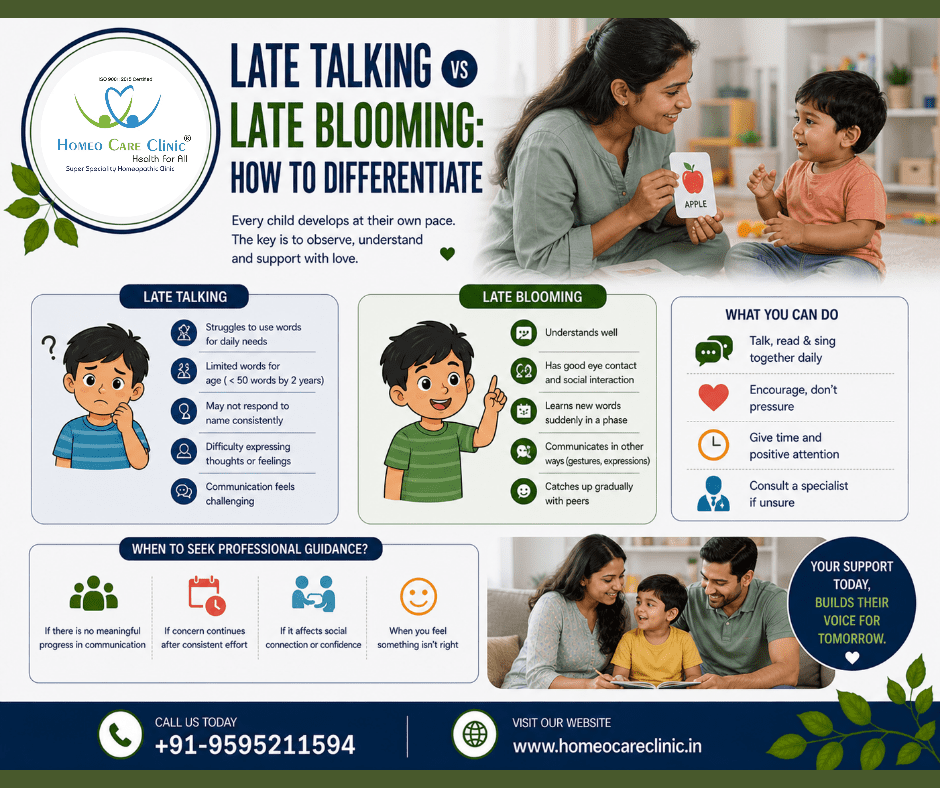
A “late bloomer” is a child whose receptive language is absolutely perfect. Their sponge is full. If you say, “Go to the kitchen and bring me your red shoes,” they will trot into the kitchen, find the red shoes, and bring them back to you. They understand exactly what is going on. They make great eye contact. They point at airplanes in the sky. They just haven’t figured out the complicated motor skills to push the expressive words out yet. They are gathering data. And usually, right around age three, the dam breaks and they start talking in full sentences.
A true “late talker”—a child with an actual developmental delay—has a glitch in the system. Sometimes the receptive sponge is dry; they don’t understand what you are saying to them. If you tell them to get their shoes, they just stare at you blankly. Or, they understand you, but the neurological pathway connecting the thought to the physical muscles of the mouth is blocked. They want to speak, but their brain literally cannot coordinate the sequence of movements required to make the sound.
The Causes: Why Do They Stay Silent?
Why does the system glitch? Why do some kids chatter away at 18 months while others are still completely silent at 36 months? The causes of speech delays in late talking children are incredibly varied, and often, it is a combination of a few different roadblocks.
The Biological Family Tree Look at your own parents. Ask them when you started talking. Ask your partner’s parents when they started talking. Genetics play a massive, undeniable role in neurological development. If the child’s father didn’t speak until he was three and a half, there is a very good chance the child’s nervous system is running on that exact same genetic timeline. It isn’t a disease; it is just a family trait.
The Silent Ear Infections (Glue Ear) This is the sneakiest, most common physical cause I see in my clinic. A child gets a mild cold. The cold goes away, but the fluid gets trapped deep inside the middle ear. It doesn’t always hurt, so the kid doesn’t cry or pull at their ears. But that thick, glue-like fluid acts like earplugs. For six months, the child is essentially living underwater. Everything sounds muffled, like Charlie Brown’s teacher. You cannot learn how to pronounce sharp consonants if you literally cannot hear them.
Oral-Motor Weakness Talking requires incredible physical strength and coordination. Your tongue, jaw, and lips have to perform highly complex gymnastics to form sounds. Some kids have very low muscle tone in their face. They are sloppy eaters, they drool a lot, and they might have a hidden tongue-tie that physically pins their tongue to the floor of their mouth. If the hardware is weak, the software can’t run.
The Pandemic Sibling Effect and Screen Time We have to talk about the environment. If you have an older sibling who is a total chatterbox, they often act as a translator for the younger child. The toddler points at the fridge, the older sibling yells, “He wants juice!” and the parents give him juice. The toddler quickly realizes he never actually has to speak to get his needs met.
Combine that with iPads. Screens are a one-way street. A tablet talks at a child; it does not require the child to respond. A brain that is constantly pacified by fast-paced, flashing videos does not develop the patience or the neural pathways required for the slow, frustrating friction of human conversation.
Neurodivergence And yes, sometimes a severe lack of speech is a symptom of a broader neurological difference, like Autism Spectrum Disorder or Apraxia of Speech. In these cases, the brain’s wiring is fundamentally different, and the speech delay is usually accompanied by other very distinct sensory and social markers.
The Signs and Symptoms: Red Flags vs. Green Flags
You cannot figure out Late talking vs late blooming: how to differentiate just by counting the number of words your child says. You have to look at the whole picture. You have to look at how they communicate without words.
Here is what you actually need to be looking for in your living room.
The Green Flags (The Late Bloomer Profile)
If your child is doing these things, take a deep breath. They are likely just taking their time.
- The Joint Attention: If a dog walks into the room, does your child look at the dog, and then look back at you to make sure you are seeing the dog too? That is joint attention. It proves their social brain is highly active.
- The Pointing and Gesturing: They might not say “up,” but they raise their arms. They point to the toy they want. They wave goodbye. They shake their head “no.” They are actively using their body to bridge the communication gap.
- High Receptive Language: They follow multi-step directions. “Pick up the ball and put it in the basket.” They understand exactly what is happening in their environment.
- Engaged Play: They pretend to drink from an empty toy cup. They try to feed a doll. Their imaginative play is developing normally.
The Red Flags (The True Delay Profile)
If you are seeing these symptoms, it is time to stop waiting and start acting.
- No Eye Contact: When you call their name from across the room, they don’t look up. They avoid looking at your face when you are talking to them.
- Losing Skills: This is a massive red flag. If they used to say “mama” and “dada” at 15 months, and now at 24 months they have completely stopped saying those words and have gone totally silent, you need an evaluation immediately.
- Severe Frustration Meltdowns: Because they cannot express their needs, and they lack the gestures to compensate, they become violently frustrated. They bite, they hit their head against the wall, and they scream inconsolably because they are trapped inside their own head.
- No Pointing by 18 Months: If they want something out of reach, they don’t point at it. Instead, they take your hand and physically push it toward the object, using you like a mechanical tool rather than a person.
- Lack of Interest in People: They prefer to stare at ceiling fans, line up toys in perfect rows, or watch the wheels of a toy car spin, rather than interact with you or other children.
Conventional Treatment: The Waiting Game and The Grind
So you notice the red flags. You are terrified. You take your child to a conventional pediatrician. What happens next?
Honestly, the conventional route is often incredibly frustrating for parents.
The “Wait and See” Brush-Off If your child is under the age of two and a half, a lot of pediatricians will simply pat you on the shoulder and say, “Boys are just lazy. Give it six more months.” They tell you not to worry. But you are the one living with a frustrated, screaming toddler. Waiting six months while a brain is in its most critical developmental window feels like absolute torture.
The Audiology Test If the doctor is thorough, they will send you for a hearing test. This is actually crucial. You must rule out fluid in the ears or partial deafness. But getting a squirmy two-year-old to sit in a soundproof booth and cooperate for an audiology exam is a nightmare.
The Speech Therapy Waitlist If they finally agree that there is a delay, they hand you a referral for a pediatric speech therapist. And then reality hits. The system is completely overwhelmed right now. The waiting list for a good speech-language pathologist can be anywhere from three to eight months.
When you finally do get in, speech therapy can be wonderful. A good therapist uses play to coax words out of the child. But forty-five minutes a week in a sterile clinic room is not enough to completely rewire a stalled nervous system. And if the child is deeply anxious or stubbornly resistant, they will often refuse to cooperate with the therapist entirely. You end up paying a fortune to watch your kid sit under a table and cry.
Homeopathy Treatment: Waking Up the Nervous System
This is why those late night talks eventually lead parents to my door. They are tired of waiting on lists. They are tired of being told to “just read to him more.” They know their child’s brain needs a biological push.
Homeopathy does not magically teach a child vocabulary. It isn’t a dictionary in a pill. What it does is treat the underlying sluggishness. We look at the kid’s entire constitutional makeup. How do they sleep? How is their digestion? Are they incredibly stubborn? Are they terrified of strangers?
We find the specific nanomedicine that matches their unique energetic blockage, and we hit the reset button. We wake the nerves up.
Here are 5 medicines we pull from the cabinet constantly for kids who are stuck in the silent phase.
1. Baryta Carbonica
- Indicated for: Severe developmental sluggishness and intense shyness.
- Best suited for: The kid who just seems undeniably “behind.” They are often physically smaller for their age. They hit every milestone late—late crawling, late walking, and late talking. But the defining feature is the shyness. If a stranger walks into the room, or if an uncle visits, they hide behind your legs and bury their face in your knees. They are terrified of being evaluated. They often have huge, swollen tonsils and catch every cold that goes around. When they do try to speak, the articulation is usually very poor and mushy.
- Key actions: Baryta Carb matures a stunted nervous system. It works deeply on the glandular system and the brain to push the child out of that infantile, fearful, delayed stage, building real internal confidence so they aren’t afraid to open their mouths.
2. Calcarea Carbonica
- Indicated for: The stubborn, slow-moving, late-walking child.
- Best suited for: The classic “Calc Carb” kid is usually a bit chunky, fair, and very slow-moving. They sweat heavily around the back of their head and neck, especially when they fall asleep. They are incredibly stubborn. If they don’t want to talk, you cannot force them. They usually walked late because they just lacked the physical stamina. Their receptive language is usually okay, but they are just too comfortable and too stubborn to put the effort into expressive speech.
- Key actions: It supports overall bone, muscle, and nerve development. It gives the physical body the stamina it needs and softens that intense, immovable stubbornness, making the child more willing to engage with the effort of talking.
3. Natrum Muriaticum
- Indicated for: Emotional late talkers who hold grudges and isolate.
- Best suited for: This is a fascinating remedy for a very specific type of kid. This child’s receptive language is usually 100% perfect. They understand everything. But they refuse to speak. They are deeply, intensely emotional, but they hide it. If you scold them, they don’t scream; they go sit in a corner, stare at the wall, and hold a massive grudge. They hate being comforted. If they are crying and you try to hug them, they will push you away. They wait to speak until they can speak perfectly, often jumping straight into full sentences very late in the game.
- Key actions: Natrum Mur breaks down the massive, defensive emotional wall the child has built. It softens the intense fear of rejection and allows the child to feel safe enough to actually communicate and make mistakes without feeling humiliated.
4. Silicea (Silica)
- Indicated for: Physically frail, exhausted kids who lack grit.
- Best suited for: The child who looks physically delicate. They have fine hair, a large head, and very thin limbs. They are prone to chronic, nasty ear infections—which often causes the glue-ear hearing loss that delays speech. They are intelligent, but they yield easily. They have no mental or physical grit. They try to say a word, fail, get exhausted, and just give up completely. They are incredibly obstinate in a very quiet, smiling way.
- Key actions: Silicea brings grit back to the physical body. It strengthens weak connective tissue, helps clear the chronic fluid out of the middle ear, and gives the nervous system the actual physical energy required to push through the frustration of learning to speak.
5. Agaricus Muscarius
- Indicated for: Clumsy, twitchy kids with motor-planning issues.
- Best suited for: The kid whose nervous system just seems totally uncoordinated. They are the ones who trip over their own feet on a flat floor. They might have strange little facial twitches or spasms. They drop their cups constantly. Their speech delay is heavily tied to apraxia—they literally cannot coordinate the muscles of their tongue and jaw to form the words, even though they know what they want to say. Their speech is jerky, and they often speak late and with a heavy stutter.
- Key actions: Agaricus acts directly on the coordination of the motor nerves. It smooths out the jerky, clumsy signals going from the brain to the muscles, helping the brain establish solid, clean connections for both walking and complex speech articulation.
Why Choose Homeo Care Clinic
You cannot treat a complex neurological delay by reading lists on the internet and guessing. If you guess wrong, you just waste six months of a critical developmental window.
This is exactly why you need to stop losing sleep and bring your child into Homeo Care Clinic to sit down with Dr. Vaseem Choudhary.
- Decades of Real Diagnostic Experience: Dr. Vaseem Choudhary has been doing this right here in Pune for nearly twenty years. He knows how to look at a child playing on the floor and instantly tell the difference between a late bloomer and a kid who is neurologically stuck. He doesn’t judge you. He cuts through the noise and figures out the actual pathology of the silence.
- We Treat the Hidden Physical Blockages: A kid who can’t talk often has a terrible gut. They are chronically constipated, or they suffer from silent acid reflux. The gut and the brain are inextricably linked. We treat the digestive tract at the exact same time we treat the speech delay, because a toxic gut creates a foggy brain.
- Accessible and Convenient: When you have a toddler who hates transitions and screams in the car, driving across the city to a clinic is a nightmare. With established, fully staffed clinics in Viman Nagar, Hadapsar, and Magarpatta, you can actually get your consultation done without ruining your entire day in Pune traffic.
- Zero Toxic Sedatives or Chemicals: We do not believe in drugging toddlers. Our nanomedicines are highly diluted, incredibly safe, and sweet-tasting. Kids actually want to take them. They gently prompt the body to heal itself without causing weird weight changes or turning the child into a zombie.
The Benefits of Homeopathy for Speech Delays
Why bother with this if you are already on a waiting list for speech therapy?
- It Acts as a Multiplier: If you are lucky enough to be in speech therapy, homeopathy doesn’t interfere. In fact, therapists constantly tell our patients, “Wow, he was so engaged today, he really woke up!” The remedy primes the brain so the child can actually absorb what the therapist is trying to teach them.
- Reduces Frustration Tantrums: The worst part of a speech delay is the biting, head-banging, and screaming that happens because the kid is misunderstood. Remedies like Natrum Mur and Calc Carb take the raw edge off that anger while their vocabulary catches up.
- Boosts Baseline Immunity: A child who is constantly fighting off low-grade ear infections or colds has zero energy left for brain development. Constitutional homeopathy massively boosts their immune system so they stop getting sick every two weeks.
- It Treats the Whole Child: We don’t just treat the vocal cords. We treat the sleep, the digestion, the fears, and the physical stamina. When the whole system is balanced, the speech naturally follows.
Lifestyle Adjustments: You Have to Change the House
Medicine gives the brain the spark. But you have to build the fire. If you want your child to speak, you have to fundamentally change how communication happens in your living room.
- Stop Being a Mind Reader: This is the hardest habit to break. If your child points at the milk, do not just hand them the milk. You are enabling the silence. Hold the milk. Look them in the eye. Say the word “Milk.” Wait five seconds. Give them a chance to try. Even if they just grunt, reward the effort. You have to create the need for communication.
- Narrate Your Entire Life: You need to become an incredibly annoying sports announcer. Turn off the TV. When you are cooking dinner, talk out loud. “I am chopping the red tomato. I am turning on the water. Splash, splash.” Bathe their brain in simple, clear language all day long.
- The Screen Time Ban: I am deadly serious about this. If your child is delayed, you must pull the plug. Screens hijack the dopamine system and promote passive staring. Put the iPads in a drawer. Let them be bored. Boredom forces them to interact with you.
- Sing Everything: The human brain processes music in a completely different area than spoken language. A kid who cannot say “twinkle” will often be able to sing the entire “Twinkle Twinkle Little Star” song. Sing directions. Sing during bath time. Use melody to bridge the neurological gap.
Diet Adjustments
A brain that is struggling to wire itself together needs heavy-duty building blocks. You cannot feed a delayed child garbage and expect their nervous system to thrive.
- Chewing Builds Talking Muscles: The exact same muscles used to chew tough food are the ones used to articulate sharp consonants. If your kid only eats soft foods—yogurt, purees, mac and cheese—their jaw muscles are weak. Give them raw carrots, apple slices, or tough pieces of meat. Make them chew. It is literally physical therapy for their mouth.
- Omega-3s are Non-Negotiable: The brain is mostly fat. The myelin sheaths that insulate the nerves and make signals travel fast are built out of fatty acids. Get a very high-quality, heavy-metal-free liquid fish oil supplement and give it to them every single day.
- Check the Iron and Zinc: Anemic kids are foggy kids. If their brain lacks oxygen, development stalls. Get a basic blood panel done. Feed them spinach, pumpkin seeds, and red meat to get their mineral levels up.
- Stop the Sugar Rollercoaster: A kid trying to focus on a difficult speech task cannot have a blood sugar crash. Sugar spikes cause hyperactivity followed by exhausted meltdowns. Feed them heavy protein in the morning—eggs or peanut butter—to keep their engine running perfectly flat and steady.
5 Commonly Asked FAQs
1. Does being bilingual cause a speech delay?
- No. This is a massive, outdated myth.
- Raising a child with two languages does not cause a delay. They might mix the words up occasionally, but their overall language milestones should hit at the exact same time as a monolingual child. Do not stop speaking your native language to them.
2. My child babbles in their own made-up language all the time. Is that good?
- Yes, jargon is actually a great stepping stone!
- If they are babbling with the correct intonation—like they are asking a question or making a statement in their own alien language—it means they understand the rhythm of conversation. The real words will usually follow.
3. Is it my fault they aren’t talking?
- No. Stop doing that to yourself.
- You did not cause this by being a working parent or by letting them watch a cartoon so you could take a shower. It is a neurological roadblock. Let the guilt go so you have the energy to help them.
4. How fast will the homeopathic medicine make them talk?
- It is not a magic trick. You won’t wake up tomorrow to them reciting poetry.
- Usually, within the first month of a well-chosen remedy, parents notice the child is making better eye contact, trying to babble more, and seems more “present.” The actual vocabulary explosion usually builds steadily over a few months of consistent treatment and lifestyle changes.
5. Should I correct them when they pronounce a word wrong?
- No. Never say “No, that’s wrong.”
- If they point to a dog and say “Gog,” you just smile and warmly say, “Yes! That is a big dog.” Model the correct pronunciation, but praise the absolute life out of the effort. If you criticize them, they will just stop trying.
A Few Final Thoughts…
So here we are.
Watching your child struggle to do something that seems so effortless for every other kid on the playground is a uniquely painful experience. It makes you feel isolated. It fuels those terrifying late night talks where you imagine the absolute worst-case scenarios for their future.
But you have to step back and look at the reality. The landscape of late talking children is vast. When you finally understand the mechanics of Late talking vs late blooming: how to differentiate, you take your power back. You stop looking at your silent toddler like they are a tragedy, and you start looking at them like a puzzle that just needs the right key.
You don’t have to just sit on a six-month waiting list and slowly lose your mind. You don’t have to accept the pediatrician’s brush-off.
You can take action today. You can change how you communicate in your house. You can change their diet. And by bringing them into Homeo Care Clinic to let Dr. Vaseem Choudhary evaluate their entire constitution, you can give their nervous system the exact biological push it needs to break through the roadblock.
They have a voice in there. They have thoughts, and opinions, and probably a lot of demands they are just waiting to unleash on you. You just have to be patient, give their body the right support, and wait for the dam to break. They are going to get there. So take a deep breath, put the internet away for the night, and let’s get to work.
“Your health deserves more than temporary relief. Choose homeopathy for lasting results”
Start your journey towards better focus today.
About the Author Bio:
Dr. Vaseem Choudhary M.D is a seasoned classical homeopath with over 16+ years of experience, dedicated to treating patients with compassion, precision and holistic care. Mainly in Pune & Mumbai, serving both national and international patients from UK, USA, Germany, France, Canada, Bhutan, Dubai and China. With a wide range of acute and chronic conditions—from skin disorders, hormonal issues, and digestive problems to autoimmune diseases and mental health concerns.
Dr. Vaseem is widely respected for his unique approach that combines classical homeopathy, personalized diet planning, lifestyle guidance, and a spiritual perspective on healing. He is known for his detailed and empathetic case-taking process, which focuses on treating the root cause rather than just symptoms.
In recognition of his dedication and clinical excellence, Dr. Vaseem Choudhary MD has been honored with the Best Homeopathic Doctor in Pune award by leading platforms such as:
- Awarded for International Excellence in Autism & ADHD Treatment 2026 in UK Parliament, London
- Dr. Vaseem Choudhary honoured at the UK Parliament, receiving International recognition PG from the London College of Homeopathy 2026
- Dr. Vaseem Choudhary, MD, was further acknowledged in Dubai in 2026 for his expertise in Autism and ADHD, reinforcing his growing international recognition in this field
- Best Homeopathy Doctor in Pune – National Healthcare Service Excellence Awards 2024
- Most Trusted Centre for Autism and ADHD in India 2025 – Healthcare Excellence & Leadership Awards
- Best Homeopathy Doctor in Pune – Dr. Vaseem Choudhary Shines at Ayush 2nd International Conference, Dubai
- Recognized for spearheading homeopathic treatment protocols, improving patient satisfaction, and healthcare advancements.
He is also a contributing author to the International Journal of Homeopathy and Natural Medicines (IJHNM), where he shares his research and clinical experiences with the global medical community.
With a passion to take homeopathy to new heights, Dr. Vaseem continues to guide patients towards natural, safe, and sustainable healing.
Homeo Care Clinic offers a holistic approach to treating the disease. The remedies mentioned above can treat the underlying causes of the condition and offer relief from the discomfort. However, it is important to consult a qualified homeopathic practitioner for the correct dosage and duration of treatment. Homeo Care Clinic provides comprehensive care for various ailments, and offers customized treatment plans based on individual requirements.
To schedule an appointment or learn more about our treatment, please visit our website or give us a call +91 9595211594 our best homeopathy doctor will be here to help.
Follow us on Facebook, Twitter and Instagram for valuable insights into the world of homeopathy and holistic health.
- Facebook– https://www.facebook.com/homeocareclinicpune
- Instagram– https://www.instagram.com/homeocareclinic_in
- Website– https://linktr.ee/homeocareclinic
- Success Stories of Patients –https://www.homeocareclinic.in/category/case-study/
- Patient Testimonials – https://www.homeocareclinic.in/testimonial/
Chat with a best homeopathic doctor privately:
If you have any queries regarding your disease or any symptoms, click to send a What‘s App message. Our best homeopathy doctor will be happy to answer you. About Us Click
Book an Appointment:
If you want to visit our clinic, click to book an appointment.
Online treatment:
If you are a busy professional, or you are living in a remote town or city, with no best homeopathic doctor near you, Click to start an online homeopathic treatment with the world’s exclusive, most experienced and best homeopathic clinic, managed by Dr. Vaseem Choudhary world-renowned homeopathic doctor expert
- About Us – https://www.homeocareclinic.in/about-us/
Our Doctors –https://www.homeocareclinic.in/team/