

I was sitting behind the desk at the clinic last week, just sorting through some messy paperwork, when a dad walked in with his little boy. The kid was maybe four years old. Cute kid. Wearing a shirt with a dinosaur on it.
He sat down in the waiting room, grabbed a plastic toy fire truck from the play bin, and flipped it upside down.
He didn’t drive it on the rug. He didn’t make siren noises. He just took his tiny index finger and flicked the back tire. The wheel spun. He watched it until it stopped. And then he flicked it again.
He did this for twenty solid minutes. Flick. Spin. Stare.
I watched the dad. You could literally see the tension creeping up his neck. He kept looking around the room to see if anyone was watching them. Finally, he snapped. He reached over, grabbed the fire truck out of the boy’s hands, and shoved it back into the bin. “Stop doing that, it’s weird,” he muttered.
The kid completely lost his mind. He threw himself on the floor, screaming this high-pitched, terrified wail, banging his fists on the carpet. The dad just looked at me with this mix of absolute embarrassment and deep, crushing fear.
Parents are terrified of the loop.
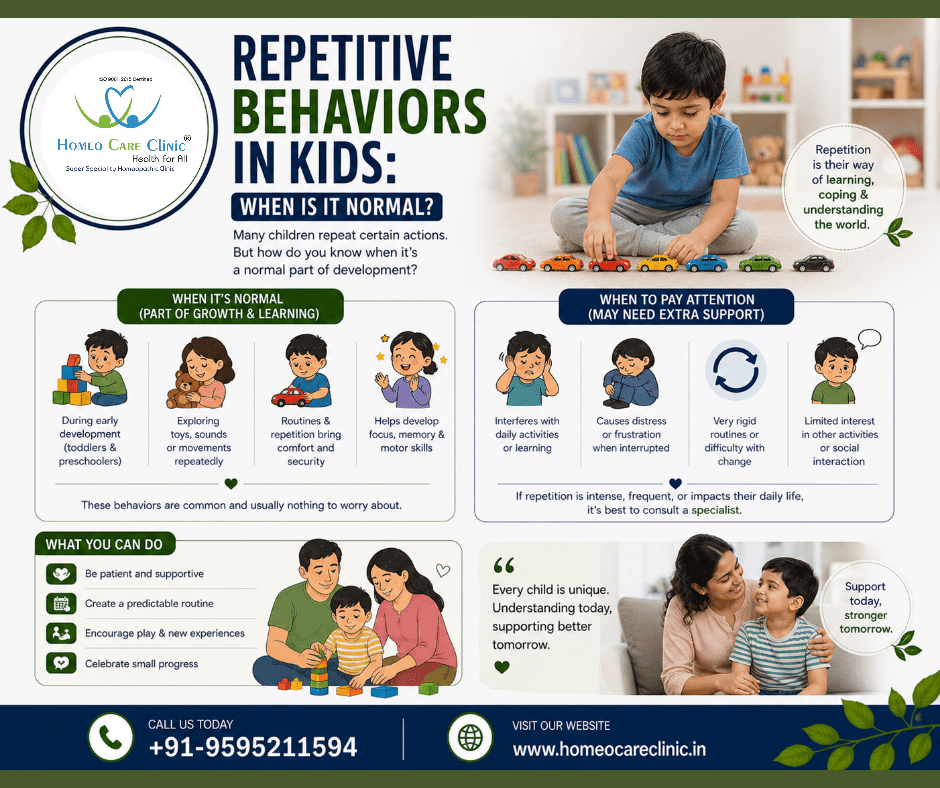
They see their kid doing something over and over again—flapping their hands, lining up blocks in a perfectly straight row, repeating a phrase from a cartoon forty times in a row—and they panic. They immediately go online at two in the morning and fall down a rabbit hole of scary medical forums. Everyone is desperately trying to figure out the exact same thing: Repetitive behaviors in kids: when is it normal?
And honestly? It’s a messy question. Because the brain is messy. Sometimes a loop is just a kid figuring out how gravity works. Sometimes it is a massive warning siren that their nervous system is totally overwhelmed and frying on the inside.
So let’s just lay all the cards on the table. Let’s talk about why kids get stuck on repeat. What it actually looks like. And how we can actually help them regulate their little bodies without just ripping the toy out of their hands and making them cry.
The Real Causes: Why Do They Get Stuck on Repeat?
Why does a human brain decide to do the exact same physical motion or make the exact same sound fifty times?
It actually makes a lot of sense if you think about it.
- The World is Too Loud. Kids have tiny sensory buckets. If you take a toddler to a loud, chaotic birthday party, their brain is getting hit with flashing lights, yelling kids, and the smell of cheap pizza all at once. It is terrifying. So they find one tiny, predictable thing they can control. Flicking a wheel. Rocking back and forth. The repetition drowns out the chaos. It is a physical anchor in a totally overwhelming world.
- Trying to Feel Gravity. This is a weird one, but it happens all the time. Some kids have a glitch in their proprioceptive system. That is the internal sense that tells your brain where your arms and legs are in space. If that system is sluggish, the kid literally feels like they are floating away. So they jump. They crash into couches. They flap their arms really hard. The heavy physical impact tells their brain, “Okay, I’m here. I have a body.”
- The Dopamine Hit. A lot of these behaviors just feel really, really good to them. The brain releases a tiny squirt of dopamine when they line the cars up perfectly by color. Why would they stop doing something that makes their brain feel happy?
- The Developmental Phase. Babies and toddlers are supposed to repeat stuff. That is literally how they learn cause and effect. I drop the spoon, mom picks it up. I drop the spoon, mom picks it up. It drives parents crazy, but for a one-year-old, that is just science.
The Signs and Symptoms You Actually See
So what does the loop actually look like in your living room?
It isn’t always just rocking in a corner. The symptoms are usually way sneakier than that. You have to watch how they play.
- The Line-Up. You buy them an expensive train set. Instead of building a track, they take every single train car and line them up end-to-end across the entire living room floor. If you bump one out of place, they scream like you just burned their house down.
- Echolalia. This is the verbal loop. You ask them, “Do you want some juice?” And instead of answering, they just repeat, “Want some juice? Want some juice? Want some juice?” Sometimes they just repeat whole scenes from a YouTube video they watched three days ago, completely out of context, while staring at a wall.
- The Physical Stims. Stimming just means self-stimulatory behavior. Hand-flapping when they get excited. Pacing back and forth across the kitchen island for an hour. Spinning in tight circles until they are dizzy, but somehow they never actually fall over.
- Obsessive Sorting. They don’t play with the Lego bricks. They just sit there for three hours sorting them. All the red ones in this pile. All the blue ones in that pile. The play has zero imagination. It is just pure, rigid organization.
Conventional Treatment: The Usual Frustration
So you finally drag your kid to a regular doctor because you are worried. What do they tell you?
Usually, if the kid is under three, they just shrug and say, “Wait and see. Boys develop slower.”
I hate the wait-and-see game. Waiting while a nervous system struggles is just wasting valuable time.
If the repetitive behavior is really severe, and they slap an autism or ADHD label on the kid, the conventional route is almost always behavioral therapy. Specifically, Applied Behavior Analysis (ABA).
And look. I’m going to tread carefully here. Some therapies are great. But a lot of old-school behavioral therapy focuses heavily on just making the kid stop the weird behavior. They train the kid to keep “quiet hands.” They use rewards and punishments to make the kid stop flapping or rocking so they look “indistinguishable from their peers.”
I have a massive problem with that.
If a kid is flapping their hands because it is the only way they know how to calm their racing heartbeat down… and you force them to sit on their hands… you haven’t cured their anxiety. You just took away their only coping mechanism. Now they are just panicking on the inside while looking perfectly still on the outside. That is how you create a kid who completely burns out and crashes at the end of the day.
We shouldn’t be trying to train them like circus animals. We should be treating the raw, buzzing anxiety that forces them to repeat the behavior in the first place.
Homeopathy Treatment
This is why I sit here and talk to parents all day.
You can’t just yell at a kid to stop lining up their cars. Their brain is demanding order. You have to figure out why their nervous system is so fragile.
Homeopathy doesn’t erase a kid’s personality. We don’t want to drug them into a stupor. We use incredibly safe, highly diluted nanomedicines to physically calm the central nervous system. We take the static out of the radio station. When the brain feels safe, the desperate need to perform those repetitive loops naturally fades away.
Here are 5 medicines we pull from the cabinet constantly for kids who are stuck on repeat.
1. Tarentula Hispanica
- Indicated for: Extreme, restless pacing and hyperactive spinning.
- Best suited for: The kid who literally never stops moving. They don’t just walk; they run, they spin, they climb the curtains. They pace the exact same track around your living room rug a hundred times. They usually have a weird obsession with music—if you put a rhythmic song on, they suddenly calm down or start dancing wildly. They break things just to see them smash.
- Key actions: It calms the extreme, manic hyper-reactivity of the peripheral nerves. It stops the physical itching sensation under their skin that makes them feel like they have to move or explode.
2. Agaricus Muscarius
- Indicated for: Twitchy, jerky, uncoordinated loops.
- Best suited for: The kid whose repetition looks almost like a physical tic. They blink really hard over and over. They jerk their shoulders. When they try to run, they are clumsy and trip over their own feet. Their repetitive behaviors feel less like a choice and more like a physical spasm they can’t control. They might also complain of weird things like their skin feeling like ice needles are poking it.
- Key actions: It specifically coordinates the motor nerves. It smooths out the jerky, erratic signals going from the brain to the muscles, stopping the involuntary twitches and clumsy loops.
3. Cina
- Indicated for: Angry, hostile repetition and picking.
- Best suited for: The cranky kid. They hate being touched. If you try to stop them from sorting their toys, they will try to bite you or hit you. Their loops are usually physical and irritating—like picking their nose until it bleeds, grinding their teeth aggressively in their sleep, or pulling at their own clothes. They are never satisfied, no matter what you give them.
- Key actions: It settles a profoundly irritated, hypersensitive nervous system. It stops the physical crawling sensations that cause the picking, and it totally resets that hostile, angry attitude.
4. Stramonium
- Indicated for: Repetitive behaviors driven by sheer terror.
- Best suited for: The kid who is absolutely terrified of the dark. They might rock back and forth, but they do it with wide, panicked eyes. They repeat the same phrase over and over because they are scared. They usually have horrific night terrors—waking up screaming, staring at the wall, totally inconsolable. Their loops are a desperate attempt to feel safe.
- Key actions: It clears intense, dark fears from the deep subconscious. It calms the violent panic and helps the brain process whatever scary thing overloaded it, so they don’t have to rock themselves into a stupor just to survive the night.
5. Calcarea Carbonica
- Indicated for: The slow, stubborn kid who demands absolute routine.
- Best suited for: The kid who lines things up perfectly. They aren’t hyper. Actually, they are usually a bit slow-moving, maybe a little chubby, and they hit their milestones late. They sweat a lot around their head when they sleep. Their repetition is all about order. They want to watch the exact same movie, eat from the exact same blue bowl, and play the exact same game every single day. Change terrifies them.
- Key actions: It brings flexibility back to a rigid brain. It supports their overall development and gives them the internal, constitutional grit to handle a sudden change in plans without having a massive meltdown.
Why Choose Homeo Care Clinic
You can’t fix a complicated kid by reading WebMD at three in the morning. You just end up terrifying yourself.
You need someone who actually does this for a living. You need a third party who isn’t emotionally exhausted by the kid.
And that is exactly why parents drag themselves into Homeo Care Clinic to see Dr. Vaseem Choudhary.
- He Sees the Whole Kid: Dr. Vaseem Choudhary has been running his clinic right here in Pune for almost twenty years. He knows that asking Repetitive behaviors in kids: when is it normal isn’t a simple yes or no. He doesn’t just treat the hand-flapping. He looks at their terrible sleep. He looks at their weird fears. He treats the whole messy puzzle.
- The Gut-Brain Connection: Kids stuck in repetitive loops almost always have garbage digestion. They are constipated for four days. They only eat plain white bread. We treat the gut at the exact same time we treat the brain. When the stomach heals, the anxiety drops. It never fails.
- Actually Convenient Clinics: When your kid hates transitions, putting them in a car for an hour is awful. With clinics planted right in Viman Nagar, Hadapsar, and Magarpatta, you can actually get your consultation done and get back to your safe space quickly.
- No Psychiatric Drugs: We aren’t going to hand you a prescription for a heavy sedative just to make your kid sit still. We use completely safe, non-toxic medicine that gently prompts the brain to calm down naturally.
The Benefits of Homeopathy for Neurodivergent Kids
Why even bother with this gentle approach? Why not just force them to stop?
- You Protect Their Personality: We don’t want to turn a quirky, brilliant kid into a silent robot. They will still be themselves. They just won’t be trapped by their own anxiety.
- It Fixes the Root Cause: If you just punish a kid for lining up their cars, they will just start biting their nails instead. The anxiety just moves. Homeopathy aims to actually heal the jittery nervous system so the urge to loop just fades away naturally.
- Zero Side Effects: Nobody is going to gain forty pounds. Nobody is going to have a chemical hangover at school. It is clean medicine.
- It Helps Them Sleep: A brain that is constantly looping is an exhausted brain. When the remedies start to work, the very first thing parents notice is that the kid finally sleeps through the night. And a sleeping kid is a healing kid.
Lifestyle Adjustments: You Have to Change the House
Medicine gives the brain the energy to heal. But you have to build an environment that doesn’t trigger them constantly. You have to meet them halfway.
- Give Them a Safe Stim: If they need to move their body to feel calm, let them. Buy a mini trampoline for the living room. Let them jump. Get a heavy, weighted blanket. Give them a physical outlet that is safe so they don’t have to pace the floors or spin in the kitchen.
- Stop the Shaming: Do not grab a toy out of their hand. Do not tell them they look weird. If they are in a loop and it isn’t hurting anyone, let them finish. If you shame them, you just spike their anxiety, which makes them want to loop even more.
- Build Massive Transition Buffers: Kids who loop hate surprises. If you are leaving the house in ten minutes, tell them. Tell them again at five minutes. Tell them exactly where you are going and what will happen. Build a script for them so their brain doesn’t panic.
- Limit the Screen Loops: iPads are terrible for these kids. The apps are literally designed to be repetitive loops. If a kid is prone to getting stuck on repeat, handing them a screen just pours gasoline on the fire. Swap the tablet for Lego blocks or a sandbox.
Diet Adjustments
A brain that is constantly misfiring needs really specific building blocks. You cannot feed them junk and expect their nervous system to act calm.
- Cut the Artificial Dyes: Red 40 and Yellow 5. I will say this until I lose my voice. These petroleum-based food dyes act like neurotoxins in a sensitive kid. It makes their brain vibrate with fake, manic energy. Read every single label. Throw out the bright blue drinks and the cheap candy.
- Omega-3 Heavy: The nervous system runs on fat. A high-quality liquid fish oil supplement every single day helps insulate the nerves. It literally coats the neural pathways and reduces that raw, overwhelming sensory panic.
- Magnesium for the Tension: Kids who stim and loop hold massive amounts of muscle tension. They clench their jaws. Magnesium is the body’s natural muscle relaxer. Use a safe pediatric magnesium spray on their feet before bed, or feed them pumpkin seeds.
- The Sugar Rollercoaster: A kid with a fragile nervous system cannot handle blood sugar spikes. If they eat a doughnut, their blood sugar spikes and crashes, and their anxiety goes through the roof. Feed them heavy protein in the morning. Eggs, nuts, meat. Keep the engine steady.
5 Commonly Asked FAQs
1. Does hand-flapping always mean my kid has autism?
- No. Not at all.
- Tons of neurotypical toddlers flap their hands when they get super excited because they just don’t know what to do with the burst of energy. It is only a red flag if it is paired with a total lack of eye contact, delayed speech, and severe social isolation.
2. Should I interrupt them when they are lining things up?
- Only if you absolutely have to.
- If they are just calming themselves down after a busy day at preschool, leave them alone. It is their version of sitting on the couch and scrolling a phone. Let them decompress.
3. Will they outgrow the repetitive behaviors?
- A lot of the normal toddler loops just fade away by age four or five as their language skills explode.
- If the behaviors persist past kindergarten, or if they are violently interfering with their ability to learn, they probably won’t just outgrow it without some structural help.
4. How fast does the homeopathic medicine work?
- You aren’t going to see a totally different kid by Tuesday.
- Usually, within a few weeks, parents notice the kid sleeps deeper and seems a little more present in the room. The intense need to loop and the violent meltdowns usually taper off over a few months of consistent treatment.
5. What do I do when strangers stare at us in public?
- You stand between your kid and the stranger.
- You focus entirely on your kid. Let the strangers stare. Your only job is to make your kid feel safe. You do not owe anyone in the grocery store an explanation for why your kid is pacing the aisle.
A Few Final Thoughts…
So yeah. It is a really stressful thing to watch.
You sit there looking at your kid flicking a wheel for twenty minutes, and you just feel this cold dread in your stomach. You start frantically trying to figure out the answer to Repetitive behaviors in kids: when is it normal because you just want someone to tell you that your kid is going to have a normal life.
It is exhausting to constantly analyze everything they do.
But you have to remember that a loop isn’t a disease. It is communication. When you start realizing that asking Repetitive behaviors in kids: when is it normal is kind of the wrong question, things get easier. You should be asking, “Why is my kid’s nervous system feeling so overwhelmed right now?”
Once you shift your perspective, you stop being embarrassed. You stop ripping the toys out of their hands.
You don’t have to just suffer through the daily meltdowns alone, and you don’t have to try to force them to be a perfectly still, quiet robot. Getting some real, constitutional help at Homeo Care Clinic with Dr. Vaseem Choudhary can actually give their incredibly sensitive nervous system the support it needs. It turns the volume down on the chaotic world just enough so they don’t have to rely on their repetitive loops to survive the afternoon.
They are going to be okay. They really are. They just need a little help getting out of the groove. So take a deep breath, let them play with their cars the way they want to for a minute, and let’s get to work on healing that burnt-out little brain. You’ve got this.
“Your health deserves more than temporary relief. Choose homeopathy for lasting results”
Start your journey towards better focus today.
About the Author Bio:
Dr. Vaseem Choudhary M.D is a seasoned classical homeopath with over 16+ years of experience, dedicated to treating patients with compassion, precision and holistic care. Mainly in Pune & Mumbai, serving both national and international patients from UK, USA, Germany, France, Canada, Bhutan, Dubai and China. With a wide range of acute and chronic conditions—from skin disorders, hormonal issues, and digestive problems to autoimmune diseases and mental health concerns.
Dr. Vaseem is widely respected for his unique approach that combines classical homeopathy, personalized diet planning, lifestyle guidance, and a spiritual perspective on healing. He is known for his detailed and empathetic case-taking process, which focuses on treating the root cause rather than just symptoms.
In recognition of his dedication and clinical excellence, Dr. Vaseem Choudhary MD has been honored with the Best Homeopathic Doctor in Pune award by leading platforms such as:
- Awarded for International Excellence in Autism & ADHD Treatment 2026 in UK Parliament, London
- Dr. Vaseem Choudhary honoured at the UK Parliament, receiving International recognition PG from the London College of Homeopathy 2026
- Dr. Vaseem Choudhary, MD, was further acknowledged in Dubai in 2026 for his expertise in Autism and ADHD, reinforcing his growing international recognition in this field
- Best Homeopathy Doctor in Pune – National Healthcare Service Excellence Awards 2024
- Most Trusted Centre for Autism and ADHD in India 2025 – Healthcare Excellence & Leadership Awards
- Best Homeopathy Doctor in Pune – Dr. Vaseem Choudhary Shines at Ayush 2nd International Conference, Dubai
- Recognized for spearheading homeopathic treatment protocols, improving patient satisfaction, and healthcare advancements.
He is also a contributing author to the International Journal of Homeopathy and Natural Medicines (IJHNM), where he shares his research and clinical experiences with the global medical community.
With a passion to take homeopathy to new heights, Dr. Vaseem continues to guide patients towards natural, safe, and sustainable healing.
Homeo Care Clinic offers a holistic approach to treating the disease. The remedies mentioned above can treat the underlying causes of the condition and offer relief from the discomfort. However, it is important to consult a qualified homeopathic practitioner for the correct dosage and duration of treatment. Homeo Care Clinic provides comprehensive care for various ailments, and offers customized treatment plans based on individual requirements.
To schedule an appointment or learn more about our treatment, please visit our website or give us a call +91 9595211594 our best homeopathy doctor will be here to help.
Follow us on Facebook, Twitter and Instagram for valuable insights into the world of homeopathy and holistic health.
- Facebook– https://www.facebook.com/homeocareclinicpune
- Instagram– https://www.instagram.com/homeocareclinic_in
- Website– https://linktr.ee/homeocareclinic
- Success Stories of Patients –https://www.homeocareclinic.in/category/case-study/
- Patient Testimonials – https://www.homeocareclinic.in/testimonial/
Chat with a best homeopathic doctor privately:
If you have any queries regarding your disease or any symptoms, click to send a What‘s App message. Our best homeopathy doctor will be happy to answer you. About Us Click
Book an Appointment:
If you want to visit our clinic, click to book an appointment.
Online treatment:
If you are a busy professional, or you are living in a remote town or city, with no best homeopathic doctor near you, Click to start an online homeopathic treatment with the world’s exclusive, most experienced and best homeopathic clinic, managed by Dr. Vaseem Choudhary world-renowned homeopathic doctor expert
- About Us – https://www.homeocareclinic.in/about-us/
- Our Doctors –https://www.homeocareclinic.in/team/