

I was having a conversation with a mother in the clinic last month. She looked completely defeated. She told me that her entire day revolves around a single, terrifying event: dinner time.
She explained how she spends an hour cooking a healthy, balanced meal. She sets the plate down in front of her four-year-old son. He looks at it, zeroes in on a microscopic green speck of parsley on a piece of chicken, and immediately starts gagging. He pushes the plate away, crosses his arms, and screams that it is “gross.”
Then, the negotiation begins. The bribing. “Just take one bite, and you can have a cookie.” Then the yelling. Then the crying. After an hour of absolute misery, he ends up eating a bowl of plain, dry chocos. Again.
She sat in my office, her hands shaking a little bit, and said, “I feel like a terrible mother. Is he just manipulating me? Or is there actually something wrong with his mouth? If I try to force him to eat, he actually throws up.”
This is the hidden nightmare of modern parenting.
We laugh about kids being picky eaters. We make jokes about toddlers surviving exclusively on chicken nuggets and air. But when you are the parent living in a house where food is a daily battleground, it isn’t funny. It is incredibly stressful, socially isolating, and terrifying. You worry about their brain development, their physical growth, and their immune system.
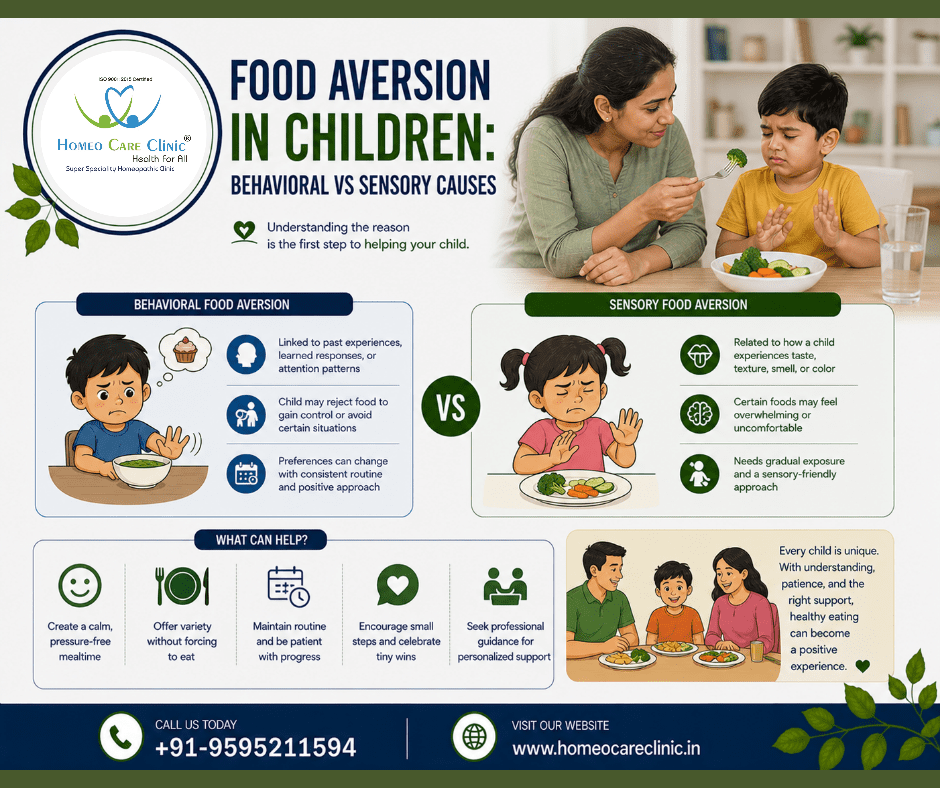
Parents are desperately searching for answers, trying to untangle the complicated knot of Food aversion in children: behavioral vs sensory causes. Because if you treat a sensory issue like a behavioral problem, you will traumatize your child. And if you treat a behavioral power struggle like a sensory issue, you will end up as a short-order cook making three different meals every single night.
So let’s sit down and pull this entire mess apart. We are going to look at the immense neurological complexity of eating, how to tell if your kid is playing a power game or if they are genuinely terrified of a blueberry, and how we can use deep, constitutional medicine to actually heal the gut and calm the nervous system. Grab a cup of coffee. We have a lot to cover.
The Physical Reality: Eating is Insanely Complicated
Before we can figure out why a child refuses to eat, we have to respect what eating actually is.
We think of eating as simple because we do it automatically. But neurologically, eating is the single most complex physical task a human being performs. It engages all of your senses simultaneously. It requires immense core strength to sit upright in a chair. It requires intense fine motor skills to use a fork. It requires your brain to process the visual appearance, the smell, and the tactile feel of the food on your fingers.
Then, you put it in your mouth. Now your brain has to coordinate your jaw, your tongue, and your lips to chew the food, mix it with saliva, and push it to the back of your throat. Finally, you have to coordinate a highly complex swallowing reflex while simultaneously holding your breath so you don’t choke and die.
If there is a glitch in any of those systems—the sensory input, the motor coordination, or the emotional state of the child—the entire process shuts down.
The Core Problem: Food aversion in children: behavioral vs sensory causes
When a child refuses to eat, they are communicating a roadblock. But the roadblocks fall into two completely different categories. You must learn how to differentiate between them.
1. Sensory Causes: The Terrifying Tomato
When a food aversion is sensory-based, the child is not trying to be difficult. Their nervous system is actively interpreting the food as a threat. This often falls under the umbrella of Sensory Processing Disorder (SPD) or Avoidant/Restrictive Food Intake Disorder (ARFID).
- Tactile Defensiveness: The inside of the mouth is packed with nerve endings. For a sensory-sensitive child, the texture of mashed potatoes might feel like a mouthful of wet cement. The feeling of a slimy mushroom might trigger an immediate, uncontrollable gag reflex.
- The Unpredictability Factor: Why do picky eaters love processed food like crackers, chips, and chicken nuggets? Because they are perfectly predictable. A branded cracker tastes, feels, and crunches exactly the same way every single time. Now look at a blueberry. A blueberry is terrifying. One blueberry might be sweet and firm. The next one might be mushy and incredibly sour. To an anxious sensory system, that unpredictability is a massive threat.
- Hyper-Smell and Taste: Some children have highly elevated olfactory and gustatory receptors. If you cook broccoli, you smell a vegetable. They smell a potent, overwhelming sulfur gas that makes their eyes water. Their taste buds register bitterness at a level you cannot comprehend.
- Oral Motor Weakness: Sometimes, a child refuses meat or thick vegetables because their jaw muscles are literally too weak to chew it safely. It exhausts them. They refuse it because they are subconsciously afraid of choking.
2. Behavioral Causes: The Dinner Table Power Struggle
When an aversion is behavioral, the child is perfectly capable of processing the food, but they are using the refusal as a tool. Toddlers and preschoolers have very little control over their lives. You tell them when to sleep, what to wear, and where to go. But you cannot force them to swallow.
- The Attention Trap: If a child realizes that refusing to eat broccoli causes you to drop everything, focus entirely on them, negotiate with them, and offer them special treats, they have won the lottery. They are getting high-quality, intense engagement from you.
- Boundary Testing: They want to know if you mean what you say. “Mom said this is what’s for dinner, but if I scream for twenty minutes, will she make me a grilled cheese?” If you cave, you just taught them that screaming works.
- Control and Autonomy: Sometimes, a child refuses a meal simply because it was your idea. They are flexing their autonomy. They are saying, “You are not the boss of my body.”
The Signs and Symptoms: How to Tell the Difference
How do you diagnose the root of the problem in your own dining room? You have to observe the nuance of the refusal.
Signs of a Behavioral Aversion:
- The Party Exception: They refuse to eat pizza at home, but if they go to a friend’s birthday party, they happily eat two slices of the exact same pizza.
- The Negotiation: They tell you, “I’ll eat the carrots if you let me watch an extra cartoon.” A child who is genuinely experiencing sensory pain will not negotiate.
- Hunger Wins: If you hold a firm boundary and say, “This is dinner, there is nothing else,” a behavioral refuser will eventually get hungry enough to eat it (even if they pout about it).
Signs of a Sensory Aversion:
- The Starvation Risk: A true sensory child will literally starve themselves before eating a non-preferred food. They will go 24 hours without eating if their specific brand of chicken nuggets is not available.
- The Gag Reflex: If you force a sensory child to put a non-preferred texture in their mouth, their body reacts violently. They gag, they retch, or they vomit. It is an involuntary biological response, not a tantrum.
- Brand Loyalty: They don’t just want macaroni and cheese. They want only Kraft macaroni and cheese, in the blue box, made with a specific spoon. If you try to sneak organic mac and cheese onto the plate, they will spot the visual difference immediately and have a panic attack.
- Fear and Anxiety: When a new food is placed near them, they don’t just say “no.” They physically shrink away, cover their face, or cry in genuine terror.
Conventional Treatment: The Limits of “Just Let Them Starve”
When a parent reaches a breaking point, they go to the pediatrician. The advice they receive is often dependent on how old-school the doctor is.
The Old-School Myth: “They will eat when they are hungry.” Generations of doctors have told parents to just put the food on the table, and if the kid doesn’t eat it, they go to bed hungry.
If your child has a behavioral aversion, this advice actually works perfectly. It ends the power struggle. But if your child has a sensory aversion, this advice is downright dangerous. An ARFID child or a child with severe sensory processing issues will not eat when they are hungry. They will choose starvation over the sensory trauma of the food. Forcing this method on a sensory child creates profound anxiety and completely destroys their trust in you.
Feeding Therapy If the child is losing weight or completely dropping off the growth curve, the conventional route is usually a referral to a pediatric Occupational Therapist (OT) or a Speech-Language Pathologist (SLP) who specializes in feeding.
Feeding therapy is wonderful. They use play-based desensitization. They teach the child to touch the food, then kiss the food, then lick the food, before ever asking them to bite it.
The problem? The waiting lists for good feeding therapists are massive. You might wait six months for an evaluation. And therapy is incredibly slow. It can take thirty sessions just to get a child to comfortably touch a piece of broccoli. Parents need help managing the biological anxiety at home while they are waiting for therapies to work.
Homeopathy Treatment: Healing the Anxious Gut
This is where the paradigm needs to shift, and this is why exhausted families end up sitting in my clinic.
You cannot separate the mind from the stomach. The gut is heavily populated with nerve endings; it is literally our “second brain.” When a child’s nervous system is vibrating with anxiety, their digestive tract shuts down. They feel nauseous, they feel bloated, and their appetite completely vanishes.
When dealing with Food aversion in children: behavioral vs sensory causes, homeopathy does not magically make a child love spinach. What it does is treat the biological terrain. We use highly diluted, constitutional nanomedicines to physically calm the vagus nerve. We treat the chronic constipation that is making them feel full. We reduce the intense, rigid anxiety so the child feels safe enough to be brave at the table.
Here are 5 medicines we rely on constantly to treat severe picky eating and food aversions.
1. Calcarea Carbonica
- Indicated for: The stubborn, slow-moving, carbohydrate-obsessed child.
- Best suited for: The classic “Calc Carb” child is usually a bit chubby, fair, and very slow to adapt to changes. They sweat heavily on the back of their neck when they sleep. Their food aversion is rooted in intense stubbornness and a sluggish metabolism. They usually crave completely bland, starchy foods—plain pasta, white bread, plain crackers. They often have weird cravings for indigestible things like dirt or chalk (pica). They absolutely refuse meat or anything that requires heavy chewing because they lack the physical stamina.
- Key actions: It deeply supports overall bone, muscle, and nerve development. It improves a sluggish metabolism, helps the body assimilate nutrients properly, and softens that intense, immovable rigidity, making the child more willing to step out of their carbohydrate comfort zone.
2. Silicea (Silica)
- Indicated for: The physically frail, highly anxious child with a severe gag reflex.
- Best suited for: The Silicea child looks delicate. They are thin, they catch colds easily, and they lack physical grit. Their food aversion is highly sensory. They gag incredibly easily. They are terrified of new textures. They often refuse warm food, preferring everything to be room temperature or cold. They are extremely picky, but unlike a loud, behavioral tantrum, their refusal is quiet, stubborn, and rooted in deep physical anxiety. Their gut is usually a mess, leading to chronic constipation where they strain but cannot pass a stool.
- Key actions: Silicea brings grit back to a frail physical body. It strengthens weak connective tissue, massively improves the sluggish digestive tract, and calms the hypersensitive gag reflex, allowing the child to process new textures without involuntarily retching.
3. Lycopodium Clavatum
- Indicated for: The bossy child with severe bloating and early satiety.
- Best suited for: This child’s aversion is often a mix of behavioral control and physical discomfort. They want to be the boss of the dinner table. They dictate exactly how their food must be cut. But physically, their digestion is terrible. They will sit down to dinner claiming they are starving, take three bites of food, and immediately push the plate away saying they are full. Their stomach fills with gas and bloats tightly after just a few bites. They crave sweets and warm food, but their liver and digestive enzymes are highly sluggish.
- Key actions: Lycopodium is a premier liver and digestive remedy. It treats the severe bloating and early satiety, meaning the child can actually eat a full meal without feeling painfully stuffed. It also treats the underlying insecurity that makes them act like an arrogant tyrant at the table.
4. Cina
- Indicated for: The angry, hostile, unpleasable child.
- Best suited for: The Cina child is profoundly cranky. They hate being touched, and they hate being looked at. At the dinner table, they are a nightmare. They cry that they are hungry, but they reject absolutely everything you offer them. They push the plate away, throw their food on the floor, and scream. They often have physical signs of parasite irritation—they grind their teeth loudly in their sleep, pick their nose constantly, and have dark circles under their eyes. Their appetite is erratic; sometimes they refuse everything, and other times they are ravenously hungry but never satisfied.
- Key actions: Cina settles a profoundly irritated, hostile nervous system. It clears parasitic or gut flora imbalances, stops the intense physical twitchiness, and totally resets the angry, unpleasable attitude so the child can actually sit at a table without starting a war.
5. Aethusa Cynapium
- Indicated for: Severe milk intolerance, sudden vomiting, and performance anxiety.
- Best suited for: This is a crucial remedy for severe, physical food aversions, especially related to dairy. The child cannot process milk; if they drink it, they vomit it up almost immediately in large, sour, thick curds, followed by extreme exhaustion where they just fall asleep. Older children needing Aethusa might have intense “brain fog” and performance anxiety. They become so anxious about eating or being watched while they eat that their stomach completely shuts down.
- Key actions: Aethusa deeply treats the inability to digest complex fats and proteins, specifically milk. It settles the violent vomiting reflex and clears the intense, paralyzing anxiety that surrounds the physical act of eating.
Why Choose Homeo Care Clinic
You cannot treat a child who is falling off the growth chart by guessing which remedies to buy at a health food store. A child’s biology is entirely too delicate for trial and error.
This is exactly why stressed, terrified parents bring their children to Homeo Care Clinic to sit down with Dr. Vaseem Choudhary.
- Mastery of Pediatric Pathology: Dr. Vaseem Choudhary has been practicing right here in Pune for nearly twenty years. He knows how to untangle the complicated knot of Food aversion in children: behavioral vs sensory causes. He listens to the parents. He doesn’t judge you for letting your child eat crackers for dinner. He observes the child’s subtle quirks in the clinic to find the exact pathological root of the aversion.
- We Fix the Gut-Brain Axis: You cannot cure picky eating if a child has chronic constipation, acid reflux, or a destroyed gut microbiome from frequent antibiotic use. We treat the digestive tract at the exact same time we treat the sensory anxiety. When the stomach is healthy and empty, true hunger signals can finally reach the brain.
- Accessible and State-of-the-Art: Managing mealtime stress is exhausting enough without adding a massive commute to a doctor’s office. With established, fully staffed clinics strategically located in Viman Nagar, Hadapsar, and Magarpatta, you can access world-class constitutional care in an environment that respects your time and your child’s sensory needs.
- Zero Forced Feeding: We refuse to use harsh appetite stimulants or heavy psychiatric medications on a developing brain. Our nanomedicines are safe, non-toxic, and incredibly gentle. They simply provide the energetic frequency the body needs to heal its own nervous system and digestive tract.
The Transformative Benefits of Homeopathy
Why should parents consider this holistic route instead of just fighting the battle every night?
- It Restores Peace to the Dinner Table: You get your family time back. When a child’s nervous system is balanced and their gut is functioning, the violent meltdowns over green beans drastically reduce.
- It Builds Real Resilience: Remedies like Silicea and Calcarea Carb do not force a child to eat; they remove the terror associated with the food. The child suddenly feels brave enough to say, “I will touch the broccoli today.”
- No Rebound Anxiety: If you only use behavioral punishments or force-feeding to get a child to eat, you create lifelong eating disorders and food trauma. Homeopathy actually heals the jittery nervous system, allowing the child to develop a natural, healthy relationship with food.
- Improves Overall Immunity: A child who only eats white bread is severely lacking in nutrients. When homeopathic treatment opens up their palate to complex proteins and vegetables, their immune system naturally skyrockets.
Lifestyle Adjustments: How to Build a Safe Dinner Table
Homeopathic medicine provides the biological spark to calm the gut and the nerves. But you, the parent, must act as the architect of the environment. You have to change how meals are handled in your house.
If you want to survive Food aversion in children: behavioral vs sensory causes, you must implement these non-negotiable rules.
1. The Division of Responsibility
This is the golden rule of pediatric feeding, developed by Ellyn Satter. It completely removes the power struggle from the table.
- The Parent’s Job: You decide what food is served, when it is served, and where it is served (at the table, not in front of the TV).
- The Child’s Job: The child decides whether they eat it, and how much they eat. You place the food down, and you say absolutely nothing. You do not bribe. You do not beg. You talk about your day. If they don’t eat, they don’t eat.
2. Always Provide a “Safe Food”
Do not send a sensory-sensitive child to the table with a plate full of totally new, terrifying foods. That triggers an immediate panic attack. Always include at least one “safe food” on the plate—even if it is just a piece of bread or a small pile of their favorite crackers. It acts as an anchor, allowing them to sit at the table without feeling threatened.
3. Food Chaining
You cannot jump from a chicken nugget directly to a piece of grilled salmon. You have to chain it. If they love McDonald’s chicken nuggets, step one is moving to a different brand of frozen chicken nuggets. Step two is moving to a homemade breaded chicken nugget. Step three is a breaded chicken strip. Step four is grilled chicken. You change the texture and appearance by tiny, microscopic degrees so the nervous system doesn’t panic.
4. Messy Play Away from the Table
A child needs to interact with a food 15 to 20 times before they will put it in their mouth. Let them play with their food when the pressure to eat is off. Let them use broccoli florets as paintbrushes with edible yogurt paint. Let them smash boiled potatoes with a toy hammer. Desensitizing their hands is the first step to desensitizing their mouth.
Diet and Supplement Adjustments for a Hungry Brain
A child’s biology can actively suppress their appetite if they are missing key nutrients.
- Zinc Deficiency is a Culprit: Zinc is directly responsible for our sense of taste and smell. If a child has a severe zinc deficiency, all food tastes like ash, metallic, or incredibly dull. A quick blood panel can check this, and a high-quality zinc supplement can sometimes restore a child’s appetite dramatically.
- Iron Deficiency and Pica: If your child is pale, exhausted, and tries to eat ice, dirt, or paper, they are likely anemic. Low iron destroys the appetite. Feed them iron-rich foods, cook in cast-iron skillets, or use a gentle pediatric iron supplement.
- Magnesium for the Nerves: A child with severe sensory food aversions is living in a state of high physical tension. Magnesium is the body’s natural muscle and nerve relaxer. Use a pediatric magnesium spray on the soles of their feet right before bed to help them physically release the tension and improve their gut motility.
- Stop the Grazing: If a child is allowed to walk around with a sippy cup of milk and a bag of crackers all day long, they will never be truly hungry at 6 PM. You must cut off all snacks and milk at least two hours before a main meal. A stomach must be entirely empty to trigger the biological drive to eat something challenging.
5 Commonly Asked FAQs
1. If I use the “Division of Responsibility” and they refuse to eat dinner, won’t they starve?
- No healthy child will willingly starve themselves to death.
- They might go to bed hungry for two or three nights as they test your boundary. It is highly uncomfortable for you, but they will survive. When they realize the power struggle is over, hunger will eventually win. (Note: This applies to behavioral aversions, not severe ARFID cases, which require close medical monitoring).
2. Should I hide vegetables in their food to make sure they get nutrients?
- You can blend spinach into a smoothie for nutrition, but you should not lie about it.
- If you hide zucchini in a brownie, and a sensory child finds a green speck, you have completely destroyed their trust. They will never eat a brownie again. Always be honest about what is in the food.
3. Is it okay to let them watch a tablet while they eat so they are distracted?
- No. This is incredibly detrimental long-term.
- Screen time hypnotizes the brain, overriding the body’s natural fullness cues. They might eat the food mechanically, but they aren’t engaging with the sensory reality of the meal. It prevents them from ever actually learning to overcome their aversions.
4. How long does the homeopathic medicine take to improve a child’s appetite?
- It is not an overnight appetite stimulant.
- Usually, within the first three to four weeks, parents notice the child’s digestion improves (less bloating, better stools) and their general anxiety decreases. The willingness to try new foods usually builds steadily over a few months of consistent constitutional treatment.
5. How do I handle relatives who try to force-feed my child at family dinners?
- You must be a fierce advocate for your child’s boundaries.
- Politely but firmly tell your family, “We do not pressure him to eat in our house. He knows his own body, and he will eat what he is comfortable with.” Do not let other adults traumatize your child over a piece of turkey.
Conclusion: Restoring the Joy of Eating
So here is the final takeaway.
Sitting at a dinner table with a child who refuses to eat is a uniquely exhausting brand of torture. The fear that you are failing to provide the most basic human necessity for your child is a heavy, crushing burden to carry.
But when you finally step back and truly understand the reality of Food aversion in children: behavioral vs sensory causes, the guilt starts to melt away. You realize that your child is not broken, and you are not a bad parent. You are simply dealing with a complex neurological roadblock.
When you learn to spot the difference between a child who is playing a game of control, and a child whose nervous system is genuinely screaming in terror over the texture of a vegetable, you change your entire approach. You stop yelling. You stop bribing. You become a calm, steady anchor.
You don’t have to just suffer through the daily dinner table war. You don’t have to accept that your child will only eat three specific branded foods for the rest of their life.
You can change how you structure meals. You can implement the division of responsibility. And by bringing them into Homeo Care Clinic for a deep, constitutional reset with Dr. Vaseem Choudhary, you can actually give their fragile nervous system and their sluggish gut the exact biological support required to heal.
They have a beautiful, healthy life ahead of them. They just need to feel physically and emotionally safe enough to explore it. Be patient, give their body the right support, and watch them learn to trust the table again. You’ve got this.
“Your health deserves more than temporary relief. Choose homeopathy for lasting results”
Start your journey towards better focus today.
About the Author Bio:
Dr. Vaseem Choudhary M.D is a seasoned classical homeopath with over 16+ years of experience, dedicated to treating patients with compassion, precision and holistic care. Mainly in Pune & Mumbai, serving both national and international patients from UK, USA, Germany, France, Canada, Bhutan, Dubai and China. With a wide range of acute and chronic conditions—from skin disorders, hormonal issues, and digestive problems to autoimmune diseases and mental health concerns.
Dr. Vaseem is widely respected for his unique approach that combines classical homeopathy, personalized diet planning, lifestyle guidance, and a spiritual perspective on healing. He is known for his detailed and empathetic case-taking process, which focuses on treating the root cause rather than just symptoms.
In recognition of his dedication and clinical excellence, Dr. Vaseem Choudhary MD has been honored with the Best Homeopathic Doctor in Pune award by leading platforms such as:
- Awarded for International Excellence in Autism & ADHD Treatment 2026 in UK Parliament, London
- Dr. Vaseem Choudhary honoured at the UK Parliament, receiving International recognition PG from the London College of Homeopathy 2026
- Dr. Vaseem Choudhary, MD, was further acknowledged in Dubai in 2026 for his expertise in Autism and ADHD, reinforcing his growing international recognition in this field
- Best Homeopathy Doctor in Pune – National Healthcare Service Excellence Awards 2024
- Most Trusted Centre for Autism and ADHD in India 2025 – Healthcare Excellence & Leadership Awards
- Best Homeopathy Doctor in Pune – Dr. Vaseem Choudhary Shines at Ayush 2nd International Conference, Dubai
- Recognized for spearheading homeopathic treatment protocols, improving patient satisfaction, and healthcare advancements.
He is also a contributing author to the International Journal of Homeopathy and Natural Medicines (IJHNM), where he shares his research and clinical experiences with the global medical community.
With a passion to take homeopathy to new heights, Dr. Vaseem continues to guide patients towards natural, safe, and sustainable healing.
Homeo Care Clinic offers a holistic approach to treating the disease. The remedies mentioned above can treat the underlying causes of the condition and offer relief from the discomfort. However, it is important to consult a qualified homeopathic practitioner for the correct dosage and duration of treatment. Homeo Care Clinic provides comprehensive care for various ailments, and offers customized treatment plans based on individual requirements.
To schedule an appointment or learn more about our treatment, please visit our website or give us a call +91 9595211594 our best homeopathy doctor will be here to help.
Follow us on Facebook, Twitter and Instagram for valuable insights into the world of homeopathy and holistic health.
- Facebook– https://www.facebook.com/homeocareclinicpune
- Instagram– https://www.instagram.com/homeocareclinic_in
- Website– https://linktr.ee/homeocareclinic
- Success Stories of Patients –https://www.homeocareclinic.in/category/case-study/
- Patient Testimonials – https://www.homeocareclinic.in/testimonial/
Chat with a best homeopathic doctor privately:
If you have any queries regarding your disease or any symptoms, click to send a What‘s App message. Our best homeopathy doctor will be happy to answer you. About Us Click
Book an Appointment:
If you want to visit our clinic, click to book an appointment.
Online treatment:
If you are a busy professional, or you are living in a remote town or city, with no best homeopathic doctor near you, Click to start an online homeopathic treatment with the world’s exclusive, most experienced and best homeopathic clinic, managed by Dr. Vaseem Choudhary world-renowned homeopathic doctor expert
- About Us – https://www.homeocareclinic.in/about-us/
- Our Doctors –https://www.homeocareclinic.in/team/