

I had a thirty-two-year-old patient sit across from my desk in my Pune clinic last week. She had recently made a massive, high-stakes career transition into the tech sector. She spends her days managing an intense workload, and her nights—often until 2:00 AM—running complex Python scripts and building heavy data visualization dashboards in Tableau to prove herself in her new role. The cognitive load is staggering.
But she didn’t come to me complaining about career burnout. She came to me because she was terrified of her own kitchen.
She looked at the floor, completely consumed by shame, and said, “I eat perfectly all day. I have my protein shake. I eat a salad for lunch. But at 11:00 PM, when the house is finally quiet and I close my laptop, it is like a completely different person takes over my body. I walk into the pantry, and I eat everything. I eat chips, I eat chocolate, I eat cold leftovers standing up in front of the fridge. I eat until my stomach physically hurts, and I can’t even taste the food anymore. I feel so disgusted with myself. I am a smart, capable woman. Why do I have zero willpower?”
She was crying because she thought she was broken. She thought she was weak.
I looked at her and told her the exact same thing I tell hundreds of women who carry this heavy, silent shame: You are not weak. You do not lack willpower. You are experiencing a profound, biological survival response.
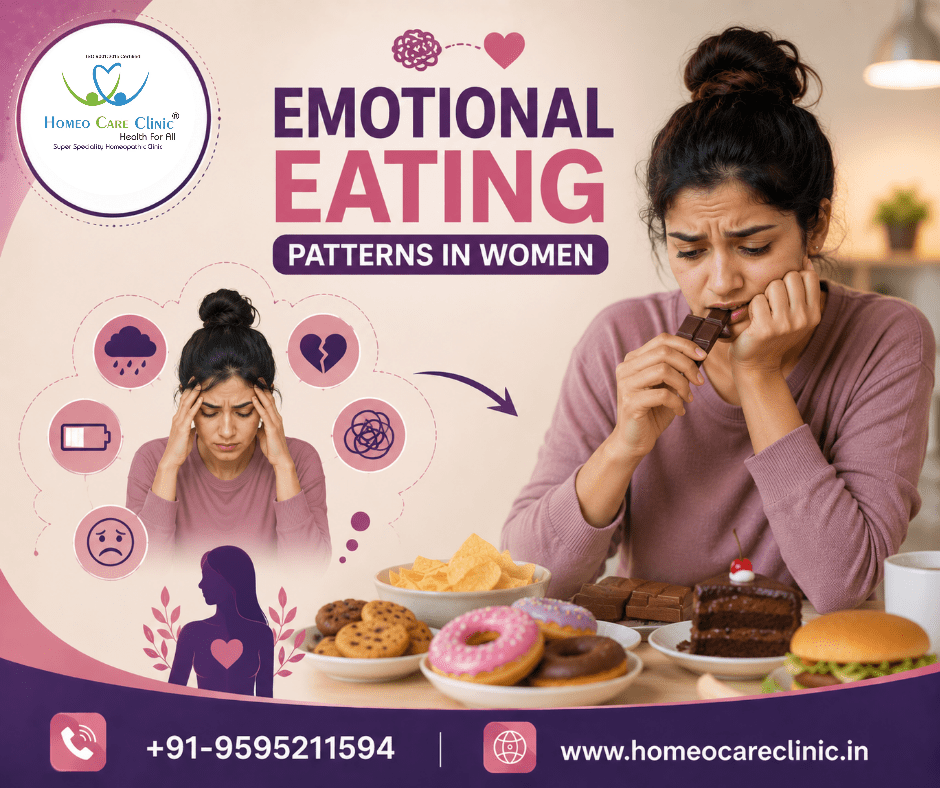
We need to have a very straightforward, uncompromising conversation about Emotional eating patterns in women.
For decades, the diet industry and the medical establishment have treated emotional eating as a character flaw. Women are handed meal plans, told to “count their macros,” or advised to simply “drink a glass of water when you feel hungry.” This advice is not just useless; it is deeply insulting. It completely ignores the intense neurological and endocrine warfare happening inside a woman’s body.
The reality of Emotional eating patterns in women is that it is not about food. It is about a nervous system that is screaming for an anesthetic.
Let’s pull the curtain back. We are going to look at the exact biological mechanics of why your brain forces you to binge, decode what your specific cravings are actually telling you, expose the severe limitations of diet culture, and explore how deep, constitutional homeopathy can repair your neuroendocrine system to finally break the cycle. Grab a cup of coffee. We have a lot of ground to cover.
The Biological Reality: Why Your Brain Demands the Binge
To stop the cycle, you have to stop blaming yourself and start understanding your biology. When you find yourself standing in front of the refrigerator at midnight, you are not making a conscious choice. Your brain has been hijacked by a desperate, primitive survival mechanism.
1. The Cortisol and Carbohydrate Trap
When you are under chronic, relentless stress—managing a household, surviving a toxic workplace, or learning complex new data skills late into the night—your adrenal glands pump out massive amounts of cortisol (the stress hormone).
Cortisol’s primary biological job is to keep you alive during a threat. It signals your brain that you are burning massive amounts of energy and need to replenish it immediately to survive. The fastest way to replenish energy is through highly palatable, calorie-dense carbohydrates and sugars. When cortisol is high, your brain literally shuts off the logical prefrontal cortex and activates the primal craving center. You don’t crave broccoli when you are stressed; you crave bread and sugar because your biology is screaming for fast survival fuel.
2. The Dopamine Deficit
Modern life drains our dopamine (the reward and pleasure neurotransmitter). If you spend your entire day suppressing your own needs, managing the emotions of everyone around you, and staring at glowing screens, your dopamine reserves are completely depleted by the evening.
Processed sugar and heavy fats trigger a massive, instantaneous release of dopamine and serotonin in the brain. For a woman whose nervous system is completely fried, eating a bag of cookies is not a lack of discipline; it is the fastest, cheapest, and most accessible way to self-medicate a failing neurochemical system. The food acts as a literal biological anesthetic.
3. The “Fawn” Response and Swallowed Anger
Many women are chronic people-pleasers. They smile when they are angry, they say “yes” when they mean “no,” and they swallow their frustration to keep the peace.
When you chronically suppress your emotions, that energy does not just disappear. It builds up as a heavy, toxic pressure in your body. Emotional eating patterns in women are frequently a subconscious physical attempt to “stuff down” the unexpressed rage, grief, or anxiety. The physical act of chewing and swallowing heavy food temporarily numbs the sharp edges of the suppressed emotion.
Decoding the Shadows: Recognizing the Symptoms
You cannot fix a dysregulated nervous system if you do not know how to read the red flags. Emotional eating is deeply isolating because it thrives in secrecy.
Here is what the fallout actually looks like behind closed doors:
1. The 9:00 PM Pantry Prowl
You restrict your food perfectly during the day. You feel totally in control. But as soon as the sun goes down and the external demands on your time stop, the internal anxiety spikes. The evening binge is almost always a sign of severe daytime nervous system suppression. You are finally alone with your thoughts, and your brain demands food to numb the sudden rush of exhaustion and anxiety.
2. The “Trance” State (Dissociation)
When an emotional binge begins, you are rarely present. Women describe it as entering a trance. You eat rapidly, barely chewing or tasting the food. You might eat strange combinations of food, or eat things straight out of the container standing up. Your brain has actively disconnected from your body (dissociation) to avoid feeling the emotional pain that triggered the binge in the first place.
3. Eating to the Point of Pain
Physical hunger stops when the stomach is full. Emotional hunger has no physical off-switch. You continue to eat long past the point of fullness, often stopping only when you feel physically sick, stretched, or in pain. The physical pain of an overstuffed stomach temporarily distracts the brain from the psychological pain it is trying to avoid.
4. The Brutal Shame Spiral
The second the binge ends, the dopamine crash hits, and the shame spiral begins. You feel a crushing sense of guilt, self-hatred, and disgust. You promise yourself you will “be good” tomorrow. You might plan a severe diet or an intense workout to “punish” yourself for the binge. This restriction triggers more cortisol, which directly causes the next binge. The cycle is perfectly, ruthlessly self-sustaining.
Conventional Treatment: The Limits of the Standard Approach
When the weight gain and the psychological distress become unbearable, women eventually look for help. Unfortunately, the standard societal and medical responses are often deeply toxic and entirely miss the root cause.
The Failure of Diet Culture
The most common response to emotional eating is to buy a new diet plan. You download an app to count calories, or you join a restrictive weight-loss program.
This is the absolute worst thing you can do for emotional eating. Restriction breeds obsession. When you tell a highly stressed, dopamine-depleted brain that it is no longer allowed to have its primary coping mechanism, the brain panics. The restriction spikes cortisol even higher, practically guaranteeing an even larger, more violent binge by the end of the week. You cannot heal a psychological wound with a meal plan.
Cognitive Behavioral Therapy (CBT) Disconnect
Therapy is an essential tool. But talk therapy requires you to use your logical prefrontal cortex to analyze your feelings. If you are in the middle of a 10:00 PM dopamine crash, your logical brain is completely offline. You cannot logic your way out of a biological urge to self-medicate. The nervous system must be physically stabilized before psychological coping mechanisms can truly take root.
The Rise of Chemical Appetite Suppressants
Recently, the medical system has leaned heavily into prescribing injectable appetite suppressants (like Ozempic or Wegovy) to stop overeating.
While these drugs delay gastric emptying and physically stop you from eating, they do absolutely nothing to heal the emotional trauma, the chronic stress, or the dopamine deficit. They force compliance by making you feel nauseous. If you artificially take away a woman’s only coping mechanism without giving her nervous system an alternative way to heal, she is left drowning in raw, unmedicated anxiety.
Homeopathy Treatment: Healing the Neuroendocrine System
This is exactly why brilliant, exhausted women bring themselves to Homeo Care Clinic. They know their relationship with food is broken. They want to actually heal the physical exhaustion and the emotional triggers, but they refuse to participate in another punishing diet or take heavy, nauseating pharmaceuticals.
Homeopathy offers a profound, structural reset for a brain that has been battered by chronic stress. We do not use medicine to artificially suppress your appetite. We use incredibly safe, highly diluted, constitutional nanomedicines to treat the physiological and psychological roots of your cravings.
We look at the exact flavor of your emotional eating. Do you crave salt because you are hiding your grief? Do you crave sweets because you are desperately lonely? Do you binge when you are furiously angry? By matching your specific emotional pathology to the exact energetic frequency of the remedy, we can prompt the central nervous system to turn off the alarm bells, breaking the trance of the binge.
Here are 5 medicines from my clinical cabinet that we rely on constantly to treat the severe fallout of emotional eating.
1. Natrum Muriaticum
- Indicated for: Emotional eating triggered by suppressed grief, isolation, and an intense craving for salt.
- Best suited for: The Natrum Mur patient experienced a massive emotional trauma, betrayal, or heartbreak, and built a thick emotional wall to survive it. She hides her emotions and isolates herself entirely when she is sad. The chronic suppression of this grief completely wrecks her nervous system. She copes by bingeing on salty, crunchy junk foods (like bags of chips or pretzels) in secret. She absolutely hates being pitied or comforted. She often suffers from stress-induced migraines and struggles to cry, using food to stuff the tears down.
- Key actions: Natrum Mur safely dismantles the defensive emotional fortress. It helps the body physically process trapped grief, stopping the chronic need to self-medicate with salt and allowing the woman to actually process her sadness.
2. Ignatia Amara
- Indicated for: Acute emotional shock, hysterical grief, and highly erratic eating patterns.
- Best suited for: This is a crucial remedy for someone who has just experienced a sudden, massive stressor—like a severe career setback or a sudden betrayal. The Ignatia patient is in a state of hysterical, suppressed shock. She sighs heavily. She gets a literal lump in her throat that she cannot swallow. Her eating is wildly erratic; she might starve herself all day because she feels “too sick” to eat, and then violently binge on sweets or carbohydrates late at night when the emotional suppression breaks.
- Key actions: Ignatia is the absolute premier remedy for acute grief and sudden emotional suppression. It acts as a rapid stabilizer for the nervous system, thawing the immediate shock and stopping the wild, erratic swings in appetite.
3. Nux Vomica
- Indicated for: The irritable, wired, type-A professional who binges to cope with extreme work stress.
- Best suited for: The Nux Vomica patient is a high-achiever surviving on espresso and pure competitive rage. She pushes herself relentlessly. Her nervous system is totally overstimulated. Because she is so stressed, she relies on heavy, rich foods, alcohol, or junk food late at night to forcefully sedate her wired brain. She suffers from severe acid reflux, chronic constipation, and wakes up at 3:00 AM with her mind racing. She snaps violently at anyone who interrupts her workflow.
- Key actions: Nux Vomica detoxifies the liver and an overworked, highly strung nervous system. It cuts through the aggressive irritability, allows the individual to actually relax without needing a heavy food-coma to shut her brain off, and repairs the gut.
4. Pulsatilla Nigricans
- Indicated for: The weeping, highly emotional patient who eats sweets to self-soothe a fear of abandonment.
- Best suited for: The Pulsatilla patient eats to fill an emotional void. She is deeply sensitive, yielding, and fears being unloved or abandoned. She weeps easily and craves constant physical affection. When she feels lonely or unappreciated, she turns almost exclusively to sweets, pastries, ice cream, and creamy desserts for comfort. Food is her surrogate for love. Her digestion is highly sensitive to rich fats, often leaving her feeling bloated and nauseous after a binge.
- Key actions: Pulsatilla deeply grounds an emotionally volatile, dependent nervous system. It takes away the desperate, weeping panic of separation and builds internal emotional security, removing the desperate biological need to self-soothe with sugar.
5. Calcarea Carbonica
- Indicated for: The sluggish, exhausted patient who feels deeply overwhelmed and seeks comfort in heavy carbohydrates.
- Best suited for: The classic “Calc Carb” patient responds to the stress of her life by completely slowing down. She is deeply overwhelmed by her responsibilities and feels like she cannot keep up with the fast pace of the world. She seeks grounding and comfort in heavy, starchy carbohydrates (breads, pastas, potatoes). She suffers from a sluggish metabolism, gains weight rapidly around her middle, and feels constantly cold. She sweats heavily on her head at night and lacks the physical stamina to exercise.
- Key actions: It is a massive constitutional builder. It supports overall metabolic function, stimulates a sluggish thyroid, clears the heavy brain fog, and helps the body process carbohydrates efficiently while removing the psychological need to use heavy food as an emotional anchor.
Why Choose Homeo Care Clinic
You cannot treat a fundamentally dysregulated neuroendocrine system by reading diet blogs and guessing which remedy to buy at a health food store. Human biology is entirely too delicate for a trial-and-error approach.
This is exactly why exhausted, frustrated women bring themselves to Homeo Care Clinic to sit down with Dr. Vaseem Choudhary.
- Deep Mastery of Psychological Pathology: Dr. Vaseem Choudhary has been practicing right here in Pune for nearly two decades. He understands the profound biological reality of Emotional eating patterns in women. He listens to you without judgment. He will never tell you that you just lack willpower or need to diet harder. He observes your physical symptoms, your sleep patterns, and your emotional stress to find the exact pathological root of your binge eating.
- Healing the Gut-Brain Axis: You cannot stop cravings if your gut microbiome is destroyed. The bad bacteria in your gut literally send signals via the vagus nerve to your brain, demanding sugar. We treat the sluggish, painful digestion at the exact same time we treat the nervous system, cutting the physical cravings at their root.
- Accessible and Welcoming Clinics: When you are already overwhelmed by the shame of a binge eating cycle, you do not have the bandwidth for a chaotic commute across the city. With established, fully staffed, and incredibly welcoming clinics strategically located in Viman Nagar, Hadapsar, and Magarpatta, you can access world-class constitutional care in an environment that respects your time and your boundaries.
- Zero Toxic Suppression: We absolutely refuse to put you on harsh chemical appetite suppressants that merely mask the symptom while destroying your digestion. Our nanomedicines are safe, non-toxic, and incredibly gentle, working in harmony with your body to heal the trauma driving the behavior.
The Transformative Benefits of Homeopathy
Why should you consider this holistic route instead of just trying another restrictive diet?
- It Removes the Biological Urge to Binge: Homeopathy does not force you to restrict. It repairs the cellular exhaustion and the adrenal burnout. When the nervous system is calm, the violent, overriding biological urge to self-medicate with food naturally disappears. You can have a box of cookies in the house and genuinely forget it is there.
- It Treats the Whole Woman: Remedies like Natrum Mur and Nux Vomica do not just address the eating; they treat the underlying migraines, the severe acid reflux, the chronic constipation, and the crushing fatigue simultaneously.
- It Breaks the Shame Spiral: By healing the structural root of the issue, you realize that the binge eating was never a moral failure. You stop punishing yourself. You rebuild a healthy, neutral relationship with food.
- Permanent Healing, No Rebound: Because the healing is structural, you are building biological resilience. The next time you face a highly stressful project at work, your first instinct is no longer to raid the pantry.
Lifestyle Adjustments: How to Scaffold Your Recovery
Homeopathic medicine provides the biological spark to calm your nervous system. But you must act as the architect of your own environment. You cannot take a homeopathic remedy and then continue to starve yourself all day and run on four hours of sleep.
If you want to survive and permanently reverse the cycle, you must implement firm, structural changes in your daily life.
- The 20-Minute Mandatory Pause: You cannot white-knuckle a binge. When the urge to eat emotionally hits you, you must implement a 20-minute pause. Set a timer on your phone. You are allowed to eat the food when the timer goes off, but for those 20 minutes, you must sit in a different room and physically ride out the adrenaline spike. Often, the peak of the emotional craving will pass within that window, giving your logical brain time to step back in.
- Stop the Daytime Starvation: You cannot skip breakfast, eat a tiny salad for lunch, and expect not to binge at 10:00 PM. Your body is physically starving. You must eat 30 grams of heavy protein (eggs, chicken, lentils) within an hour of waking up, and eat substantial, protein-heavy meals throughout the day. If you feed your body properly during the daylight hours, the nighttime primal panic drops by 80%.
- Replace the Dopamine Source: If you take away emotional eating, you must give your brain a new way to get dopamine, or it will crash. You need a “friction hobby.” Engage your hands in the physical, analog world. Knit, paint, do a puzzle, or take a hot shower. You must engage in an activity that provides sensory comfort without involving a screen or food.
- The “Hard Stop” Screen Boundary: The blue light from your monitors completely destroys your melatonin production and keeps your cortisol artificially elevated all night long. Shut down the data dashboards and the laptops at least an hour before you intend to sleep. You have to force your brain to understand that the “work day” is over so the body can exit the fight-or-flight state without needing food to sedate it.
5 Commonly Asked FAQs
1. Is emotional eating an actual eating disorder?
- Emotional eating exists on a spectrum. While occasional emotional eating is a normal human behavior, when it becomes chronic, uncontrollable, and causes severe distress, shame, and physical pain, it often crosses the line into Binge Eating Disorder (BED), which is a clinical, diagnosable condition.
2. Why do I only crave junk food when I am stressed, not healthy food?
- Because your body is incredibly efficient. Cortisol signals that you need immediate, fast-burning fuel for survival. Junk food (sugar and simple carbohydrates) enters the bloodstream rapidly, providing an instant hit of glucose and a massive dopamine spike. Broccoli does not provide that chemical reward.
3. Will losing weight cure my emotional eating?
- No. This is the biggest lie of diet culture. Weight gain is a symptom of emotional eating, not the cause. If you force weight loss through restriction without healing the nervous system, you will eventually rebound and binge harder. You must heal the trauma first; the weight normalizes naturally once the nervous system feels safe.
4. How long does the homeopathic medicine take to stop the cravings?
- For acute emotional shock and intense cravings, you can often see a noticeable calming of the nervous system within the first few weeks of a well-chosen constitutional remedy. Deep healing of the entire endocrine system to completely rewire your relationship with food usually takes a few months of consistent treatment alongside lifestyle changes.
5. How do I explain to my partner that I can’t just “stop eating” when I am stressed?
- You must shift the conversation from willpower to biology. Do not say, “I have no self-control.” Say, “My autonomic nervous system is currently misfiring due to prolonged stress. I am experiencing a biological state where my brain overrides my logic to seek a dopamine hit for survival. I am receiving medical treatment to heal my nervous system so I can regain control.”
Conclusion: Reclaiming Your Peace
So here is the final takeaway.
Living at war with your own appetite is an incredibly exhausting, lonely existence. It is profoundly painful to wake up every single morning, promise yourself that today will be different, and then find yourself standing in the kitchen at midnight, completely disconnected from your own body, watching yourself eat away your pain.
When you read about the terrifying reality of Emotional eating patterns in women, and you watch the cycle erode your physical health, your self-esteem, and your ability to trust yourself, it is easy to feel a profound sense of despair. You feel like you are fundamentally broken.
But you are not broken. Your body is trying to protect you.
When you finally step back and truly understand the biological mechanics of why your brain pulled the fire alarm, the chaos starts to make sense. You realize that your midnight binges and your intense cravings are not a reflection of a weak character. They are not a moral failure. They are simply the physical, external hallmarks of a nervous system and an endocrine system that have been starved of dopamine, overwhelmed by stress, and pushed far beyond their biological limits by an unnatural, demanding world.
You do not have to just surrender to the shame. You don’t have to spend the rest of your life starting a new diet every Monday, wondering if you will ever feel safe in your own kitchen again. And you definitely don’t have to resort to heavy, nauseating pharmaceutical suppressants that ignore the crying need of your soul.
You can draw the hard boundary on the late-night screens. You can start eating heavy protein in the morning. You can implement the massive dietary changes required to rebuild your gut lining. And by bringing yourself into Homeo Care Clinic for a deep, constitutional reset with Dr. Vaseem Choudhary, you can actually give your fragile, exhausted nervous system the exact biological push it needs to heal from the inside out.
You have a brilliant, razor-sharp mind and a resilient body waiting to be reactivated. You just need to clear the static, seal the emotional wounds, turn off the inflammatory alarm bells, and give your biology the right support. Be patient, build your boundaries, trust the holistic process, and watch what happens when your body finally feels safe enough to put the food down. You’ve got this.
“Your health deserves more than temporary relief. Choose homeopathy for lasting results”
Start your journey towards better focus today.
About the Author Bio:
Dr. Vaseem Choudhary M.D is a seasoned classical homeopath with over 16+ years of experience, dedicated to treating patients with compassion, precision and holistic care. Mainly in Pune & Mumbai, serving both national and international patients from UK, USA, Germany, France, Canada, Bhutan, Dubai and China. With a wide range of acute and chronic conditions—from skin disorders, hormonal issues, and digestive problems to autoimmune diseases and mental health concerns.
Dr. Vaseem is widely respected for his unique approach that combines classical homeopathy, personalized diet planning, lifestyle guidance, and a spiritual perspective on healing. He is known for his detailed and empathetic case-taking process, which focuses on treating the root cause rather than just symptoms.
In recognition of his dedication and clinical excellence, Dr. Vaseem Choudhary MD has been honored with the Best Homeopathic Doctor in Pune award by leading platforms such as:
- Awarded for International Excellence in Autism & ADHD Treatment 2026 in UK Parliament, London
- Dr. Vaseem Choudhary honoured at the UK Parliament, receiving International recognition PG from the London College of Homeopathy 2026
- Dr. Vaseem Choudhary, MD, was further acknowledged in Dubai in 2026 for his expertise in Autism and ADHD, reinforcing his growing international recognition in this field
- Best Homeopathy Doctor in Pune – National Healthcare Service Excellence Awards 2024
- Most Trusted Centre for Autism and ADHD in India 2025 – Healthcare Excellence & Leadership Awards
- Best Homeopathy Doctor in Pune – Dr. Vaseem Choudhary Shines at Ayush 2nd International Conference, Dubai
- Recognized for spearheading homeopathic treatment protocols, improving patient satisfaction, and healthcare advancements.
He is also a contributing author to the International Journal of Homeopathy and Natural Medicines (IJHNM), where he shares his research and clinical experiences with the global medical community.
With a passion to take homeopathy to new heights, Dr. Vaseem continues to guide patients towards natural, safe, and sustainable healing.
Homeo Care Clinic offers a holistic approach to treating the disease. The remedies mentioned above can treat the underlying causes of the condition and offer relief from the discomfort. However, it is important to consult a qualified homeopathic practitioner for the correct dosage and duration of treatment. Homeo Care Clinic provides comprehensive care for various ailments, and offers customized treatment plans based on individual requirements.
To schedule an appointment or learn more about our treatment, please visit our website or give us a call +91 9595211594 our best homeopathy doctor will be here to help.
Follow us on Facebook, Twitter and Instagram for valuable insights into the world of homeopathy and holistic health.
- Facebook– https://www.facebook.com/homeocareclinicpune
- Instagram– https://www.instagram.com/homeocareclinic_in
- Website– https://linktr.ee/homeocareclinic
- Success Stories of Patients –https://www.homeocareclinic.in/category/case-study/
- Patient Testimonials – https://www.homeocareclinic.in/testimonial/
Chat with a best homeopathic doctor privately:
If you have any queries regarding your disease or any symptoms, click to send a What‘s App message. Our best homeopathy doctor will be happy to answer you. About Us Click
Book an Appointment:
If you want to visit our clinic, click to book an appointment.
Online treatment:
If you are a busy professional, or you are living in a remote town or city, with no best homeopathic doctor near you, Click to start an online homeopathic treatment with the world’s exclusive, most experienced and best homeopathic clinic, managed by Dr. Vaseem Choudhary world-renowned homeopathic doctor expert
- About Us – https://www.homeocareclinic.in/about-us/
- Our Doctors –https://www.homeocareclinic.in/team/