
Introduction
Picture this: your child is at a birthday party. Another child makes a harmless, sarcastic joke. Every other kid in the room laughs, but your child gets incredibly upset because they took the words completely literally. Or perhaps you watch them try to join a group of kids playing, but instead of saying “hello,” they just stand too close, stare, and start talking endlessly about their favorite video game without ever letting anyone else speak.
You watch the other kids slowly walk away. You see the confusion and hurt on your child’s face. They want to make friends. They just don’t know the “rules” of the game.
Let’s deal with the raw, emotional reality of Social Communication Disorder (SCD). This condition is incredibly frustrating because it lives in the gray area of development. Your child has perfect grammar. They have a massive vocabulary. But they cannot read the room. They struggle with pragmatics—the unwritten, invisible rules of how we use language to interact with other human beings.
Here in Pune, the social pressure on kids is immense. School environments are fast-paced, and if a child cannot read social cues, they are very quickly labeled as “weird” or “rude,” leading to severe bullying and isolation.
We need to figure out exactly why your child’s brain is missing these vital social signals. We are going to look at the deep neurological causes of social communication disorder. I’ll show you how to clearly identify the behavioral social communication disorder symptoms so you can intervene before your child completely withdraws. We will talk about why standard behavioral charts often fail. Most importantly, we’ll explore how homeopathy acts as a deep cognitive and emotional reset, offering a powerful social communication disorder treatment to help your child natively understand the world around them.
Let’s help them connect. At Homeo Care Clinic, we help children unlock their social processing skills so they can finally build meaningful friendships.
Why the Brain Misses the Cue
To help your child, you have to understand that they are not being intentionally rude or awkward. They are literally blind to the social cues that you and I process automatically.
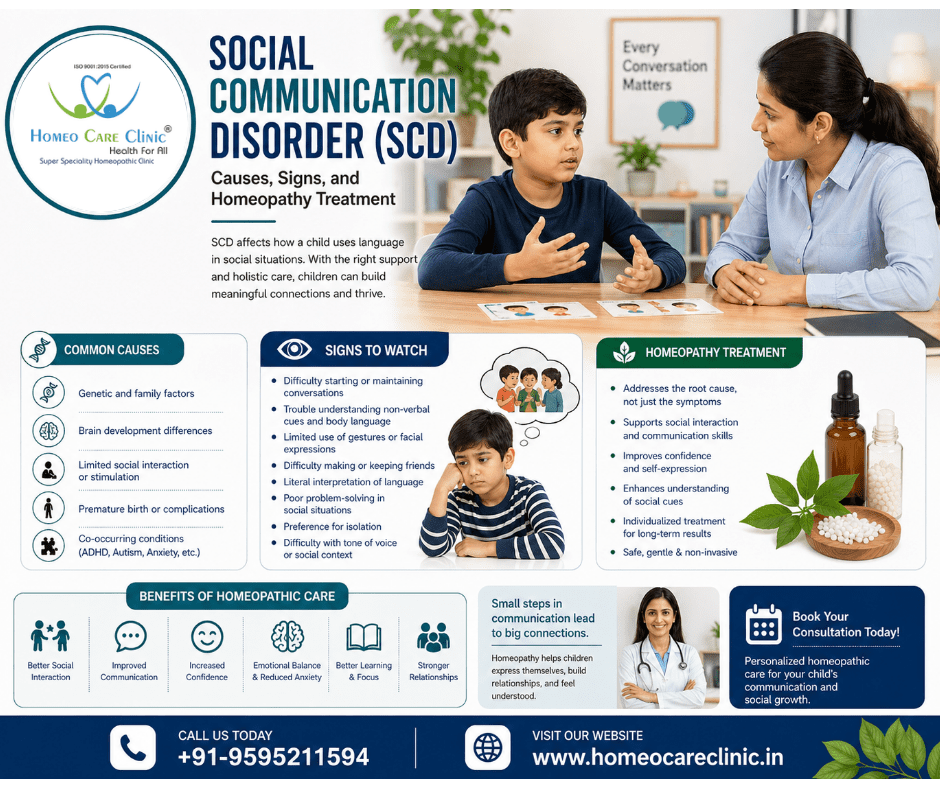
If your child is struggling to fit in, here are the real biological and environmental causes of social communication disorder:
- Neurological Wiring Differences: This is the absolute core of the issue. The right hemisphere of the brain is heavily responsible for processing tone of voice, sarcasm, facial expressions, and body language. In a child with SCD, the neural pathways connecting the language centers to the social-emotional processing centers are underdeveloped or firing at a slower rate.
- Genetics and Family History: There is a massive hereditary component. If a parent, uncle, or sibling struggled with severe social awkwardness, language delays, or learning disabilities, the child has a highly increased chance of inheriting that exact same neurological delay.
- The Screen-Time Epidemic: The human brain learns social rules through face-to-face, real-time human interaction. When a toddler spends their critical developmental years staring at an iPad, they are receiving fast visual data, but zero social data. A screen does not teach you how to take turns talking, how to read a disappointed facial expression, or how to negotiate a shared toy.
- Early Language Delays: Children who had severe expressive or receptive language delays early in life often graduate into SCD. Because they spent so much mental energy just trying to learn how to speak, they entirely missed the window where children naturally learn how to use speech socially.
In homeopathy, we don’t just punish a child for interrupting. We look at the nervous system. Is the child interrupting because they are hyperactive? Are they missing jokes because their brain’s processing speed is too slow? We have to treat the exact source.
Signs Your Child is Socially Lost
How do you tell if your child is just a little quirky or if they are actively suffering from a clinical disorder? The body and behavior leave massive clues. You just have to watch how they talk to others.
The Daily Warning Signs
- Taking Everything Literally: These are classic social communication disorder symptoms. If you say, “It’s raining cats and dogs,” they will literally look out the window for animals. They cannot grasp sarcasm, metaphors, or idioms.
- Inability to Code-Switch: A healthy brain knows you talk to a baby differently than you talk to a teacher. A child with SCD uses the exact same tone, vocabulary, and volume whether they are talking to a toddler, their best friend, or the school principal.
- The Monologue: They do not know how to have a back-and-forth conversation. They talk at people, not with people. They will talk about trains for twenty minutes without ever pausing to notice that the other person is looking away, yawning, or completely bored.
- Ignoring the Rules of Conversation: They constantly interrupt. They stand way too close to people’s faces when speaking. They say things that are brutally honest and socially inappropriate (e.g., pointing at someone and loudly saying, “Why are you so fat?”) without any intent to be mean.
- Difficulty Making Inferences: If someone looks at their watch and sighs, a normal brain infers, “They are in a hurry.” A child with SCD entirely misses the clue and keeps talking.
The Crucial Difference: SCD vs. Autism
Every parent who notices these social red flags immediately panics about the Autism Spectrum. We have to clearly define the difference.
- Autism Spectrum Disorder (ASD) involves social communication struggles, but it also requires the presence of restricted, repetitive behaviors. This means extreme rigid routines, hand-flapping, rocking, or intense sensory issues (cannot stand loud noises or certain textures).
- Social Communication Disorder is diagnosed when the child struggles only with the social use of language, but has absolutely zero repetitive behaviors, rigid routines, or severe sensory issues.
Conventional Therapy vs. The Internal Storm
Go to a pediatrician, and the standard advice is usually behavioral therapy.
- Speech-Language Pathology (SLP): A therapist works with the child using role-play to teach them “social scripts” and how to practice taking turns.
- Social Skills Groups: The child is put in a small group to practice interacting under the guidance of a psychologist.
Let me be absolutely clear. SLP and social skills groups are fantastic and highly necessary.
But there is a massive gap here. You can teach a child a “script” for how to say hello. But if that child is crippled by social anxiety, totally exhausted by trying to remember the rules, and highly rigid in their thinking, the script falls apart the second a real-life conversation goes off-script. Parents sit across from me completely drained. They want a social communication disorder treatment that actually primes the brain to adapt natively, rather than just acting like a robot.
Homeopathy Treatment for Social Pragmatics
Homeopathy views a social processing delay entirely differently. We don’t just drill the child with flashcards of facial expressions. We don’t ignore the severe anxiety they feel when they get rejected by peers.
We focus on the internal nervous system. By using targeted constitutional medicine, we actively stimulate the social-emotional processing centers. We calm the underlying anxiety so the child can actually observe their environment. When the brain is biologically primed and relaxed, social therapy works ten times faster, and the child learns to adapt naturally.
Key Homeopathic Medicines for Social Integration
Here are the remedies we use to wake up the brain’s social processing centers.
Baryta Carbonica
- Indicated for: Children who act significantly younger than their actual age and show deep social immaturity.
- Best suited for: The extremely shy, timid child who hides behind their parents. They struggle to understand peer dynamics and often prefer playing with children who are 3 or 4 years younger than them because the social rules are simpler.
- Key action: The absolute master remedy for constitutional cognitive and social slowness. It acts deeply on the brain to mature the emotional and social responses.
Natrum Muriaticum
- Indicated for: The child who gets their feelings hurt incredibly easily because they take every single comment literally.
- Best suited for: Deeply sensitive, serious children. Because they don’t understand jokes or sarcasm, they constantly feel like other kids are making fun of them. They build a wall, isolate themselves in their room, and refuse to try making friends to avoid the pain of rejection.
- Key action: Drops the heavy emotional blockages. It helps the walled-off child process emotional nuances better and feel safe enough to attempt peer interactions without intense fear.
Lycopodium Clavatum
- Indicated for: The child who acts like a “little adult” with grown-ups but completely fails at playing with kids their own age.
- Best suited for: The child who is actually very smart but lacks social confidence. To hide their insecurity, they become extremely bossy and dictatorial with other kids, which drives peers away. They cannot handle being corrected.
- Key action: Drops the intense psychological pressure and hidden insecurity. It softens the bossy, rigid behavior and helps the brain adapt to cooperative, equal play.
Agaricus Muscarius
- Indicated for: Social delays accompanied by extreme awkwardness, clumsiness, or lack of physical boundaries.
- Best suited for: The child whose brain misfires socially. They stand too close, talk too loud, and struggle to follow the rhythm of a back-and-forth conversation. They often interrupt wildly.
- Key action: Directly targets the processing centers of the brain. It clears neurological misfires, helping the child regulate their impulses and respect spatial boundaries.
Pulsatilla Nigricans
- Indicated for: The highly emotional child who desperately wants friends but pushes them away by being too clingy.
- Best suited for: The child who weeps easily and constantly asks, “Are we still best friends?” They miss the subtle cues that the other child needs personal space.
- Key action: Stabilizes the wild emotional swings and massive neediness. It helps the child develop secure, balanced social attachments.
Don’t try guessing your remedy yourself. A medicine for a shy, withdrawn child won’t help a loud, bossy child. You need a trained doctor mapping the exact cognitive and emotional pathology.
Why Choose Homeo Care Clinic for Your Child?
Watching your child get left out of birthday parties or sit alone at lunch breaks your heart. I run my own multi-speciality setup right here in Pune. I consult with countless parents who are terrified their child will grow up completely isolated because they just don’t “get” people. I know what it feels like when you just want them to have one good, true friend.
Standard doctors usually hand over a therapy referral and tell you it’s just a phase. We do things entirely differently at Homeo Care Clinic under Dr. Vaseem Choudhary.
- We map the exact origin: We don’t just look at the awkwardness. Did they isolate after a massive change? Do they have a history of severe early ear infections? We find the actual neurological or emotional roadblock.
- We heal the tissue natively: We know you are tired of watching them struggle. We support the body’s neural pathways. We use remedies to actively prime the brain so it can finally decode social cues.
- Understanding the local lifestyle: We see these social crashes daily. Nuclear families, zero outdoor play, heavy screen addiction. We know how modern life starves a developing brain of social data. We know how to support it.
- Listening to the details: Your child’s specific frustration matters. Do they boss people around? Do they cry in their room? That specific detail points us to the exact remedy their brain needs.
You don’t have to watch them struggle in silence. Let’s unlock their potential safely.
Lifestyle and Diet Tips for Brain Development
Medicine fixes the internal engine. But if you park your child in front of a video game for five hours a day, their social brain will completely atrophy. You have to change the environment.
Managing the Mechanics
What you MUST do immediately:
- The Screen Detox: This is absolute, non-negotiable law. Screens are the enemy of social pragmatics. You cannot learn to read a human face by looking at a cartoon. Cut passive screen time to the absolute minimum to force real-world interactions.
- Board Games, Not Video Games: Board games are the ultimate tool for SCD. They physically force a child to practice taking turns, waiting patiently, winning gracefully, and losing without a meltdown. Play them daily.
- The “Pause and Think” Method: After watching a movie together, pause and ask inference questions. “Why do you think that character is crying? What do you think he meant when he said that?” You have to actively teach their brain to look for the hidden meaning.
Diet Recommendations (The Neural Reset)
What you MUST stop eating:
- Refined Sugar and Artificial Dyes: Sugar causes violent spikes in blood glucose, destroying a child’s ability to focus on complex social rules. Artificial colors act as neurotoxins, creating severe impulsivity, which makes them interrupt conversations constantly.
What to eat:
- Omega-3 Fatty Acids (DHA): The brain is made of fat. The social processing centers require massive amounts of high-quality DHA to wire themselves correctly. Give your child pure cow’s ghee, walnuts, or a high-quality fish oil supplement daily.
- Zinc and Magnesium: Magnesium deeply calms a highly frustrated, anxious nervous system so the child can observe social rules without having a meltdown from the stress.
5 Most Commonly Asked Questions
Parents come in completely overwhelmed and scared for their child’s social future. Here is the actual clinical reality.
1. Is Social Communication Disorder a form of Autism?
No. While they share the symptom of struggling with social pragmatics, a child with SCD does not have the restricted, repetitive behaviors, rigid routines, or extreme sensory issues that define the Autism Spectrum.
2. Can my child still make friends if they have SCD?
Absolutely. With the right homeopathic support to calm their anxiety and clear their cognitive processing, combined with social skills training, these children can learn the “rules” of interaction and build deep, incredibly meaningful friendships.
3. Does this disorder go away as they get older?
It does not magically disappear with age without intervention. In fact, if left untreated, the social gap widens in middle and high school when teenage social rules become incredibly complex (sarcasm, peer pressure, dating). Early intervention is critical.
4. Why does my child talk like an adult but can’t talk to a 7-year-old?
Adults naturally compensate. When your child talks to an adult, the adult patiently listens to their 20-minute monologue and asks polite questions. A 7-year-old peer won’t do that; they will just walk away. Your child prefers adults because adults do all the heavy lifting in the conversation.
5. How fast will homeopathy help my child’s social skills?
This isn’t an overnight magical pill. For acute issues like severe social anxiety or extreme bossiness, remedies act quickly to soften the behavior within a few weeks. But forcing stalled neurological processing centers to decode complex social nuances takes sustained, constitutional treatment over 4 to 6 months. We look for improved eye contact and better turn-taking first, followed by more natural, relaxed peer play.
Conclusion
It completely breaks your heart to watch your child stand on the edge of the playground, desperately wanting to join in, but having absolutely no idea how to cross that invisible social line. The cycle of watching them get rejected, taking them to endless behavioral therapies, and worrying about their future happiness is a truly exhausting way to parent. Purely external behavioral scripts sometimes miss the internal neurological roadblock.
Flashcards don’t fix an exhausted, overwhelmed nervous system. Homeopathy offers a real shift here. It works deeply at the cellular level, nourishing weak nerve tissue, clearing the cognitive blockages natively, dropping the extreme fear of rejection, and giving your child’s brain the biological support it needs to finally decode the human world.
You deserve to see them laugh with a friend. They deserve to feel understood. We are ready, listening to your daily struggles, and helping your family heal.
“Your health deserves more than temporary relief. Choose homeopathy for lasting results”
Start your journey towards better focus today.
About the Author Bio:
Dr. Vaseem Choudhary M.D is a seasoned classical homeopath with over 16+ years of experience, dedicated to treating patients with compassion, precision and holistic care. Mainly in Pune & Mumbai, serving both national and international patients from UK, USA, Germany, France, Canada, Bhutan, Dubai and China. With a wide range of acute and chronic conditions—from skin disorders, hormonal issues, and digestive problems to autoimmune diseases and mental health concerns.
Dr. Vaseem is widely respected for his unique approach that combines classical homeopathy, personalized diet planning, lifestyle guidance, and a spiritual perspective on healing. He is known for his detailed and empathetic case-taking process, which focuses on treating the root cause rather than just symptoms.
In recognition of his dedication and clinical excellence, Dr. Vaseem Choudhary MD has been honored with the Best Homeopathic Doctor in Pune award by leading platforms such as:
- Best Homeopathy Doctor in Pune – National Healthcare Service Excellence Awards 2024
- Most Trusted Centre for Autism and ADHD in India 2025 – Healthcare Excellence & Leadership Awards
- Best Homeopathy Doctor in Pune – Dr. Vaseem Choudhary Shines at Ayush 2nd International Conference, Dubai
- Recognized for spearheading homeopathic treatment protocols, improving patient satisfaction, and healthcare advancements.
He is also a contributing author to the International Journal of Homeopathy and Natural Medicines (IJHNM), where he shares his research and clinical experiences with the global medical community.
With a passion to take homeopathy to new heights, Dr. Vaseem continues to guide patients towards natural, safe, and sustainable healing.
Homeo Care Clinic offers a holistic approach to treating the disease. The remedies mentioned above can treat the underlying causes of the condition and offer relief from the discomfort. However, it is important to consult a qualified homeopathic practitioner for the correct dosage and duration of treatment. Homeo Care Clinic provides comprehensive care for various ailments, and offers customized treatment plans based on individual requirements.
To schedule an appointment or learn more about our treatment, please visit our website or give us a call +91 9595211594 our best homeopathy doctor will be here to help.
Follow us on Facebook, Twitter and Instagram for valuable insights into the world of homeopathy and holistic health.
- Facebook– https://www.facebook.com/homeocareclinicpune
- Instagram– https://www.instagram.com/homeocareclinic_in
- Website– https://linktr.ee/homeocareclinic
- Success Stories of Patients –https://www.homeocareclinic.in/category/case-study/
- Patient Testimonials – https://www.homeocareclinic.in/testimonial/
Chat with a best homeopathic doctor privately:
If you have any queries regarding your disease or any symptoms, click to send a What‘s App message. Our best homeopathy doctor will be happy to answer you. About Us Click
Book an Appointment:
If you want to visit our clinic, click to book an appointment.
Online treatment:
If you are a busy professional, or you are living in a remote town or city, with no best homeopathic doctor near you, Click to start an online homeopathic treatment with the world’s exclusive, most experienced and best homeopathic clinic, managed by Dr. Vaseem Choudhary world-renowned homeopathic doctor expert
- About Us – https://www.homeocareclinic.in/about-us/
- Our Doctors –https://www.homeocareclinic.in/team/