

Introduction
Picture this: you’re sitting at the kitchen table, and you give your child a basic instruction. Something like, “Please go grab your shoes and bring me your jacket.” But they just stare back at you blankly. Or perhaps they’re trying to share a story about their day, yet the sentences come out entirely jumbled, missing crucial words, and making almost no sense.
You can practically see the frustration building in their eyes. Worse, you might notice them pulling away from other kids simply because keeping up with normal chatter feels impossible.
This brings us to the difficult reality of a Language Disorder. It’s incredibly confusing for parents. Often, a child knows physically how to form sounds, but the actual meaning gets lost in translation. Moms and dads sit in my clinic feeling completely overwhelmed, asking: what is language disorder, really? The easiest way I can explain it is like a translation error happening inside the brain. The brain either struggles to decode incoming words or fumbles when trying to organize words on the way out.
Here in Pune, parents understandably stress out when they see their little one falling behind socially or in class. We hear the broad phrase speech and language disorders tossed around a lot, but we really need to distinguish between the two. A speech disorder means the muscles of the mouth literally can’t form sounds. A language disorder, on the other hand, means the brain is having trouble processing meaning.
We have to figure out exactly where the brain’s filing system is getting jammed up. We’re going to dive into the different types of language disorders. I’ll show you how to spot the behavioral and physical signs long before your child starts shutting down at school. We’ll also cover why simply forcing them to memorize vocabulary words usually backfires. Most importantly, we’ll explore how homeopathy can serve as a deep cognitive reset, naturally helping your child’s brain organize information.
Let’s clear that mental fog. At Homeo Care Clinic, we help kids naturally unlock their cognitive processing skills so they can finally connect with the world around them.
The Brain’s Translation Glitch
To resolve a communication block, you first need to understand what’s actually happening inside the brain’s language centers (specifically Broca’s and Wernicke’s areas). A healthy brain catches words, decodes them in a split second, and formulates a response. But with a language disorder, the brain catches those words and the file basically gets corrupted.
If your child is having a hard time connecting, here are the real biological triggers usually at play:
- Neurological Wiring Differences: This is typically the core of the issue. The neural pathways responsible for taking in, organizing, and expressing language just developed at a different or slower pace.
- The Screen Time Black Hole: Kids learn language through active, two-way, emotional human interaction. Staring at a tablet provides fast, one-way visual stimulation that actively suppresses the auditory processing centers needed for true language formulation.
- Chronic Ear Infections in Infancy: When a baby spends their first two years battling fluid-filled ears, they end up hearing the world as if they’re underwater. Because the brain didn’t get crisp audio data during that crucial developmental window, the language centers can fail to wire correctly.
- Family History: Genetics play a massive role here. If a parent or sibling struggled deeply with reading, writing, or delayed language, the child has a much higher chance of inheriting that exact same neurological delay.
In homeopathy, we don’t just hand over a grammar workbook and call it a day. We look closely at the nervous system. Is the child struggling because they can’t focus? Is their brain just totally overwhelmed? We have to treat the root cognitive terrain.
Recognizing the Different Types of Language Disorders
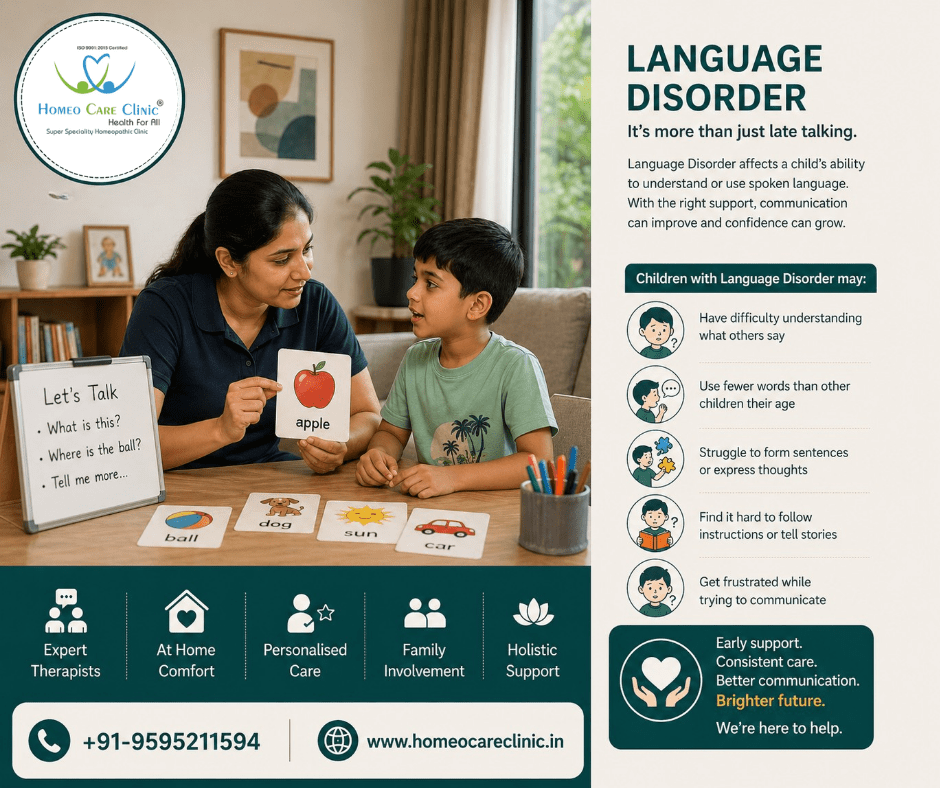
How do you figure out what specifically is going wrong inside your child’s head? You have to watch how they interact. Clinically, doctors break this down into three distinct types of language disorders.
1. Receptive Language Disorder (The “Input” Problem)
The child physically hears what you’re saying, but their brain can’t quite decode the meaning.
- They struggle to follow multi-step directions (like, “Put your toys away and wash your hands”).
- They often just repeat what you say (echolalia) because they genuinely don’t know how to formulate an answer.
- They might seem like they aren’t listening or are constantly “zoning out.”
2. Expressive Language Disorder (The “Output” Problem)
Your child understands everything you say perfectly fine, but their brain hits a wall when trying to organize the words to reply.
- Their vocabulary is severely limited compared to other kids their age.
- They leave out key words in a sentence (saying something like “Boy jump” instead of “The boy is jumping”).
- They rely heavily on placeholder words like “thing” or “stuff” because they can’t seem to retrieve the exact noun from their brain’s mental filing cabinet.
3. Mixed Receptive-Expressive Language Disorder
This one is a tough combination of both. The child struggles deeply to understand what is being said, while simultaneously struggling to formulate their own thoughts. Communication quickly turns into a massive source of anxiety and frustration.
Conventional Therapy vs. The Internal Storm
If you go to a pediatrician, the standard treatment for speech and language disorders tends to be pretty mechanical.
- Speech-Language Pathology (SLP): This is the gold standard. A therapist works closely with the child using games and targeted exercises to build vocabulary, improve sentence structure, and teach better comprehension strategies.
- Special Education Plans (IEPs): Schools provide extra time and specialized instruction to help ensure the child can keep up academically.
Let me be absolutely clear: good speech and language therapy is miraculous, and it is entirely necessary.
However, there is a big gap here. You can put a child with a severe processing delay into therapy for several hours a week. But if that child’s brain is totally exhausted, their attention span is zero, and they are incredibly anxious about failing, the therapist won’t be able to get them to absorb the lessons. Parents sit across from me completely drained, having spent a fortune on therapy while seeing very slow progress. They want something that actually primes the brain to learn.
Homeopathy Treatment for Cognitive Processing
Homeopathy views a processing delay quite differently. We don’t just drill the child with flashcards, and we certainly don’t ignore the severe anxiety they feel when they can’t find the right word.
We focus heavily on the internal nervous system. By utilizing targeted constitutional medicine, we actively stimulate those sluggish cognitive centers. We calm the hyperactive or anxious mind so the child can actually sit still and absorb what the therapist is trying to teach. When the brain is biologically primed, language therapy works ten times faster.
Key Homeopathic Medicines for Cognitive Repair
Here are the remedies we frequently use to wake up the brain’s processing centers.
Baryta Carbonica
- Indicated for: Global developmental delays, which includes severe receptive and expressive language struggles.
- Best suited for: The extremely shy, timid child who acts much younger than their actual age. They might hide behind their parents. Their memory tends to be very weak, and they struggle deeply to grasp new concepts or remember a word they learned just yesterday.
- Key action: This is the absolute master remedy for constitutional cognitive slowness. It acts deeply on the brain to jumpstart stalled neurological development.
Calcarea Phosphorica
- Indicated for: The child who is mentally exhausted and gets intense headaches just from trying to focus or learn.
- Best suited for: The child who looks thin, is growing rapidly, and complains a lot. They understand the words perfectly well but lack the sustained mental energy required to organize them into proper sentences.
- Key action: A massive cellular builder. It physically nourishes a weak nervous system, giving the brain the stamina it desperately needs to process complex language.
Lycopodium Clavatum
- Indicated for: Expressive language issues that are driven heavily by deep performance anxiety.
- Best suited for: The child who is actually very smart but lacks physical and mental confidence. They might mix up syllables or struggle to find the right word simply because they’re terrified of sounding foolish. You might notice them getting very bossy at home just to hide that insecurity.
- Key action: Drops the intense psychological pressure, builds up internal confidence, and helps the brain retrieve words smoothly without panic.
Natrum Muriaticum
- Indicated for: The child who shuts down completely and outright refuses to talk because communication is just too stressful.
- Best suited for: Deeply sensitive, stubborn late talkers. They get incredibly angry and might even cry if you correct their grammar. They prefer playing alone, building a wall to protect their feelings.
- Key action: Drops heavy emotional and psychological blockages. It helps the walled-off child feel safe enough to attempt complex communication without the constant fear of failure.
Agaricus Muscarius
- Indicated for: Language delays accompanied by extreme clumsiness, twitching, or delayed motor skills.
- Best suited for: The child whose brain misfires constantly. They might struggle with the rhythm of language, stumble over their words, and have a really hard time following a logical sequence of events when telling a story.
- Key action: Directly targets the motor cortex and processing centers of the brain. It clears out neurological misfires, allowing the child to sequence their thoughts much more smoothly.
Please don’t try guessing the remedy yourself. A medicine meant for a shy, slow child won’t do much for a stubborn, anxious one. You really need a trained doctor to map out the exact cognitive pathology.
Why Choose Homeo Care Clinic for Your Child?
Watching your child struggle to express themselves breaks your heart. I run my own multi-speciality setup right here in Pune, and I consult with countless parents who are terrified their child will be bullied or left behind in school just because they can’t follow the teacher’s instructions. I know what it feels like when you just want to hear them tell you a clear story.
Standard doctors usually just hand over a therapy referral and tell you to wait. We do things entirely differently at Homeo Care Clinic under Dr. Vaseem Choudhary.
- We map the exact origin: We don’t just look at the bad grammar. Did the delay become glaringly obvious after they started school? Do they have a history of thick ear infections? We find the actual neurological or physical roadblock.
- We heal the tissue natively: We know you’re tired of watching them struggle. We support the body’s neural pathways. We use remedies to actively prime the brain so it can finally absorb language patterns.
- Understanding the local lifestyle: We see these cognitive crashes every single day. Heavy screen time, working parents, immense academic pressure at very young ages. We understand how modern life stresses a developing brain, and we know exactly how to support it.
- Listening to the details: Your child’s specific frustration really matters. Do they give up easily? Do they get angry? That specific detail points us straight to the exact remedy their brain needs.
You don’t have to watch them struggle in silence. Let’s unlock their potential safely.
Lifestyle and Diet Tips for Brain Development
Medicine fixes the internal engine. But if you park your child in front of a tablet for four hours a day, the brain’s language centers will completely atrophy. You absolutely have to change the environment.
Managing the Mechanics
What you MUST do immediately:
- The Screen Detox: This is absolute, non-negotiable law for a child with a processing delay. Screens provide fast visual dopamine but require zero auditory decoding. They actively worsen receptive language skills. You have to cut screens down to the absolute minimum.
- Pause and Wait: When your child is trying to find a word, do not jump in and rescue them. It’s painful to watch them struggle, but if you always fill in the blank, their brain never learns to retrieve the word on its own. Give them 10 full seconds to process.
- Read Face-to-Face: Don’t just play an audiobook. Sit with your child, point to the pictures, and ask them “Wh-” questions (Who is this? What is he doing?). Make the reading active, rather than passive.
Diet Recommendations (The Neural Reset)
What you MUST stop eating:
- Refined Sugar and Artificial Dyes: Sugar causes violent spikes in blood glucose, completely destroying a child’s ability to focus on language tasks. Artificial colors act as neurotoxins, making cognitive processing significantly harder.
What to eat:
- Omega-3 Fatty Acids (DHA): The brain is made of fat. The language processing centers require massive amounts of high-quality DHA to wire themselves correctly. Give your child pure cow’s ghee, walnuts, or a high-quality, heavy-metal-free fish oil supplement daily.
- Zinc and Magnesium: Zinc heavily supports neuroplasticity (the brain’s ability to learn). Magnesium calms a highly frustrated, anxious nervous system so the child can focus without throwing a tantrum.
5 Most Commonly Asked Questions
Parents come in completely overwhelmed and scared for their child’s future. Here is the actual clinical reality.
1. Is a language disorder the same thing as Autism?
No. A child with autism often has language delays, but they also have deep deficits in social intent (lack of eye contact, not pointing, lack of interest in peers). A child with a pure Language Disorder desperately wants to be social and will use eye contact and gestures; their brain just struggles with the words themselves.
2. Can a child completely outgrow this?
If it is a very mild delay, some children do catch up. But a true, clinically diagnosed processing disorder requires active intervention. If you just “wait and see,” the gap between them and their peers widens massively, often leading to severe academic failure in reading and writing later on.
3. Does learning two languages at home cause a language disorder?
No. This is a massive myth. Bilingualism does not cause clinical disorders. A healthy brain can easily map out two languages. If a bilingual child is showing signs of a severe receptive or expressive delay, it’s a neurological issue, not a language confusion issue.
4. Why does my child seem to ignore me when I give instructions?
They likely aren’t ignoring you; they probably have a Receptive Language Disorder. You spoke a sentence containing 10 words. Their brain processed the first three, got overwhelmed, and dropped the rest of the file. To them, it just sounded like noise. Try giving instructions in single, clear steps.
5. How fast will homeopathy help my child’s comprehension?
This isn’t an overnight magical pill. For acute issues like severe frustration and tantrums, remedies act quickly to calm the nervous system within a few weeks. But forcing stalled neurological processing centers to fire and wire together takes sustained, constitutional treatment over 4 to 6 months. We look for an improved attention span and better understanding of instructions first, followed by an explosion in their own vocabulary.
Conclusion
It completely breaks your heart to watch your child struggle to tell you a simple story, or watch them get left out on the playground just because they can’t follow the rules of the game. The cycle of watching them get frustrated, taking them to endless therapy sessions, and worrying about their future is a truly exhausting way to parent. Purely external drills sometimes miss the internal neurological roadblock.
Flashcards don’t fix an exhausted, overwhelmed nervous system. Homeopathy offers a real shift here. It works deeply at the cellular level, nourishing weak nerve tissue, clearing the cognitive blockages natively, dropping the extreme performance anxiety, and giving your child’s brain the biological support it needs to finally decode the world.
You deserve to hear their thoughts clearly. They deserve to be understood. We are ready, listening to your daily struggles, and helping your family heal.
“Your health deserves more than temporary relief. Choose homeopathy for lasting results”
Start your journey towards better focus today.
About the Author Bio:
Dr. Vaseem Choudhary M.D is a seasoned classical homeopath with over 16+ years of experience, dedicated to treating patients with compassion, precision and holistic care. Mainly in Pune & Mumbai, serving both national and international patients from UK, USA, Germany, France, Canada, Bhutan, Dubai and China. With a wide range of acute and chronic conditions—from skin disorders, hormonal issues, and digestive problems to autoimmune diseases and mental health concerns.
Dr. Vaseem is widely respected for his unique approach that combines classical homeopathy, personalized diet planning, lifestyle guidance, and a spiritual perspective on healing. He is known for his detailed and empathetic case-taking process, which focuses on treating the root cause rather than just symptoms.
In recognition of his dedication and clinical excellence, Dr. Vaseem Choudhary MD has been honored with the Best Homeopathic Doctor in Pune award by leading platforms such as:
- Best Homeopathy Doctor in Pune – National Healthcare Service Excellence Awards 2024
- Most Trusted Centre for Autism and ADHD in India 2025 – Healthcare Excellence & Leadership Awards
- Best Homeopathy Doctor in Pune – Dr. Vaseem Choudhary Shines at Ayush 2nd International Conference, Dubai
- Recognized for spearheading homeopathic treatment protocols, improving patient satisfaction, and healthcare advancements.
He is also a contributing author to the International Journal of Homeopathy and Natural Medicines (IJHNM), where he shares his research and clinical experiences with the global medical community.
With a passion to take homeopathy to new heights, Dr. Vaseem continues to guide patients towards natural, safe, and sustainable healing.
Homeo Care Clinic offers a holistic approach to treating the disease. The remedies mentioned above can treat the underlying causes of the condition and offer relief from the discomfort. However, it is important to consult a qualified homeopathic practitioner for the correct dosage and duration of treatment. Homeo Care Clinic provides comprehensive care for various ailments, and offers customized treatment plans based on individual requirements.
To schedule an appointment or learn more about our treatment, please visit our website or give us a call +91 9595211594 our best homeopathy doctor will be here to help.
Follow us on Facebook, Twitter and Instagram for valuable insights into the world of homeopathy and holistic health.
- Facebook– https://www.facebook.com/homeocareclinicpune
- Instagram– https://www.instagram.com/homeocareclinic_in
- Website– https://linktr.ee/homeocareclinic
- Success Stories of Patients –https://www.homeocareclinic.in/category/case-study/
- Patient Testimonials – https://www.homeocareclinic.in/testimonial/
Chat with a best homeopathic doctor privately:
If you have any queries regarding your disease or any symptoms, click to send a What‘s App message. Our best homeopathy doctor will be happy to answer you. About Us Click
Book an Appointment:
If you want to visit our clinic, click to book an appointment.
Online treatment:
If you are a busy professional, or you are living in a remote town or city, with no best homeopathic doctor near you, Click to start an online homeopathic treatment with the world’s exclusive, most experienced and best homeopathic clinic, managed by Dr. Vaseem Choudhary world-renowned homeopathic doctor expert
- About Us – https://www.homeocareclinic.in/about-us/
- Our Doctors –https://www.homeocareclinic.in/team/